Skip to content
The Mechanics of Magic

The Mechanics of Magic

Game Design Writings by Students at Stanford taking 247G and 377G

  • Library
    • CS247G Community Game Design Resources
    • Game Design Resources
    • Graphic Design for Game Designers
    • Graphic Design Resources
    • Chapter 11 from Game Balance
  • Read Write Play
    • Hollow Knight: RWP 4 2023
    • Mystic Messenger: RWP 6 2023
    • Undertale: RWP 3 2023
    • What Remains of Edith Finch: RWP 5 2023
    • Catan: RWP1 2023
    • 80 Days: RWP 2 2023
  • 247G Syllabus
    • The Formal Elements of Game Design
    • Design for Play | Week One | Lecture A
    • Design for Play | Week One | Lecture B
    • Design for Play | Week Two | Lecture A
    • Design for Play | Week Two | Lecture B
    • Design for Play | Week Three | Lecture A
    • Design for Play | Week Three | Lecture B
    • Design For Play | Week Four | Section A
    • Design For Play | Week Four | Section B
    • Design for Play | Week Five | Class A
    • Design for Play | Week 5 | Class B
    • Design for Play | Week 6 | Class A (no class)
    • Design for Play | Week 6 | Class B
    • Design for Play | Week 7 | Class A
    • Design for Play | Week 7 | Class B
    • Design for Play | Week 8 | Class A
    • Design for Play | Week 8 | Lecture B
  • Serious Play Study Group Overview
    • Study Group Week by Week Breakdown
      • Formal Elements of Games
      • Final Reflection Essay
    • [Optional Material] What is fun?
    • Project 1: Those Who Play, Teach
      • READING Visual Design of Board Games
      • Pitch Your Teaching Game
      • Sketchnote: Playtesting Boardgames
      • Sketchnote: Erin Hoffman // Wind, Not Sand: Mapping Dynamic Emotion Across a Product Landscape
      • SketchNote: MDAO
      • Critical Play: Write up your game of FLUXX
      • [Optional Material] Playtesting
      • OPTIONAL Board Game Usability
    • P2: The Future We Deserve
      • Critical Play: A Mechanic and a Story to Tell
      • Interactive Fiction: Tiny Playable Prototype
      • Introducing Interactive Fiction
      • Map and Premise
      • Critical Play: Story AND Storytelling games
      • Essay or Sketchnote: Rise of the Video Game Zinesters
      • Sketchnote: Art of game design- Story
      • [Optional Material] Emergence and Progression
      • Essay or Sketchnote: Rise of the Video Game Zinesters
      • Project 2 Reflection Essay
      • Share what you Learned: Writing Excuses Podcast
      • Values at Play & P2 Peer Grading
    • P3: The Game of Unexpected Consequences
      • P3 Concept Doc
      • Playable prototype
      • Working With System Dynamics (mindmap the reading, apply it to your game)
      • Mapping Systems
      • Sketchnote/Response for Rules & Tutorials
      • Project 3 Check-in
      • Project 3 Reflection Essay
    • P4: Refine a game
      • Sketchnote/Response for Playtesting with Strangers
      • Read: Mechanic is the Magic
  • On Sketchnotes
  • Printing at Stanford

Month: April 2026

Prototype questions – Tianze

April 9, 2026

Our group is about to make a marine biology themed social deduction game, with reference titles including Goose Goose Duck, Feign, etc. After our…

Critical Play – Avalon – Tianze

April 9, 2026

Name of the Game: The Resistance: Avalon Game’s Creator: Don Eskridge (Designer) Platform of the Game: Physical Board Game Target Audience: Player Count: 5…

Chaos Backstage: How Dr. Langeskov Proves the Author Isn’t in Control

April 9, 2026

In the reading “The Death of the Author,” Barthes argues that meaning does not come from a single controlling voice behind a work, but…

Short Exercise: What Do Prototypes Prototype?

April 9, 2026

My questions and comments are as follows: How can we ensure that players want to continue playing the game? How can we give players…

What do Prototypes Prototype?

April 9, 2026

Can new players understand the game after one explanation? Our game has a lot of moving elements: hidden roles, hidden quests, role deduction, acting,…

Critical Play: Judging – Cards Against Humanity

April 9, 2026

I played Cards Against Humanity with friends from my cohort last week after dinner. We are already pretty close to each other, and we…

Do We Really Need to Kill the Author? Playing Dr. Langeskov

April 9, 2026

When it comes to all media, we generally do think back to the author, creator, parent, or anything of the sort. Sometimes we don’t…

shrmp

What do Prototypes Prototype? – Tray

April 9, 2026

For P1, Team Barracuda (my team) is thinking about creating “The Shrimp Game”, a free-for-all social deduction game with various types of sea creatures…

What Do Prototypes Prototype

April 9, 2026

Game Concept: A world experience of our world with the emphasis of senses and being in the present. 1. How will the transition from…

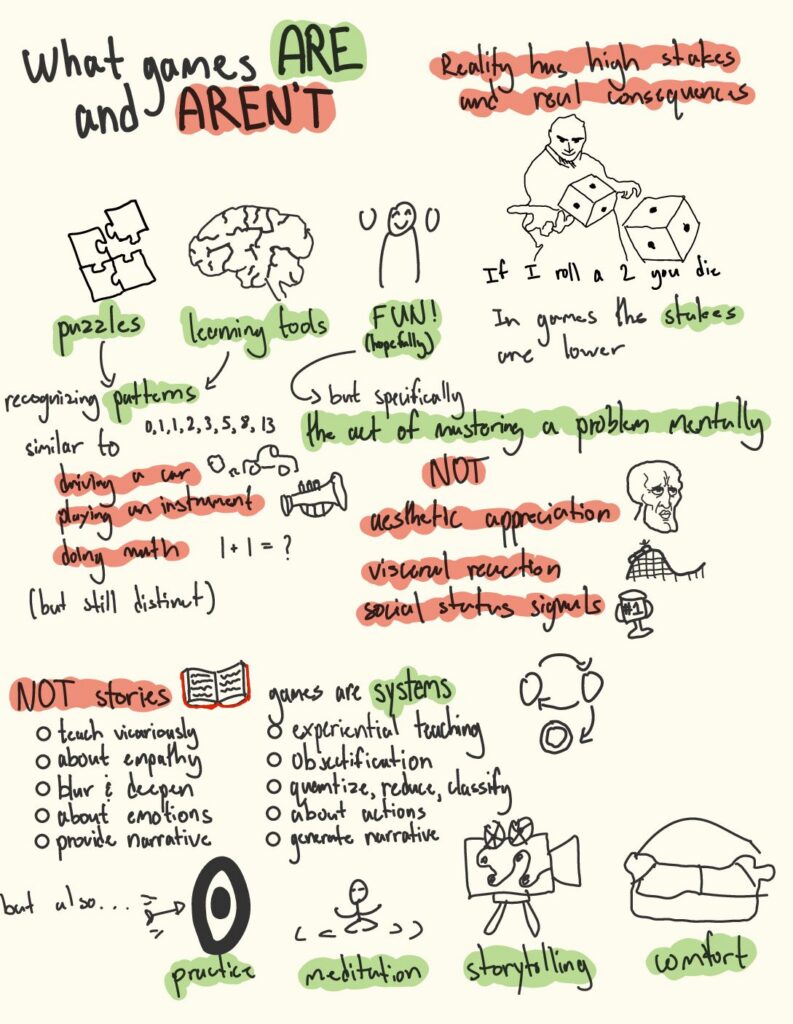
Sketchnote: what games are and aren’t

April 9, 2026

Shuci Prototype Short Exercise

April 9, 2026

Game concept summary: Scab! A Game of Worker Solidarity and Betrayal is a social deduction game for 5-10 people where workers try to strike…

Critical Play: Wavelength

April 9, 2026

Wavelength is a social guessing game designed by Alex Hague, Justin Vickers, and Wolfgang Warsch, and published by CMYK in 2019. It is made…

Short Exercise: What do Prototypes Prototype?

April 9, 2026

Our team is current planning on a game that combines monopoly with gambling/RNG elements. Here are some questions that can be answered through prototyping….

The Tension of a Pre-Defined Path: Dr. Langeskov, The Tiger, and The Terribly Cursed Emerald

April 9, 2026

The second I began Dr. Langeskov, The Tiger, and The Terribly Cursed Emerald: A Whirlwind Heist, I felt unsettled, like I had stepped into…

Short Exercise: What do Prototypes Prototype?

April 9, 2026

  Will the gambling aspect outweigh the property-buying aspect? This is an important question to answer as if one aspect is clearly better and…

What do Prototypes Prototype

April 9, 2026

1: Will players immediately understand the core idea that one player is a secret capitalist and everyone else is trying to expose them? Why…

Critical Play: Bluffing, Judging and Getting Vulnerable…

April 9, 2026

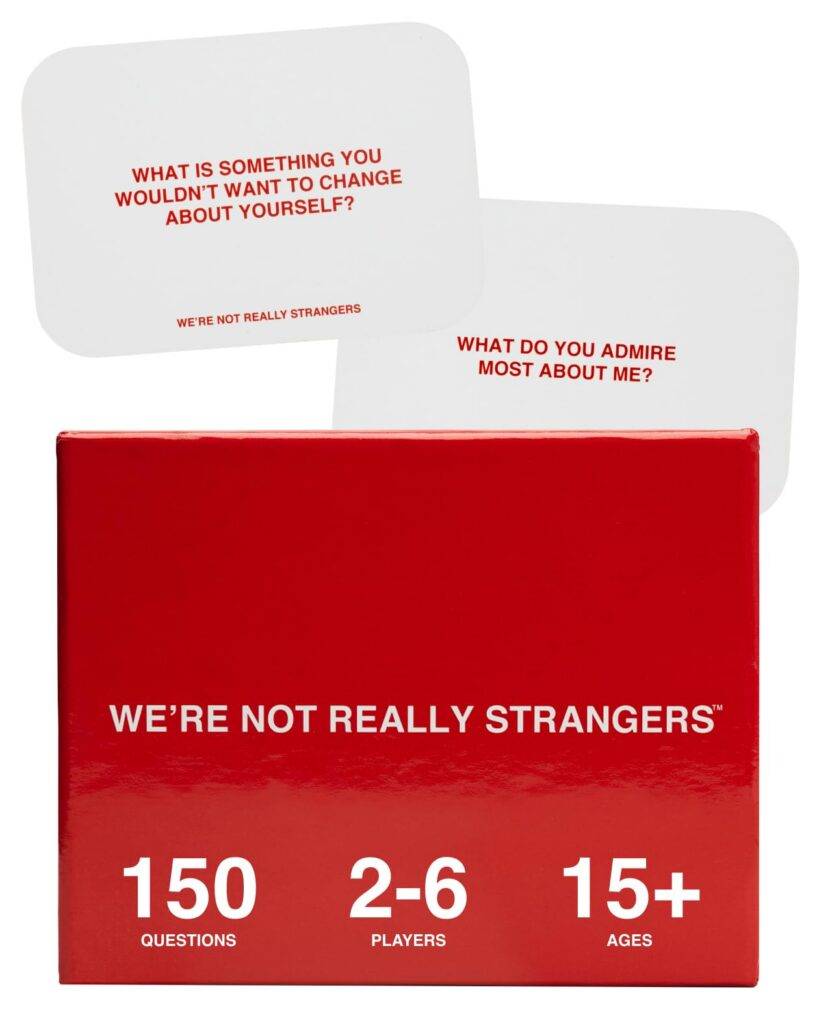
For this week’s Critical Play, I played We’re Not Really Strangers, the get-to-know-you party game published by the independent We’re Not Really Strangers company…

Critical Play: Bluffing, Judging and Getting Vulnerable…

April 9, 2026

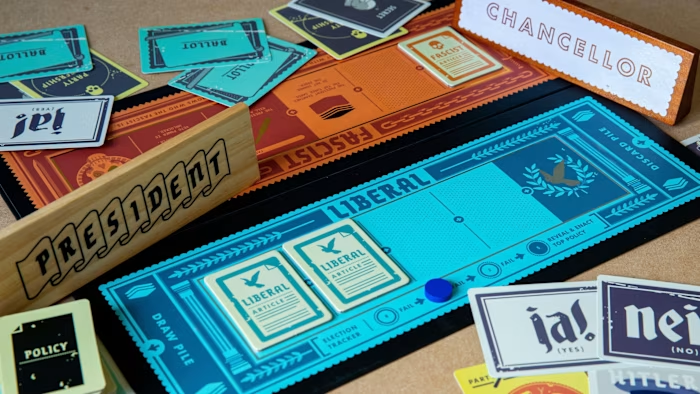
Secret Hitler is a 5–10 player social deduction game of political collusion and betrayal. The target audience is anyone who is 13 and older….

Short Exercise: What Do Prototypes Prototype?

April 9, 2026

For P1, our team wants to test a few changes to Bananagrams. My ideas focus less on pure vocabulary speed and more on teamwork,…

Critical Play: Bluffing, Judging and Getting Vulnerable

April 9, 2026

“Yellow is sus vote him” For my critical play, I chose Among Us, a social deduction game created by Innersloth. It’s offered on basically…

Posts pagination

Previous 1 … 20 21 22 … 35 Next

Welcome to the Stanford HCI Game Design Blog.

Currently this blog holds two formal classes being taught by Christina Wodtke as well as Independent Study Work. In winter of 2022, cs377g was cancelled because of covid-19 uncertainty, and became a study group. You can follow along by looking at the SGSG syllabus and weekly break down.

CS 247G: Design for Play(SYMSYS 195G)

A project-based course that builds on the introduction to design in CS147 by focusing on advanced methods and tools for research, prototyping, and user interface design. Studio based format with intensive coaching and iteration to prepare students for tackling real world design problems. This course takes place entirely in studios; please plan on attending every studio to take this class. The focus of CS247g is an introduction to theory and practice of the design of games. We will make digital and paper games, do rapid iteration and run user research studies appropriate to game design. This class has multiple short projects, allowing us to cover a variety of genres, from narrative to pure strategy. Prerequisites: 147 or equivalent background.

CS 377G: Designing Serious Games

Over the last few years we have seen the rise of "serious games" to promote understanding of complex social and ecological challenges, and to create passion for solving them. This project-based course provides an introduction to game design principals while applying them to games that teach. Run as a hands-on studio class, students will design and prototype games for social change and civic engagement. We will learn the fundamentals of games design via lecture and extensive reading in order to make effective games to explore issues facing society today. The course culminates in an end-of- quarter open house to showcase our games. Prerequisite: CS147 or equivalent. 247G recommended, but not required.

SGSG: Serious Games Study Group

  • Library
    • CS247G Community Game Design Resources
    • Game Design Resources
    • Graphic Design for Game Designers
    • Graphic Design Resources
    • Chapter 11 from Game Balance
  • Read Write Play
    • Hollow Knight: RWP 4 2023
    • Mystic Messenger: RWP 6 2023
    • Undertale: RWP 3 2023
    • What Remains of Edith Finch: RWP 5 2023
    • Catan: RWP1 2023
    • 80 Days: RWP 2 2023
  • 247G Syllabus
    • The Formal Elements of Game Design
    • Design for Play | Week One | Lecture A
    • Design for Play | Week One | Lecture B
    • Design for Play | Week Two | Lecture A
    • Design for Play | Week Two | Lecture B
    • Design for Play | Week Three | Lecture A
    • Design for Play | Week Three | Lecture B
    • Design For Play | Week Four | Section A
    • Design For Play | Week Four | Section B
    • Design for Play | Week Five | Class A
    • Design for Play | Week 5 | Class B
    • Design for Play | Week 6 | Class A (no class)
    • Design for Play | Week 6 | Class B
    • Design for Play | Week 7 | Class A
    • Design for Play | Week 7 | Class B
    • Design for Play | Week 8 | Class A
    • Design for Play | Week 8 | Lecture B
  • Serious Play Study Group Overview
    • Study Group Week by Week Breakdown
      • Formal Elements of Games
      • Final Reflection Essay
    • [Optional Material] What is fun?
    • Project 1: Those Who Play, Teach
      • READING Visual Design of Board Games
      • Pitch Your Teaching Game
      • Sketchnote: Playtesting Boardgames
      • Sketchnote: Erin Hoffman // Wind, Not Sand: Mapping Dynamic Emotion Across a Product Landscape
      • SketchNote: MDAO
      • Critical Play: Write up your game of FLUXX
      • [Optional Material] Playtesting
      • OPTIONAL Board Game Usability
    • P2: The Future We Deserve
      • Critical Play: A Mechanic and a Story to Tell
      • Interactive Fiction: Tiny Playable Prototype
      • Introducing Interactive Fiction
      • Map and Premise
      • Critical Play: Story AND Storytelling games
      • Essay or Sketchnote: Rise of the Video Game Zinesters
      • Sketchnote: Art of game design- Story
      • [Optional Material] Emergence and Progression
      • Essay or Sketchnote: Rise of the Video Game Zinesters
      • Project 2 Reflection Essay
      • Share what you Learned: Writing Excuses Podcast
      • Values at Play & P2 Peer Grading
    • P3: The Game of Unexpected Consequences
      • P3 Concept Doc
      • Playable prototype
      • Working With System Dynamics (mindmap the reading, apply it to your game)
      • Mapping Systems
      • Sketchnote/Response for Rules & Tutorials
      • Project 3 Check-in
      • Project 3 Reflection Essay
    • P4: Refine a game
      • Sketchnote/Response for Playtesting with Strangers
      • Read: Mechanic is the Magic
  • On Sketchnotes
  • Printing at Stanford

Archives

  • August 2026
  • July 2026
  • June 2026
  • May 2026
  • April 2026
  • March 2026
  • December 2025
  • November 2025
  • October 2025
  • September 2025
  • June 2025
  • May 2025
  • April 2025
  • February 2025
  • December 2024
  • November 2024
  • October 2024
  • September 2024
  • June 2024
  • May 2024
  • April 2024
  • December 2023
  • November 2023
  • October 2023
  • September 2023
  • August 2023
  • June 2023
  • May 2023
  • April 2023
  • March 2023
  • February 2023
  • January 2023
  • December 2022
  • September 2022
  • August 2022
  • July 2022
  • June 2022
  • May 2022
  • April 2022
  • March 2022
  • February 2022
  • January 2022
  • June 2021
  • May 2021
  • April 2021
  • September 2020
  • February 2017

Recent Posts

  • Final CS247G Reflection
  • Critical Play on WorldBuilding: Cyberpunk’s Night City Doesn’t Have Races — It Has Lifepaths
  • Critical Play: Puzzles — EXIT: The House of Riddles
  • Critical Play: Mysteries & Escape Rooms — Cube Escape: Paradox
  • Protected: Independent Study Final Reflection

Recent Comments

  • Christina Wodtke on Personal Reflection
  • Christina Wodtke on Final Class Reflection – Nicholai K.
  • Christina Wodtke on 247G Final Class Reflection
  • Christina Wodtke on Final Class Reflection – Joseph Gu
  • Christina Wodtke on Final Class Reflection

Categories

  • P2: The Empathy Machine
  • Featured
  • Project One
  • milestone
  • P2: The Future We Deserve
  • mindmap
  • P1: Social Games
  • CS247G
  • Assignments
  • P1: those who play, teach
  • Lectures
  • P2: Games In Space
  • Critical Play
  • P3: The Game of Unexpected Consequences
  • Project Two
  • Project Four REFINE
  • P4: Refine a Game
  • Sketchnotes
  • Project Two: The Future We Deserve
  • From the Instructor
  • Project Three: The Game of Unexpected Consequences
  • ReadWritePlay
  • 377G: Serious Games
  • SGSG

Meta

  • Register
  • Log in
  • Entries feed
  • Comments feed
  • WordPress.org

Meta

  • Register
  • Log in
  • Entries feed
  • Comments feed
  • WordPress.org
Copyright The Mechanics of Magic. All rights reserved. | Theme by SuperbThemes