“Yellow is sus vote him”
For my critical play, I chose Among Us, a social deduction game created by Innersloth. It’s offered on basically every gaming platform (PlayStation, Xbox, PC, Switch, Mobile), but I played on mobile online multiplayer. Its age rating is Everyone 10+, making its target audience broad, but it especially appeals to players who enjoy bluffing and deception games. Since I played it on public online lobbies with strangers rather than with friends over voice chat, that specific context ended up shaping my experience more than I expected. More than anything else, Among Us showed me that my communication style depends heavily on having room to explain myself. When that room disappears, I tend to become much less persuasive and more cautious.
Throughout COVID, I watched streamers and YouTubers alike play Among Us and was already slightly familiar with the game’s mechanics, but I’d never actually gotten around to playing it myself. The. first thing I realized was how quickly suspicion turns into consensus in this game.
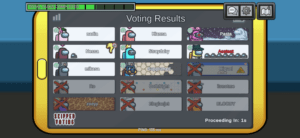
(Me being unanimously voted out by the whole lobby)
Once one player framed someone as suspicious, usually by calling them out for being “sus”, more often than not, everyone else seemed willing to accept the accusation and move on. That made me reflect on how I act in group settings: I usually try to gather more information before committing to a judgment, but Among Us does not always reward that kind of patience. Its meetings are brief, and the game seems to reward confidence over actually being right. My instinct is usually to slow things down, explain, and reconstruct what happened, but the structure of the game pushes the opposite behavior.
That experience became even clearer because I was playing with strangers over text chat instead of with friends in person or over voice.

(How hard it is to discuss in chaotic text-only lobby)
In a voice conversation, I might rely on changing my tone to be more persuasive or quick accusations to defend myself or judge whether someone sounds trustworthy. In text chat, especially in a public online lobby, all of that disappears as discussion becomes compressed and often chaotic, often leading to people being voted out without even getting the time to defend themselves. When I can’t use my voice and am confined to arguing and especially persuasion through writing in a fast-paced environment, I realized that I’m less effective at defending myself and less confident in reading others.
One of Among Us’ smartest mechanics is that death does not immediately remove a player from the game, but instead redesigns their role within it. The game’s procedures divide players into roles with different abilities and win conditions: crewmates must complete tasks and identify impostors, while impostors must deceive, kill, and sabotage.
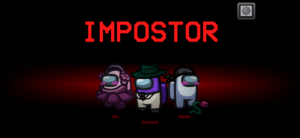
Its boundaries are also clear, separating the ordinary world from a tightly structured space where lying and accusation become expected parts of play. What makes this system especially effective is that death does not remove players from that space but changes how they participate in it. Dead crewmates can still complete tasks, and dead impostors can still sabotage, so elimination becomes a transformation rather than a loss of agency.

(Still controlling the pace of the game while dead)
That choice keeps players inside the magic circle and still connected to the game’s objectives, even after losing the ability to speak for themselves. Through the MDA framework, these mechanics create dynamics of mistrust and continued participation, producing an aesthetic experience of tension, anxiety, and sustained engagement. Instead of treating death as exclusion, Among Us treats it as transformation, and that is part of what makes its social deception so effective.
Compared to other bluffing games like Secret Hitler or even Poker, Among Us stands out because it combines social deduction with movement through space and observable action. Among Us adds bodies, maps, routes, tasks, and timing to the game, introducing an increased aspect of strategy rather than chance. This also means suspicion is tied not only to what someone says, but to where they were in the game, what they appeared to be doing, and who else was there to verify it. This makes the game feel more embodied than many other deception games. At the same time, public online play exposes one of its weaknesses because when communication is reduced to rushed text, the deduction can become less about careful reasoning and more about whoever gains momentum first. One way to improve this would be to make public lobbies more customizable by communication style, adding a cooldown before voting and limiitng the messages one can send so players who prefer slower more thoughtful discussion can play with people with similar playstyles.
The ethical question attached to bluffing games asks whether lying in a game is morally wrong. I’d personally say that I don’t think so, at least not in the same way that lying in ordinary life is wrong. In Among Us, deception isn’t a betrayal of the game’s social contract, in fact it’s a literal expectation of the game to win. Everyone enters the game knowing that some players will be lying and so the impostor’s lies aren’t violating trust but instead, they’re just playing their role the game assigns them. This ties back to how the magic circle makes games special because it allows certain actions take on different meanings since all players consent to the rules and goals in advance. My experience in public lobbies made it clear that there is still an ethical difference between bluffing inside the game and making the social environment hostile. Lying about where you were is part of play but using Ad Hominem and attacking or mocking people goes beyond the game’s intention, so I don’t think the key ethical distinction is simply between lying and telling the truth, but between actions that sustain the shared game and actions that damage the people playing it.