Critical Play: Puzzles — EXIT: The House of Riddles
For this Critical Play, I played EXIT: The House of Riddles during office hours with Alex, Xi, and Michelle. It’s a card-based escape-room game where players work through a deck of riddles, ciphers, and physical puzzle components to “escape” a themed scenario — in this case, a haunted house.
Narrative through mechanics
What struck me most is that the narrative isn’t delivered around the puzzles — it’s delivered through them. There’s no game board; the rulebook is explicit that you have to figure out for yourself what the rooms even look like, building the fictional space out of what riddles and cards reveal. Each solved puzzle directly unlocks the next piece of the house’s story: a new room, a new detail, a new fragment of the mystery. Solving a puzzle is how the story moves forward, not a gate you pass to reach the “real” content.
This matters because the game never has to choose between “puzzle time” and “story time” — they’re the same time. Every cipher you crack is simultaneously a logic exercise and a narrative reveal. It echoes Bob Bates’ point that puzzles work best when they feel “natural to the environment” rather than parachuted in — here, puzzles are the only way the environment reveals itself.
The role of puzzles in player experience
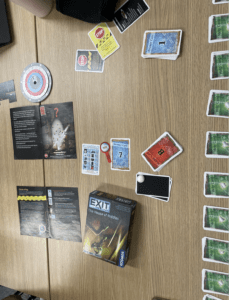
The puzzles were the entirety of the experience. What made them land wasn’t just the individual aha! moments, but also learning the game’s own mechanics: specialized card decks and a decoder disk you dial a cracked riddle’s code into to reveal which numbered card to pull next — systems learned on the fly, with no tutorial up front.
Playing with Alex, Xi, and Michelle shaped this further. None of us had played this system before, so we naturally specialized rather than all four of us doing the same thing at once: I managed the card decks — keeping the Riddle, Answer, and Help piles organized and pulling the right card at the right moment — while Alex, Xi, and Michelle rotated through solving the ciphers and leading our next move. That split meant the puzzle I was most engaged with was often logistical (keeping 87 cards straight so nobody looked at the wrong one too early) rather than the cipher itself, which was satisfying in its own way. The tactile element mattered too: physically dialing the decoder disk and handling cards felt different from a screen-based puzzle. Even failure stayed low-stakes — an incorrect code just returns a card telling you to look again, no penalty beyond re-thinking. That lines up with Scott Kim’s observation that a good puzzle works like a good toy — fun to handle even before you’ve solved it.
Ethics: what knowledge does the game assume?
The ethics question asks what “inside the box” knowledge a puzzle game assumes, and who that includes or excludes. House of Riddles leaned heavily on ciphers and numerical pattern recognition. Its language stayed at a standard, international level of English, not leaning on regional idioms or cultural references that would require a specific national background to catch. That’s a meaningful inclusivity choice, whether intentional or not: a fluent English speaker, regardless of dialect or nationality, likely isn’t excluded the way a puzzle built around a narrow cultural reference would exclude an outsider.
The cipher-based puzzles do still assume baseline comfort with numbers and symbolic substitution, which isn’t universal and could disadvantage players with certain learning differences or less school exposure to that style of logic. On accessibility, the game seemed designed with color-blind players in mind: it uses color in places, but I never hit a puzzle where color was the only channel of information, so a colorblind player likely wouldn’t be functionally locked out. That’s a small but meaningful choice — it suggests the designers thought about accessibility beyond “does the puzzle make sense,” extending to who can physically perceive the clues at all.