

Final CS247G Reflection
Before this class, I thought about game design mostly through an engineering lens — I had some interest in games as systems to build, but I wasn’t really aware of design theory or process as its own discipline. I could think about how to make something work technically, but not necessarily why a mechanic or a level felt good or bad to play. Over the quarter, I did a mix of theory and hands-on work: reading and reflecting on design essays, running Critical Plays on existing games (worldbuilding, puzzles, mysteries and escape rooms), and building my own project through P2: Level Design & Architecture across its checkpoints. Honestly, I don’t always remember the specific authors of the readings, but the actual takeaways stuck — ideas like affordances, how narrative gets woven into a game’s mechanics rather than just its text, and how puzzles function as more than just obstacles.
A handful of concepts really stuck with me. The idea of a game’s “verbs” — the core actions a player can take, and how a whole level can be built to teach just one of those actions — changed how I look at level design; I now notice when a game is quietly teaching me a mechanic through its layout instead of a tutorial popup. Related to that, the “teach, don’t tell” idea — that good games get players to learn by doing rather than by reading instructions — is something I now actively look for and appreciate when I see it done well. I also picked up on affordance design, interaction loops, narrative arcs, and different types of fun (like challenge versus fellowship), which gave me actual vocabulary for reactions I used to only have vague feelings about. Where I actually applied these ideas was mostly in iterating on my P2 project based on playtest feedback — watching where people got confused or disengaged and adjusting from there, with types-of-fun thinking in the back of my mind. If I’m being honest with myself, some of the concepts I value most — like deliberately designing a level around a single verb, or building teach-through-play moments instead of instructions — were more aspirational for me this quarter than things I actually executed well. I understood them, but I didn’t always build them into my own project as intentionally as I’d like to next time.
The challenges were real. Time management was probably the biggest one — balancing this class’s workload (playtests, writeups, ongoing project work) against other things going on this summer and some health complications. On the project side, I also hit a wall with Unity early on, which slowed me down until I moved to a different, more open-source-friendly workflow for P2 that was easier to work with. Storyline and puzzle/level design were also genuinely hard for me — it’s one thing to analyze someone else’s puzzle design in a Critical Play and another to build a fair, well-paced one myself. I went from having no real design vocabulary to being able to name what’s working or not working in a game, both games I played critically and my own project. I also got more comfortable identifying when I was following a design principle only in theory versus actually building it into my work — which feels like a small but real step toward being more intentional as a designer rather than just an engineer who makes games. If I keep working on games, I want to get more comfortable with the tools and engine so less time gets lost fighting the pipeline and more time goes into actual design decisions. I also want to design narrative and puzzles more intentionally from the start of a project, rather than treating them as something to bolt on once the core mechanics exist — building that in early, the way the strongest examples we studied this quarter did.
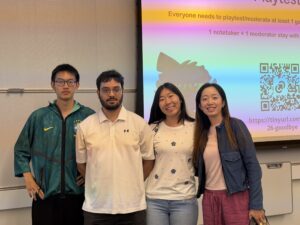
^ My P1/P2 team: Mi chelle, Xi, and Alex