Critical Play: Mysteries & Escape Rooms — Cube Escape: Paradox
For this Critical Play I looked at Cube Escape: Paradox, a short point-and-click puzzle game by Rusty Lake, paired with a live-action short film of the same name. The game follows Detective Dale Vandermeer, who wakes up in a strange room and has to piece together where he is and how to escape, all while a sinister voice on the other end of a phone taunts him about the “consequences of his actions.” The graphics were good, the audio was also good, but the point and click blunted a lot of the immersion I would have preferred, but significantly more immersive then House of Riddles.
—
Narrative through mechanics
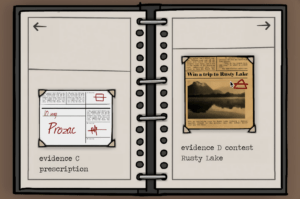
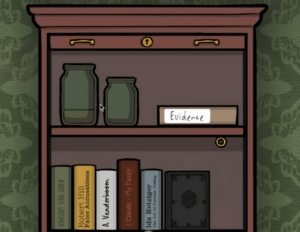
Rusty Lake’s games are built on a formula where the point-and-click logic — find an object, combine it with another, use it on the environment — is the only way the story is told. There’s no separate cutscene layer explaining what happened to Vandermeer; you learn it by interacting with the room itself; a locked drawer, a strange vial, a ringing phone. Each solved interaction is both a puzzle and a narrative beat, since the objects themselves carry the story’s meaning (a recurring motif across the Cube Escape series is that ordinary objects hide dream-logic significance).
This mirrors what Bob Bates calls letting puzzles be “natural to the environment” — the mystery of the room and the mystery of what happened to Vandermeer are the same mystery, solved with the same verbs. It’s a tighter version of what I noticed in House of Riddles last week: puzzles aren’t a separate layer bolted onto the story, they’re the delivery mechanism for it. The difference is that Paradox is a single continuous psychological space (a hotel room, warped by dream logic) rather than a sequence of discrete printed cards, so the narrative reveal feels more environmental and less modular.
—
The role of puzzles in player experience
Rusty Lake’s puzzles lean on surreal, dreamlike associations rather than straightforward logic — you’re less often solving a cipher and more often intuiting what a strange object “wants” to be used for, in a world where normal cause-and-effect is loosened. That’s a different flavor of the aha! moment than a cipher click: it’s less “I decoded this correctly” and more “I understood the dream-logic of this place.” The tension in the room is amplified by a countdown-like urgency (the voice on the phone warns Vandermeer that “some men find this place hard to leave”), which suggests the design is using puzzle pacing to build dread rather than pure challenge.
Because the puzzles are the only obstacle standing between the player and escaping the room, the game’s short runtime (Rusty Lake titles are typically well under 30 minutes) means each puzzle carries a lot of narrative weight — there isn’t room for a purely mechanical “throwaway” puzzle the way a longer game might include. Every interaction seems to matter to the mood or the mystery, which raises the stakes of each solve but could also mean a single unclear puzzle disrupts the whole experience more than it would in a longer, more forgiving game.
 —
—
Ethics: accessibility barriers
This week’s ethics prompt asks about accessibility barriers rather than assumed cultural knowledge, and it’s worth reflecting on why that shift matters between a card-based tabletop game and a point-and-click digital one — the barriers are genuinely different in kind. A physical card game like House of Riddles has barriers rooted in shared table space and fine motor handling of physical components. A point-and-click game like Paradox has different risks: precise pixel-hunting for tiny interactive hotspots, reliance on visual contrast in a moody, dark art style, and — since key moments (like the sinister phone call) are delivered through voice acting and ambient sound — potential reliance on audio cues without guaranteed captioning.
I don’t identify as having a disability that would be directly implicated here, and I can’t confirm firsthand whether Paradox includes subtitles, colorblind considerations, or adjustable interaction sensitivity. I wasn’t about to seek out firsthand accounts from disabled players rather than guess — a design can look accessible in a screenshot and still fail in practice, and the only way to know is testimony from someone who’s actually run into the barrier. Design-wise, the genre’s reliance on dark, atmospheric visuals and moody audio is a common flashpoint for accessibility criticism in indie horror/mystery games broadly, since mood-driven art direction and legibility are often in direct tension with each other.
—