

In the reading “The Death of the Author,” Barthes argues that meaning does not come from a single controlling voice behind a work, but it instead comes from language, structure, and the reader’s experience. The game “Dr. Langeskov, The Tiger, and The Terribly Cursed Emerald: A Whirlwind Heist” makes this idea a playable experience. What starts as a tightly guided, narrated game quickly reveals that the “author” is improvising, suggesting ideas that fail, and not in control at all.
From the beginning of the game, the narrator presents himself as the authority. He tells you what to do, explains the situation, and positions himself as the one orchestrating the experience. However, almost immediately, things start to fall apart. You realize that you are not actually playing the heist, and that you’re backstage, helping run it for someone else. Just like that, the illusion of a single, controlled narrative begins to crack. You are not inside the story; you are inside the making of the story.
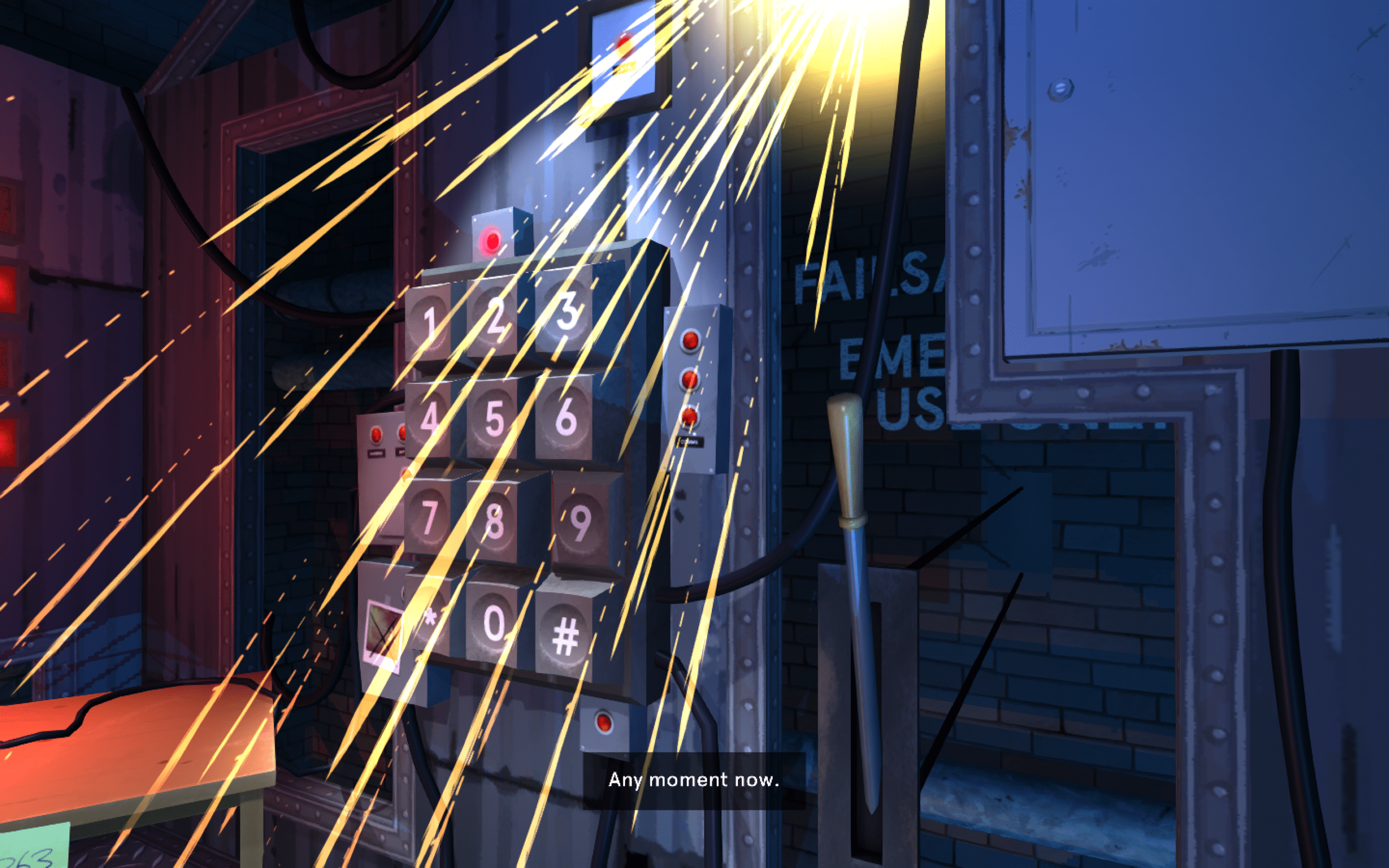
What’s striking is how often the narrator’s instructions don’t lead to clarity, but rather they lead to chaos. The control panel in the image uploaded captures this perfectly. You’re told to press certain numbers, to follow directions precisely, but instead of smoothly advancing the game, your actions trigger sparks, malfunctions, and escalating confusion. The bright flashes of electricity and the frantic pace of the moment make it clear: this system isn’t stable. Even while following a manual, the narrator doesn’t fully understand it, and neither do you.
This is where Barthes’ argument comes alive. If the author were truly in control, then meaning, and experience, would be stable and intentional. But in Dr. Langeskov, the supposed “authorial voice” is constantly reacting, adjusting, and improvising. The narrator isn’t delivering a pre-determined meaning; he’s scrambling to keep things from collapsing. His authority depends on your cooperation, and even then, it often fails.
The phone sequence makes this even clearer. You’re repeatedly told to pick up ringing phones, but every button you press seems to hang them up instead. The narrator grows increasingly frustrated, as if you’re doing something wrong, but from your perspective, you’re following instructions. The disconnect is almost comedic, but it reveals something deeper: meaning is not being transmitted successfully from narrator to player. Instead, it’s being produced in the gap between intention and action, where confusion and interpretation take over.
Even the game’s structure reinforces this breakdown of authorship. You’re told that you’re helping another player complete the “real” game, and that eventually it will be your turn. But when that moment finally comes, everything collapses again. A new player appears backstage, makes mistakes, and the system spirals into failure, ending, seemingly, with you being eaten by a tiger. There is no clean handoff, no moment where the “intended” experience is finally delivered. The game never stabilizes into a single, authoritative version of itself.
Barthes writes that a text is not a single line of meaning but “a space of many dimensions.” Dr. Langeskov embodies this idea by refusing to settle into one coherent narrative or perspective. Are you a player? A stagehand? A disruptor? The game never fully answers. Instead, it leaves you navigating a shifting system of instructions, failures, and improvisations.
By the end, the narrator’s voice, once confident and authoritative, feels fragile. He is not the source of meaning but just another part of the system, subject to its breakdowns and contradictions. The real experience of the game comes not from what he intends, but from how you interpret the chaos: the sparks flying from the control panel, the failed instructions, the collapsing illusion of order.
In this way, Dr. Langeskov quietly proves Barthes right. The “author” may speak, but he does not control. Meaning isn’t delivered, it’s constructed, moment by moment, by the player trying to make sense of a system that refuses to behave.
