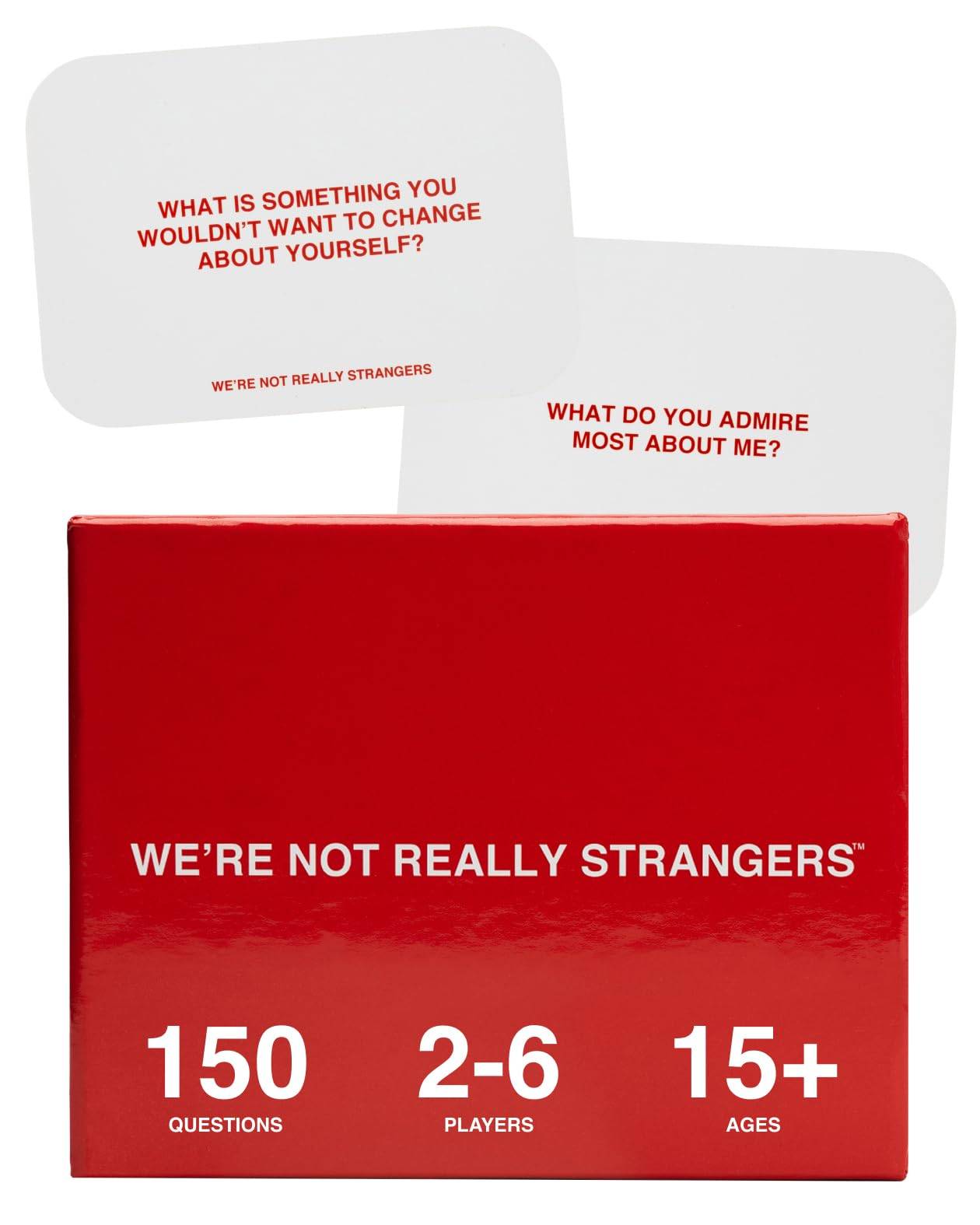
For this week’s Critical Play, I played We’re Not Really Strangers, the get-to-know-you party game published by the independent We’re Not Really Strangers company and meant to help at least two but more than six strangers get to know one another better. The gameplay for WNRS is simple, with players taking turns drawing cards and answering the printed questions, but WNRS sets itself apart from other icebreaker games in that the objective is not to “win” in the traditional sense. There are no points, no captured pieces, no fake dollar bills — only the inherent reward of learning about other people as well as ourselves. I learned, for instance, that when I’m around people I don’t know well, I tend to emphasize aspects of myself, such as my sense of humor and music taste, that I think are the most broadly interesting. I also learned more about my aversion to conflict in group settings and the ways that this impacts my effectiveness as a teammate.
The game itself has three rounds, each with its own deck of cards. In the first round, which contained more playful, surface-level prompts, I drew a card asking the other players to draw conclusions about me based on my phone wallpaper, which I appreciated, since I specifically chose my wallpaper to show off my interests in horror movies and heavy metal. This was one of several cards we encountered that used technology in creative ways, asking questions about Spotify playlists, Instagram posts, and so forth, which I appreciated and which made for some of our more fun discussions. We’ve heard in some of our readings that what we experience as “fun” is often a form of learning or exploration, and that may be why these early cards were the most fun: they allowed us to explore our blind spots, the parts of us that are more apparent to others than they are to us, as shown by the teammate who told me that they appreciated when I said that they came across as laid back.
As we transitioned to the second deck of cards, the questions grew more personal, and I became increasingly aware of where my social weak points are. For instance, another player and I were prompted by a wild card to “make assumptions about one another” and I decided that I did not want to risk hurting the other person by saying anything too personal or stereotypical, and so instead, I gave a pseudo-answer in which I said that I assumed that they were really into online poker. This was, of course, wildly inaccurate, but it did reveal that my first instinct when faced with the possibility of conflict was to deflect, and to undermine the sincere intentions of the game in order to avoid conflict. Reflecting on it now, I realize that this is often how I am in group settings: I try very hard to be agreeable, to the point where I will prioritize social and emotional comfort over the project itself during moments of conflict. Also, part of me really thought that he looked like an online poker pla yer.
yer.
I have played a couple other games of this sort, and one thing that stands out about this game was that it was more thoughtfully structured and, frankly, more fun. The three-round system allows players to start with sillier, more playful questions before transitioning into more personal ones and then finishing the game with a debriefing round. This approach is considerate, but it also has its drawbacks: the quick pacing of the rounds can often be uncomfortable, and introducing too many personal prompts too quickly can lead to avoidant behaviors like the ones I showed. I cannot help but wonder if the experience might benefit from alternating between the more playful and personal prompts, rather than grouping them together in rounds.
Overall, I found WNRS to be a successful counter to the social expectation that our interactions with strangers be superficially upbeat, that we not discomfit others by revealing anything too personal. These kinds of norms are common in large, mixed settings where interaction is necessary but often shallow, such as at work or in the classroom, and I appreciate games that seek to inject warmth into these settings. Of course, a game intended to interrogate