
When it comes to all media, we generally do think back to the author, creator, parent, or anything of the sort. Sometimes we don’t think about it until the end, when we are in awe or dissatisfaction of a piece of work, and sometimes we’re required to think of the creator the entire time. This was the case with Dr. Langeskov, The Tiger, and The Terribly Cursed Emerald: A Whirlwind Heist, as we move through the game with narration from what we presume is the creator. Our role as a player of the Whirlwind Heist shifts as we’re no longer the player, but instead assistants to the production of the game for another player who’s actually playing it.
From this perspective, Barthes’ Death of the Author highlights how a work can be separated from an author’s expressiveness and instead give power to the reader, who activates its meaning. While Barthes’ argument is compelling, playing Dr. Langeskov suggests that the death of the author isn’t always required for the birth of the reader. Rather, the author’s intentions can still be considered, or at the very least acknowledged, without limiting our own interpretation.

When starting the game, you expect mystery, danger, thrill, and even an emerald – none of which we really get. However, almost immediately, something feels off, beginning with the glitching in the first few seconds. Instead of entering the game, it feels like you’re backstage in a production studio, waiting for the actual heist to begin. As I explored, I collected coins and post-it notes without knowing their purpose. I could also pick up a record player and play tapes, including one about a “Parrot Game” that sounded intentionally terrible. At this point, I was pretty confused about whether the game had even started.
Then, unexpectedly there’s a narrator, who presents himself as one of the creators, begins directing the experience. He informs you that you can’t play the game and instead asks you to assist in running it. As I continued exploring, I also discovered signs of a strike due to low wages. This moment reframes the entire experience, especially when, in the Steam description, Tina writes, “…Slip into the soft-soled shoes of the mastermind responsible for the greatest heist—oh god I can’t do this any more, I’m joining the strike…” The game then becomes less about the heist itself and actually more about the director’s coordination, systems, labor, and chaos behind its production.
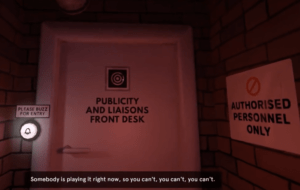
At this point, I realized that I was, in some sense, collaborating with the director of the actual game. The narrator constantly references the game’s design, its failures, and its social context, shaping how I interpret what’s happening. While I agree with Barthes that “the image of literature…is tyrannically centered on the author,” this game actually complicates that idea. The narrator’s so consumed by his own goals and vision that I’m no longer a player of the heist, but that very experience also becomes part of how I understand the game and the creator outside of the game.
Nevertheless, I couldn’t fully separate the game from the author or even myself from the author and I think that’s okay. Barthes argues that “linguistically, the author is never anything more than the man who writes,” but this game makes it difficult to ignore the creator entirely. Even beyond the in-game narrator, I found myself asking: what was the creator thinking? Why design a game where I can’t actually play the game? Why position me as an assistant instead?
But that’s the point, I didn’t need to know the author’s exact intentions for the game to be meaningful or for me to create my own interpretation. In fact, I still don’t know who the author is. However, considering the possibility of their intentions shaped my experience and interpretation, which in all honesty was up to me to take into account or not. As a player, I hold power in how I understand the game, and it doesn’t have a single, authoritative meaning tied to its creator. At the same time, I wouldn’t completely disregard the existence of the author, as Barthes suggests, because there is still value in what may have been intended.
In Dr. Langeskov, there are effectively two authors: one inside the game and one outside of it. Both can be seen in ways that diverge from their intentions, especially since the player can ignore the narrator’s instructions and construct their own understanding and version of the experience. Rather than limiting interpretation, the presence of both authors actually introduce other perspectives, which can be rich, revealing, and worth engaging with, even if it’s not definitive. Ultimately, this game reinforces Barthes’ idea that meaning is constructed by the player, but it also shows that authorship can still shape that process without fully determining it, as we acknowledge the power of the user.