

The second I began Dr. Langeskov, The Tiger, and The Terribly Cursed Emerald: A Whirlwind Heist, I felt unsettled, like I had stepped into some abandoned, post-apocalyptic movie set. I was met with a chaotic, nervous voice — the narrator — inviting me in to “help” run the game. As I moved inside, the doors slamming behind me, I assumed this was a classic escape room. Great, a crazed director traps people on set — what a fun premise! However, I soon realized this wasn’t an escape room — it didn’t grant the player enough agency for that. Instead, it was a carefully controlled experience — a sort of procession where each step was predetermined. Overall, Dr. Langeskov, The Tiger, and The Terribly Cursed Emerald: A Whirlwind Heist explores this tension between personal agency and pre-constructed experience, and, in doing so, reveals both the force and the limits of authorial control.
The game leans into its “meta” premise, but more importantly, into the idea of control. At first, the offer to help “run” the game felt like an interesting twist—but the longer I lingered, the more insistent the narrator became, even noting that it would be “difficult” for me to leave. What initially seemed like an invitation quickly became a kind of pressure to comply.
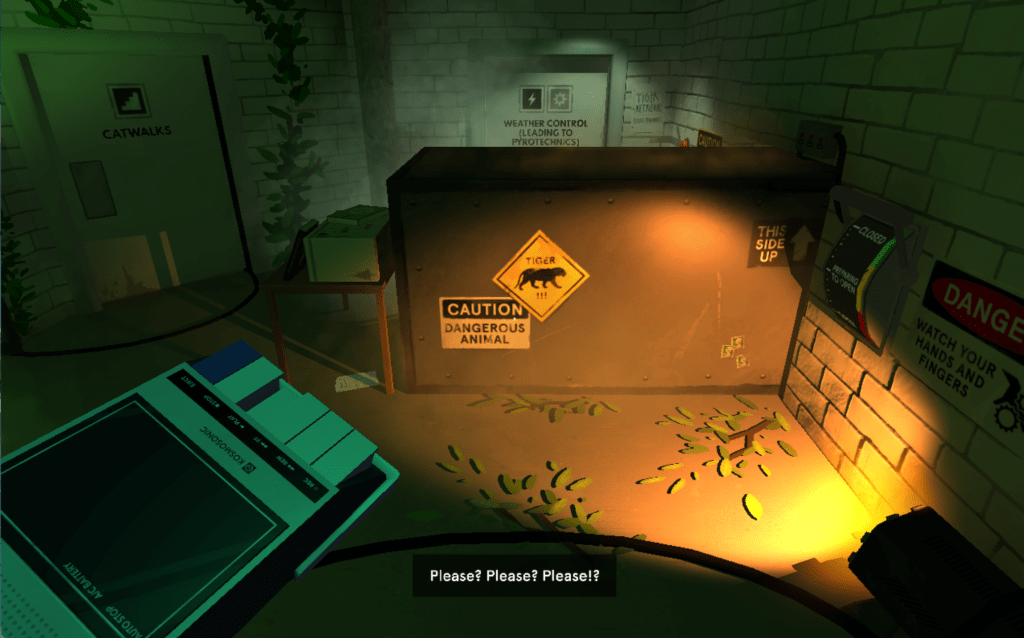
As I moved through these backstage spaces, assisting with various tasks, that tension built. The narrator rushed me from one action to the next, citing the “current player’s experience” as justification. At the same time, I increasingly felt like I was missing something—whether that was the “clues” (for the escape room I initially assumed it to be) or the experience itself. Every time I tried to slow down or investigate—to read a note or take in the environment—I was interrupted by the narrator’s urgency and pleas.
Although I appreciated the narrator’s humor and the continuous stream of new rooms, I felt increasingly frustrated — even after realizing the game was more of a guided sequence than a puzzle. If the point was simply to experience the world (rather than “solve” it), why was I being pushed through it so quickly? Why create such an interesting, detailed, quirky environment that invites curiosity, only to deny me the time to explore it?
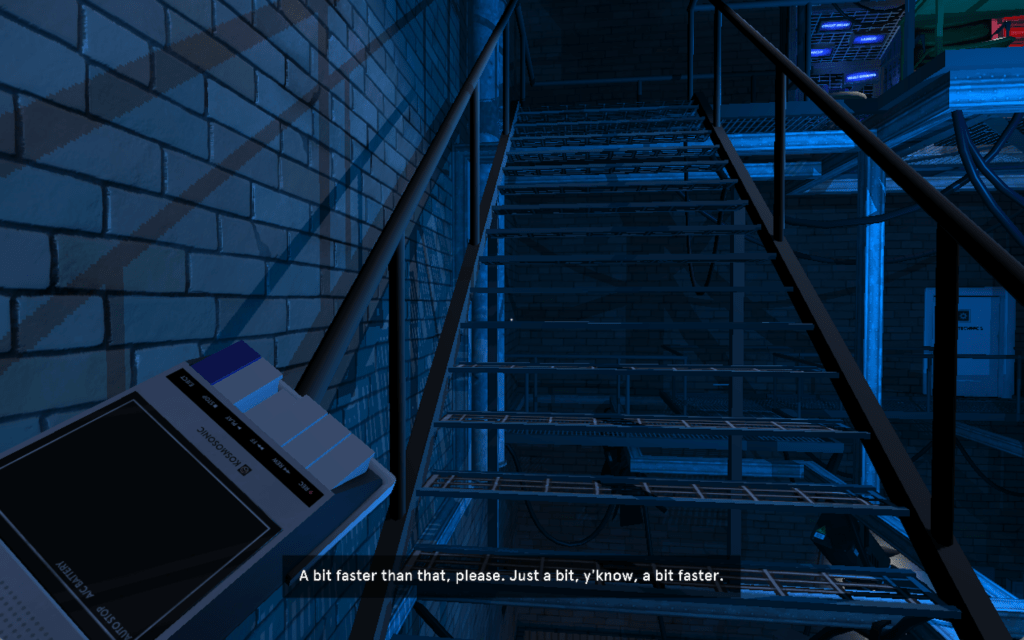
Of course, some players might argue that this guided “walk-through” is precisely the point. The eccentric rooms, odd narrator, and “meta” premise are enjoyable on their own. The narrator’s urgency and control enhance the experience, creating a distinct, surreal mood that is, admittedly, quite impressive. While I can appreciate this artistry, I was ultimately more absorbed by this tension between my wants and the narrator’s demands.
This tension reflects the core argument of The Death of the Author. Barthes notes that, when experiencing games, we must strip them of reference to the author. As soon as we include the designer — their intentions, mindset, and background — we prescribe a “finality” to pieces. He explains, “Once the Author is gone, the claim to ‘decipher’ a text becomes quite useless. To give an Author to a text is to impose upon that text a stop clause, to furnish it with a final signification, to close the writing,” (https://writing.upenn.edu/~taransky/Barthes.pdf).
In Dr. Langeskov, The Tiger, and The Terribly Cursed Emerald: A Whirlwind Heist, the “author” never fully disappears. Instead, he manifests as the narrator, constantly directing my movement and shaping my experience. Rather than inviting interpretation or exploration, the game enforces a single path forward. I wasn’t encouraged to explore on my own — I was instructed to proceed, even making the “mistakes” the narrator prescribed. This illustrates Barthes’ argument: through constant narration and authorial control, the game functions more like a performance or lecture than an open-ended text.
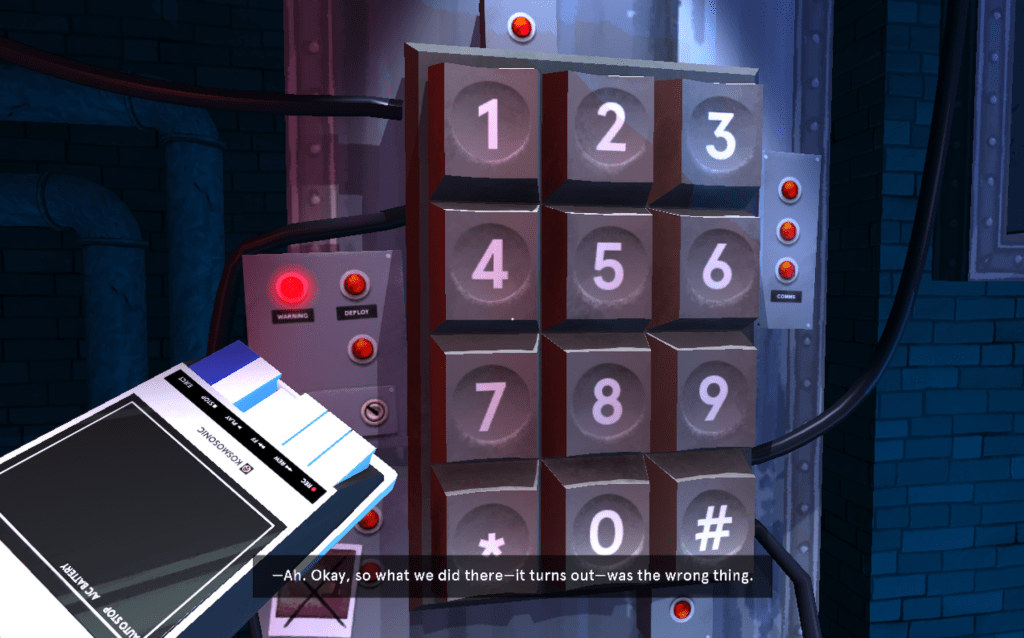
With that said, the narrator didn’t maintain total control. My frustration — my desire to linger, to search for meaning in the environment — did not disappear simply because the narrator told me to move on. In fact, it became more pronounced. Due to, frankly, human nature, the more I was rushed, the more I wanted to stay — the more aware I became of what I was being denied. In this sense, the game reinforces Barthes’ point: meaning cannot be fully controlled by the author because the player continues to interpret, question, and resist.
This became especially clear when I replayed the game. By deliberately ignoring the narrator’s instructions — rudely tuning him out — I was able to engage with the world on my own terms and, consequently, discover more. I found hidden details, like audio recordings of quirky auditionees and workers, which added depth and character to the environment and revealed the personality of the workplace. These moments felt far more meaningful precisely because they were not dictated to me.
Overall, Dr. Langeskov, The Tiger, and The Terribly Cursed Emerald: A Whirlwind Heist reveals a constant tension between authorial authority and a player’s desire for freedom. While the simple “walk-through” has its own merit, the most meaningful moments emerged when I let go of imposed control and explored the world on my own terms.
