

Tray Chen, Jaduk Suh, Tianze Shao, Ryan Li
Artist Statement
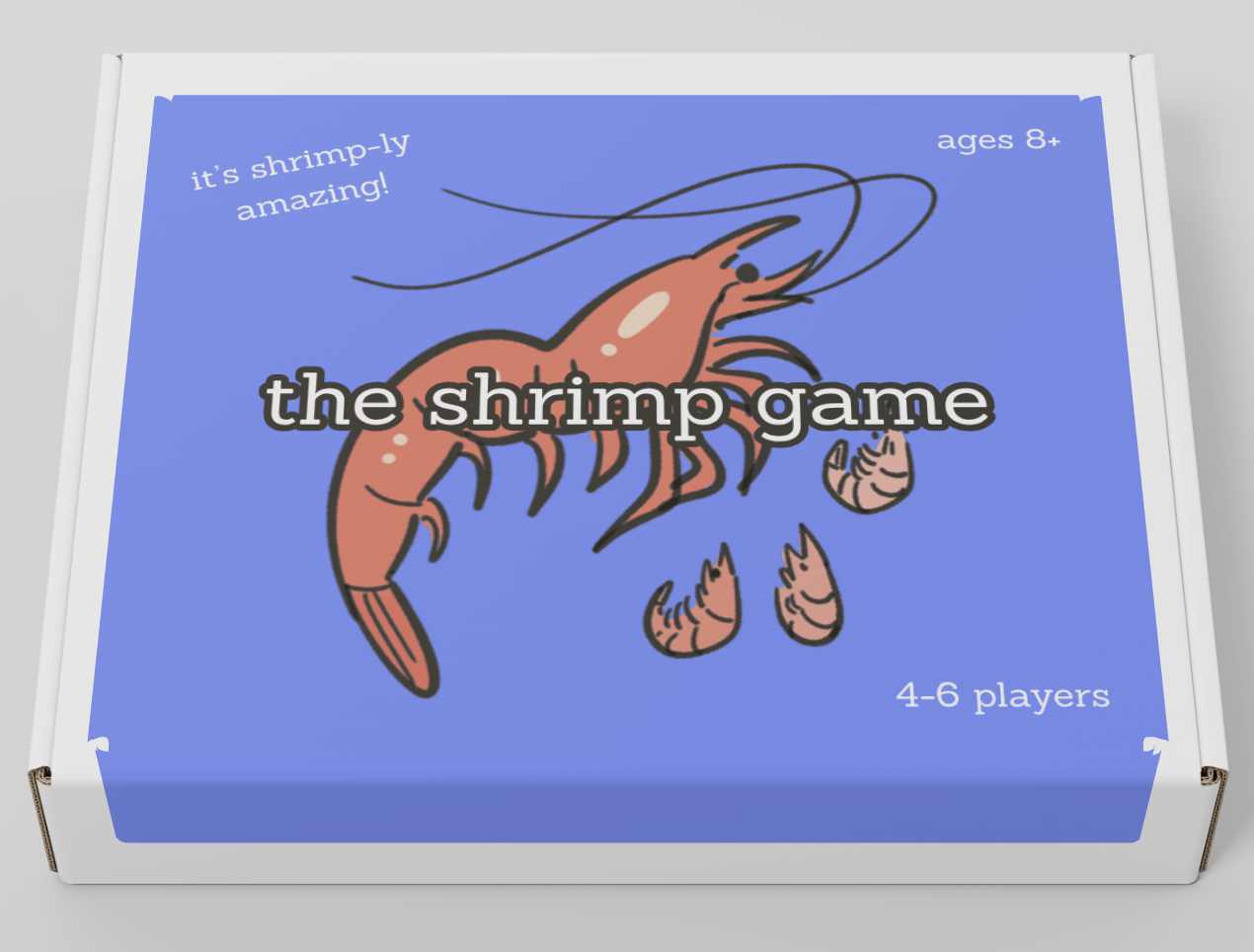
Have you ever wished that money wasn’t money, but money was shrimp instead? You have? Great! The Shrimp Game is a social deduction game where the main mechanic is bartering shrimp with one another to be the first to fulfill their top secret goal. Designed for a group of 4-6 players, aged 8+, each player is assigned a secret sea creature role with a unique shrimp-related win condition.
Social deduction games tend to lean dark, often featuring roles like assassins and traitors and villagers who end up dead quite early in the game, leading to an unevenly-fun experience depending on who you were assigned. We wanted to prove that social deduction games don’t always need to be so dark! The Shrimp Game is a goofy, fellowship-type fun game where nobody gets eliminated early, but challenge is still present as each role must hide their true identity to most efficiently pursue their own asymmetric win condition and hide from the Detective Narwhal, a role who wins by guessing other peoples’ identities. The result is a game where players can scheme, barter, and bluff freely, but must still guard what they reveal. Because somewhere at the table, a narwhal may be watching.
Concept Map
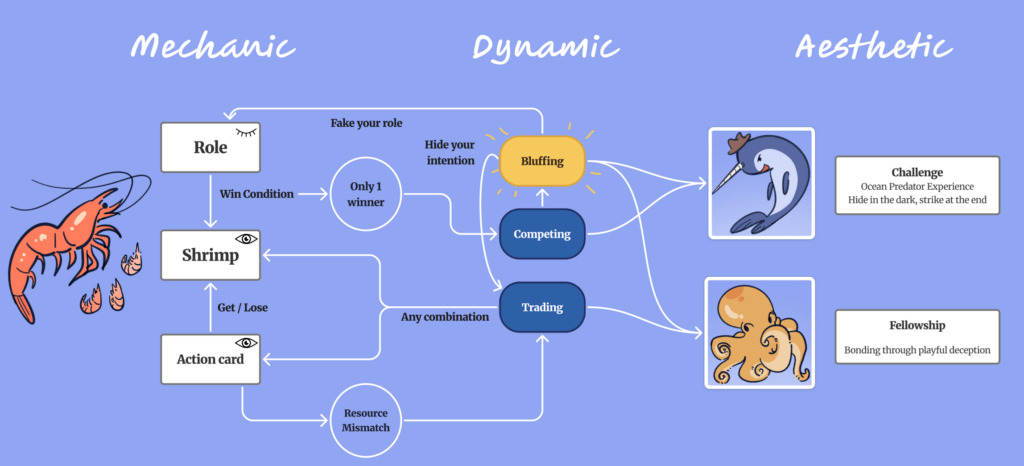
[Fig 1. Concept Map of The Shrimp Game.]
The Shrimp Game is a social deduction game. From a mechanics perspective, it includes three important elements: roles, action cards, and shrimp. The interaction of these elements sparks social dynamics such as competing, trading, and bluffing, ultimately delivering two core aesthetics: the challenge of “an ocean predator experience” where players hide to strike at the end, and the fellowship forged by playful deception.
The player experience begins with a role card. Each role has different win conditions – such as acquiring a specific number of certain types of shrimp. Action cards allow players to get or lose shrimp. Note that action cards don’t always play towards the player’s favor – for example, the blue whale, whose goal is to collect over 30 shrimp protein, might draw two “discard shrimp” action cards. However, for the jellyfish, whose goal is to discard all shrimps to win, this is exactly the key to win. Just as this example shows, these discrepancies and asymmetry in win conditions drive players to engage in negotiating and trading.
However, this is not a cooperative game—only one player can win. While trading solves one’s own problems, it might also help an opponent win faster. This brings forth another social dynamic – bluffing. A winner from a playtest once stated, “The trick to winning is to not let others know you are close to winning, otherwise they won’t trade with you.”
Additionally, the tension between “public information” and “hidden identity” forces players to mask their intentions with words, and execute trades that “look like a loss, but are actually highly profitable.” This shapes an ocean predator-like experience: hiding one’s identity in the dark, only to strike at the last moment and snatch victory. In playtests, when the winner’s identity exceeds everyone’s expectations, it consistently triggers a strong sense of accomplishment for the “deceiver” and laughter from the “deceived.”
Initial Decisions
For objectives, we designed asymmetric roles where each role has its own win condition. Rather than competing over a single goal, players pursue divergent targets. The exact win condition for each role were as follows:
- The Mother Shrimp must hold exactly two of each shrimp sizes – small, medium, large.
- The Coconut Crab must hold exactly ten small shrimps.
- The Blue Whale must accumulate a total of thirty or more worth of shrimps.
- The Immortal Jellyfish must discard all shrimps and hold none after the first round.
- The Mimic Octopus must trade once with every player and hold exactly eight small shrimps.
- Finally, the Narwhal wins by correctly identifying every other player’s role after someone else declares victory.
Because each player is racing toward a different endpoint, the group must cooperate to surface information — if someone looks close to their win condition, everyone else has reason to intervene. This is how we preserved the deductive fellowship of social games like Mafia and Avalon within a free-for-all format. Through these objectives, we tried to implement our game’s intended core value of fellowship within a free-for-all.
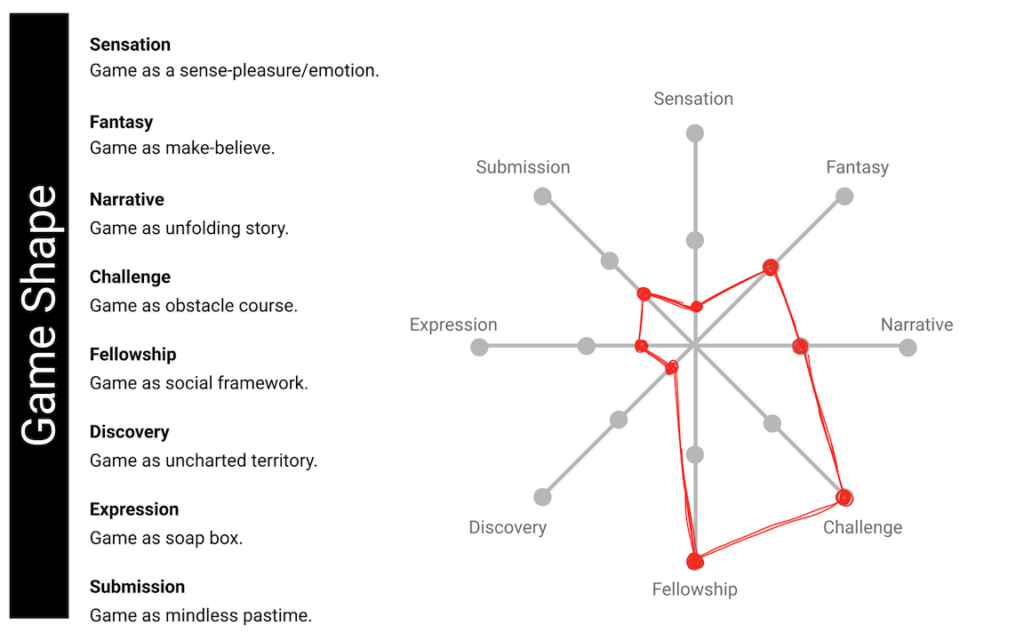
[Fig 2. 8 types of fun in the initial prototype – we emphasized fellowship and challenge types of fun.]
The rules and procedures are straightforward. At the beginning of the game, roles are distributed randomly and kept hidden; bluffing is allowed and encouraged. Each round, every player draws an action card and plays it immediately, and may optionally initiate a trade with another player. There are three action card types: Draw X Shrimp (take a specified amount or size of shrimp from the pile), Whirlpool (every player passes their shrimp clockwise), and Shrimp Migration (one chosen player returns all their shrimp to the pile). Trades are not required to be equal in value, and players are free to bluff about one’s role while doing so. We expect these trade mechanics will bring out bluffing/deception dynamics and fellowship type of fun.
Resources take the form of physical shrimp tokens in three sizes – small, medium, and large. A medium shrimp is worth three small shrimps, and a large shrimp is worth five. Most win conditions are tied to shrimp quantity or composition, making shrimp the central currency of both the economy and the deduction.
Conflict in our game is deliberately informational and economic rather than combative. We made a conscious decision to replace Coup-style elimination with subtler pressures: players must deduce hidden roles while concealing their own, compete for a finite shrimp pool where some win conditions (Blue Whale’s thirty shrimp) actively strain supply for others, and manage the constant threat of the Narwhal watching their every trade. The tension is real, but no one ever loses their seat at the table — which was essential to our value of a stakes-free, inclusive experience suitable for players as young as seven.
Finally, the game outcomes are determined the moment a player declares they have met their win condition — but the game is not over yet. The Narwhal may then attempt to name every other player’s role, and if correct, steals the victory. This outcome structure means hidden identity remains meaningful until the very last beat of the game, reinforcing that what you reveal during play is always a liability.
Iteration History
Playtest 1: Testing Out the Waters (In-Class)
[Lecture 3A] / Moderator: Tray / Notetaker: Ryan / 4 players, CS 247G students
We had 4 players from studio and conducted one playtest. In this playtest, we realized that the wording on our cards was hard to understand, specifically the difference between big, mid, and small shrimps in terms of win conditions like “own X amount of shrimp,” since our cards originally described big and mid shrimp as representing 5 and 3 small shrimp, respectively. As a result, we changed our cards to clarify size versus value, instead counting for protein instead of small shrimp, which would increase player understanding in later playtests. We also learned that we needed to incentivize trading more, which we would eventually iterate on over future playtests.
Playtest 2: Balancing Action Cards and Roles (In-Class)
[Lecture 3B] / Moderator: Tianze / Notetaker: Jaduk / 4 players, CS 247G students
Audio Recording & Transcription: https://app.audioscribe.io/share/df4622bc-ed49-4819-b3c2-d873b2573a48
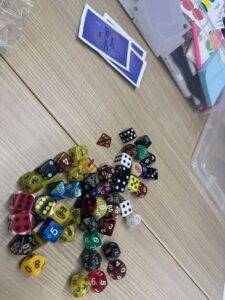
[Fig 3. Photo of our second playtest. We used dice as shrimps and used yellow stickers to denote medium shrimp, and red stickers for big shrimp.]
This playtest demonstrated that players can genuinely enjoy the game. One player became highly engaged, disguising himself in various roles and explaining his strategy as “pretending to want to do a trade, bait the swordfish into getting it wrong” [00:11:41]. He won through bluffing and rated the game highly, showing that we successfully stimulated the bluffing dynamic and that players found it enjoyable. Strengthening this dynamic further is our central iteration goal.
At the same time, the playtest surfaced several important issues. First, players told us “there needs to be more ways to lose shrimp” [00:10:43]. Because the action cards only allowed players to collect shrimp, our shrimp pile nearly ran out, and the jellyfish–whose win condition requires discarding all shrimp–found victory nearly impossible. Related to this, players felt that win conditions across roles were poorly balanced. The octopus role was seen as extremely difficult, since being forced to trade with everyone too easily gave away the player’s identity [00:13:22]. The detective role (swordfish) was criticized as feeling artificial (more like a balancing mechanism than a genuine role) and lacked fun: as one player put it, “I feel like the whole purpose of the swordfish is just nobody wants to reveal their role” [00:12:49]. Players also disliked action cards that drastically altered the game state, particularly the whirlpool card, which shifts everyone’s shrimp clockwise: “The shuffling around feels real bad” [00:11:11]; “it would feel bad to lose your whole point” [00:11:18]. Finally, trading behavior was much rarer than intended–only three trades occurred during the entire game.
Based on this feedback, we revised our mechanics for the next iteration. First, we redesigned the action cards: several new cards now force players to discard shrimp, and whirlpool cards are limited to two per deck. We also reworked the card-drawing and trading system. Previously, players had to use cards immediately and could only trade shrimp; now they may hold up to two cards and trade cards as well. Together, these changes should encourage more trading and help players pursue their goals–for example, a jellyfish can actively seek out discard cards from others. They should also enrich identity deduction, since the cards a player chooses to trade can hint at what they are/aren’t trying to do. Finally, we refined the swordfish’s win condition: instead of needing every guess correct, the swordfish now receives a point boost scaled to the number of identities correctly identified. This keeps the role from being purely about guessing and gives it genuine shrimp-collection goals that accurate deduction helps achieve.
Playtest 3: What Do Non-Game Designers Think? Pt. 1 (Friends)
[Friday] / Moderator: Tray / Notetaker: Tray / 6 players, friends
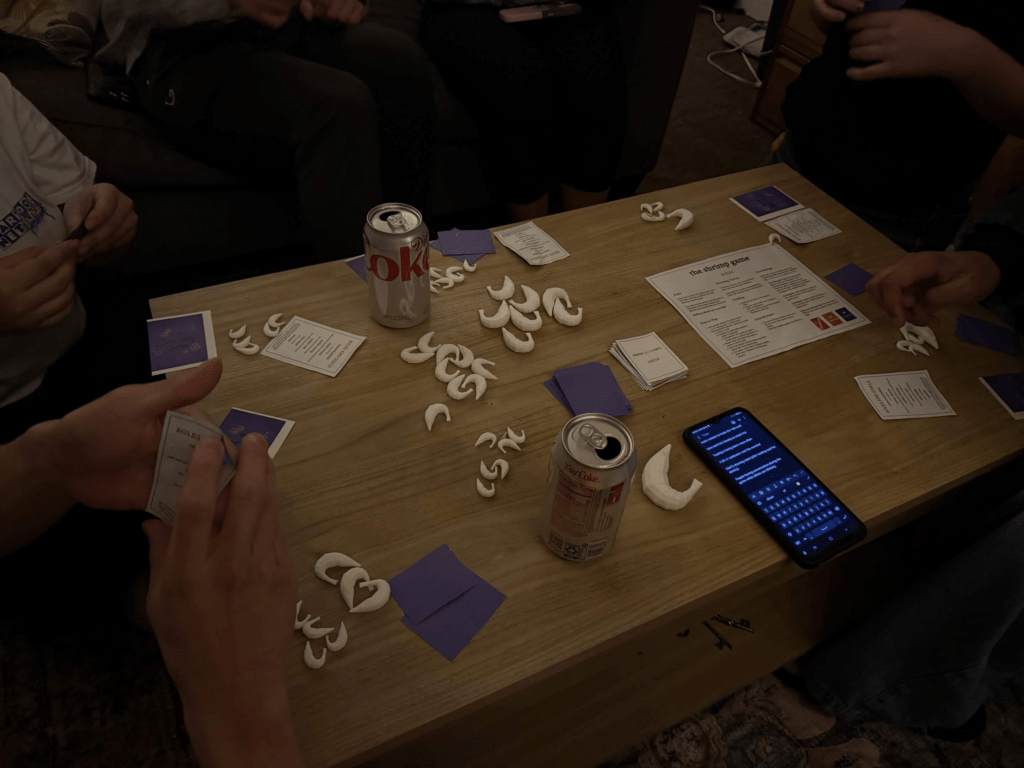
[Fig 4. Photo of playtest 3. From this point and on we 3D-printed the shrimps.]
In this playtest, the main issue exposed in the game was the lack of clarity on the rules. Multiple players throughout the game were confused on topics such as the order of actions completed during a turn, how the Narwhal role worked, and other small details. To amend this, we made our rules much more specific and detailed on the correct procedures throughout the game. We also added some small balancing changes, such as making it easier for the blue whale to win, and limiting each turn to 1 trade so players didn’t need to wait so long for their turn each time. Again, players said they had fun!
Playtest 4: What Do Non-Game Designers Think? Pt. 2 (Friends)
[Saturday] / Moderator: Tray / Notetaker: Tray / 5 players, more friends
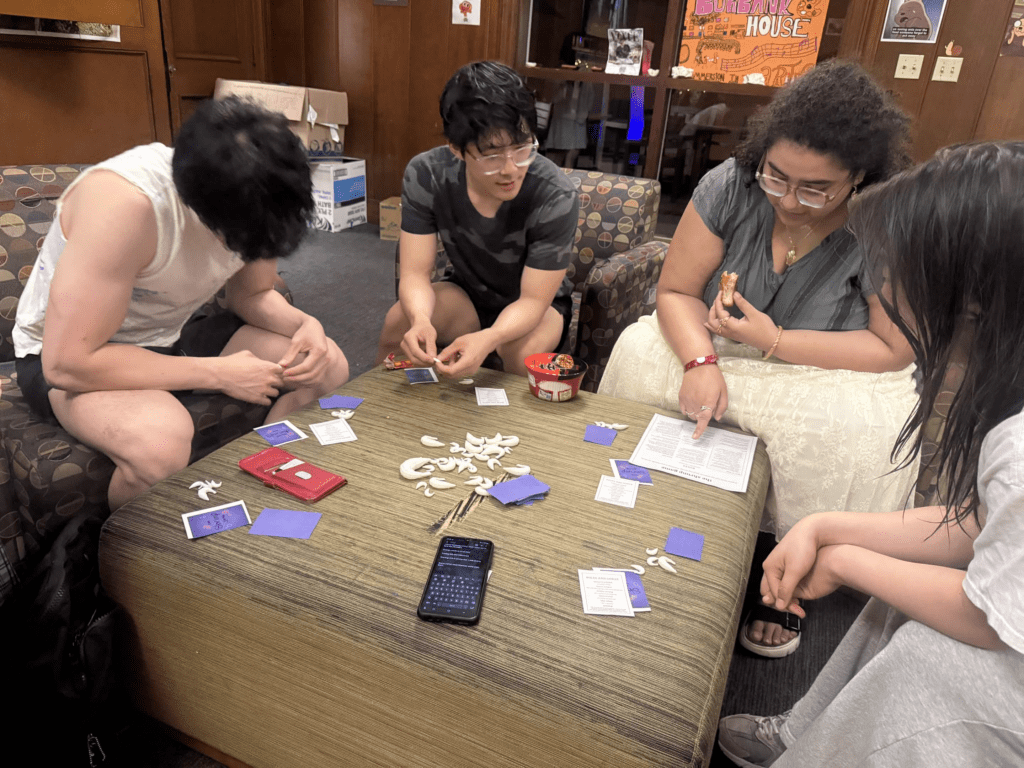
[Fig 5. Photo of playtest 4.]
The major change that occurred during this playtest was making the action cards public information (face up) rather than each player’s private hand. This change was suggested by Mai, who said that trading felt unfair because it disproportionately favored players who lied, which wasn’t always fun despite it being a social deduction game. A reason for this may have been a lack of public information: the fun of deduction is the challenge of figuring out other players’ roles with limited information, but if information is too limited, the experience can often feel more frustrating than satisfying. After we tested a version of the game with the action cards face up, all of the players agreed that the game felt much better to play. Narwhal was still noted to be confusing, and other minor balancing changes were made.
Playtest 5: Role-Balancing & Narwhal-Wrangling
[Monday] / Moderator: Tray / Notetaker: Tray / 4 players, CS 247G students
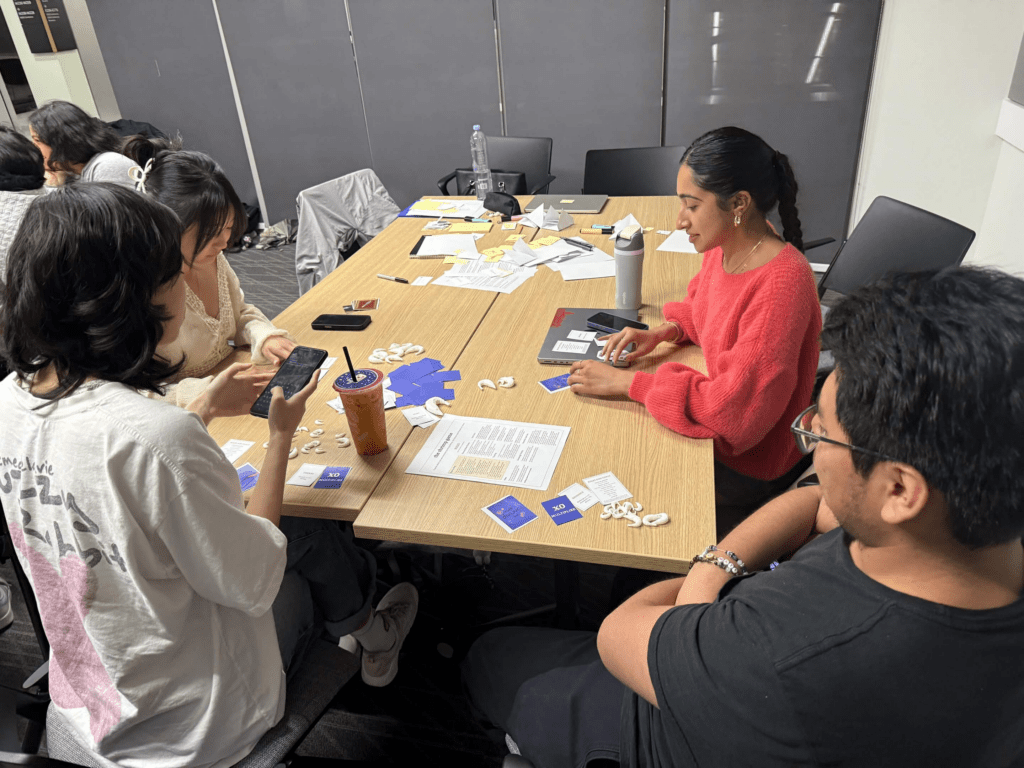
[Fig 6. Photo of playtest 5.]
This is the game where we finally changed Narwhal to be more understandable. The role had gone through many iterations, the most notable of which being able to “steal” a victory by guessing everybody’s roles to guessing during the game itself to fulfill an otherwise-impossible protein amount. During this game, it finally hit home that players were too confused by the protein Narwhal concept to even bother guessing. After this playtest, we changed the role to be more intuitive so players still had to guess roles during the game to earn shrimp, but the goal itself was a simple “earn X big shrimp” type goal. This reduced confusion and encouraged more open guessing. We also made the rulebook less wordy/overwhelming for players to read.
Playtest 6: Final Playtest… DUN DUN DUN
[Lecture 4A] / Moderator: Tray / Notetaker: Ryan / 6 players
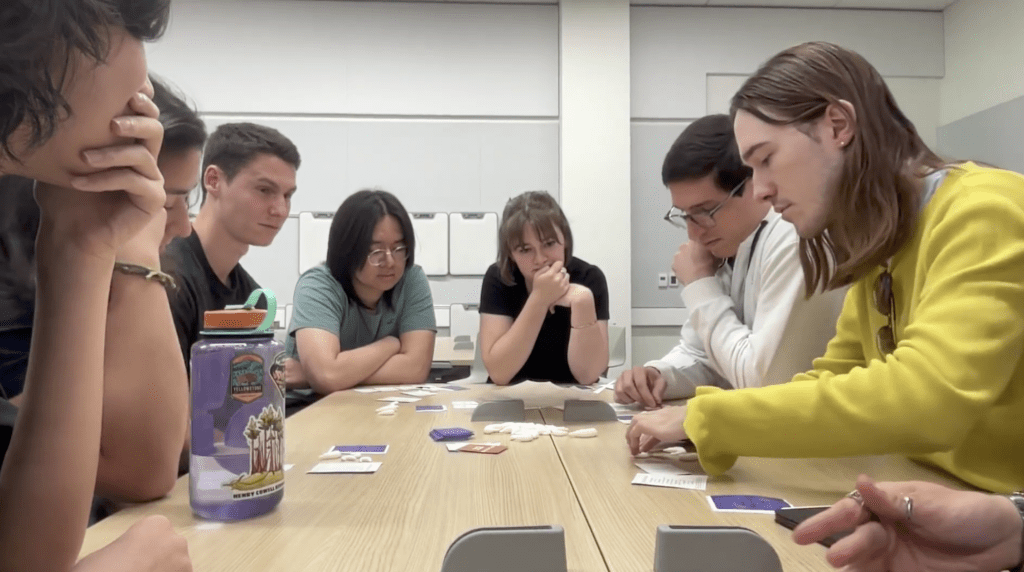
[Fig 7. Photo of final playtest 6.]
We got a lot of feedback for minor adjustments during this playtest, mostly about insignificant features of balancing that we resolved to be a result of first-game-confusion. After making the rules easier to read, some players were once again confused about correct turn procedures, but we clarified that the turn procedure was in the rulebook and since made those features more visible. Another example of a minor change is about graphic design, making so that “full color” cards can be played at any time in the game, creating an easy association between each other. In response to one player’s comment that they liked the different sizes of shrimp but wished they could be different colors, we painted the shrimp pink, yellow, and blue to represent small, mid, and large respectively. We chose these colors because they are high-contrast and would be accessible to color-blind players.

[Fig 8. Shrimps are colored to make it more accessible for color-blind players.]
Final Playtest Video
https://drive.google.com/file/d/1NNeZjG9DZVkhPGxM0FGQnJKSiZOcvNEK/view?usp=drive_link
Print-n-Play
The print-and-play version of our game can be found in the following link:
https://drive.google.com/file/d/1IiJBSUbON_erYvcTaF0Iwczoo1pgwy1h/view?usp=sharing
Box Art
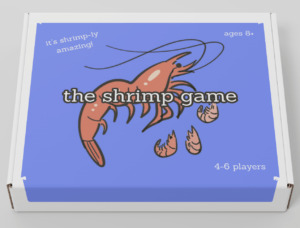
[Fig 9. Front cover.]
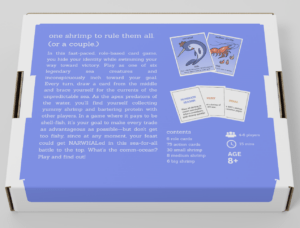
[Fig 10. Back cover.]
 [Fig 11. Final Product.]

WOOHOO SHRIMP GAME HYPEEEE 🦐🦐🦐🦐🦐🦐
SCRIMP