

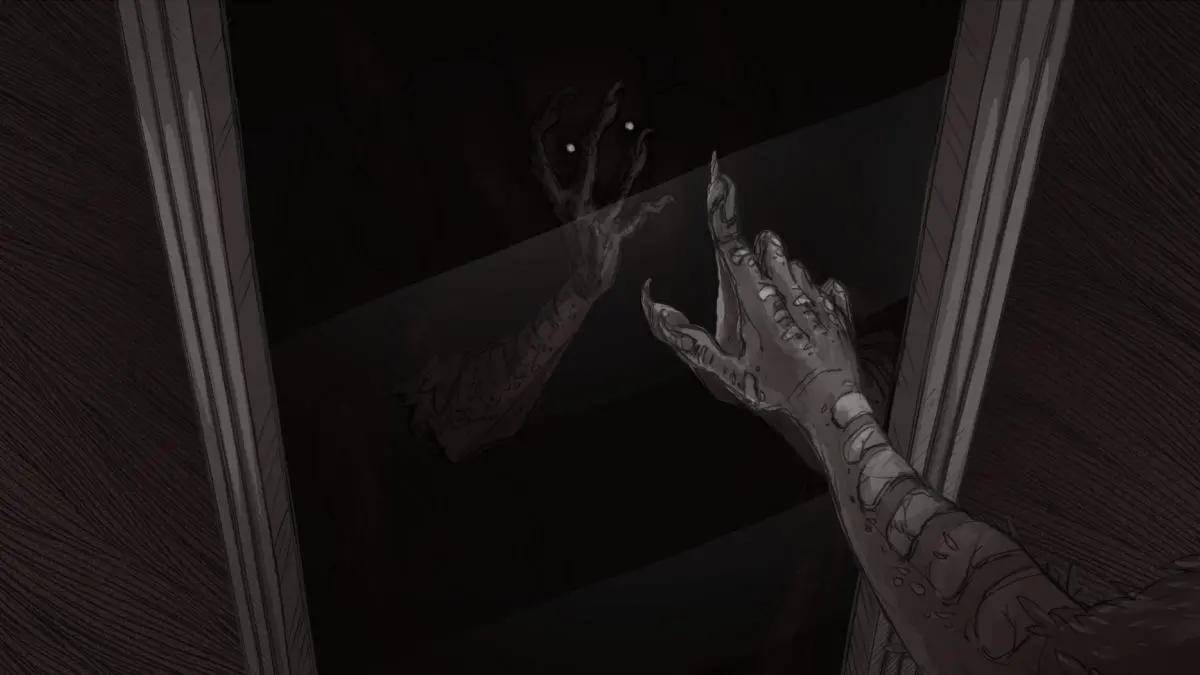
Playing Slay the Princess this week was my first introduction to the genre of interactive fiction. It was my first time experiencing a game where the story did not simply unfold in front of me, but instead demanded that I move it forward through my own decisions. At first, the premise felt straightforward: walk down a path, enter a cabin, and decide whether or not to kill the Princess. But almost immediately, that sense of control began to unravel. The narrator insisted on a single “correct” choice, the Princess resisted and reshaped herself in response to my actions, and each decision I made seemed to loop back on itself in unexpected ways. Even when I tried to act decisively, it became clear that I was not freely shaping the story so much as navigating a system that anticipated and constrained my behavior.
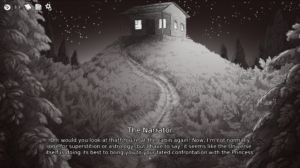
Every path leads back to the princess’s cabin.
Yet paradoxically, this lack of control made each choice feel heavier. Instead of feeling like a sandbox where anything was possible, the game made me acutely aware of my role in producing its outcomes, forcing me to sit with the discomfort of my decisions. This experience suggests that the ethical power of “evil” in video games does not come from unrestricted player freedom, but from the illusion and constraint of agency. While players are never truly in control, games like Slay the Princess show that limiting choice can heighten moral weight, forcing players to confront the meaning of their actions rather than treating them as inconsequential mechanics.
Parkin argues that video games become ethically fraught because they ask players not just to witness violence, but to enact it, “implicating [their] audience through interactivity” (Parkin). In many mainstream games, however, this participation is rendered hollow by the sheer breadth of available actions: when everything is possible, nothing feels particularly meaningful. Slay the Princess takes the opposite approach. Rather than offering expansive freedom, it carefully restricts and structures the player’s choices, creating a suffocating sense that the game is nudging you toward a specific outcome. As I played, it became increasingly difficult to do what I considered the “right” thing. Even when I tried to make my intentions clear and resist the narrator, there was always a pressure pushing me back toward violence. The interface itself reinforces this; when first confronted with the command to kill the Princess, the option to spare her is not immediately visible but buried deep within a scrolling list of identical commands urging you to “Slay the Princess.” Finding it requires deliberate effort, almost an act of resistance.
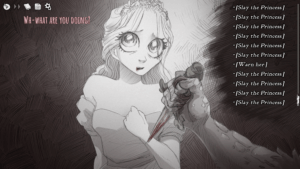
A hidden moral path is buried within the choices.
This design choice complicates the player’s sense of responsibility. On one hand, it might seem that the game absolves you of guilt: if the system overwhelmingly pushes you toward a violent outcome, are you really to blame for following it? But in practice, the opposite happens. Because the “good” option is still present, just obscured, you are made aware that choosing violence is not inevitable. It becomes something you actively allow to happen. The illusion of limited agency heightens the moral weight of your actions; you are not freely exploring a sandbox, but navigating a constrained system where each decision feels deliberate. In this way, the game aligns with Stang’s argument that agency in video games is constructed rather than real, yet still meaningful (Stang). Even if my choices were anticipated and pre-scripted, the effort required to deviate from the expected path made those deviations, and failures to deviate, feel deeply personal. Succumbing to the narrator’s pressure no longer felt like passively progressing through a story, but instead like consciously ignoring my own moral instincts.
This tension is further amplified by the way the game constructs and then destabilizes your identity as the “hero.” Early on, the narrator frames your role in explicitly moral terms, presenting you as the one who must save the world. Your responses are labeled in ways that reinforce this identity, encouraging you to believe that your actions are justified, even necessary. However, this framing begins to unravel the moment you encounter your reflection. In one of the most striking moments of my experience, I reached out toward a mirror and was confronted not with a noble protagonist, but with a distorted, clawed hand.
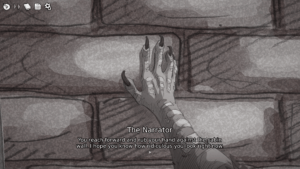
The hero’s form is revealed for the first time.
This reveal forces a reevaluation of everything that came before. If you are not the heroic figure the narrator described, what does that make your actions? The game never fully shows your body, instead limiting your visible form to these glimpses and leaving the rest to your imagination. Rather than definitively telling you that you are monstrous, the game provides just enough evidence to destabilize your assumptions, denying you the comfort of a fixed moral identity and forcing you to fill in the gaps yourself. As a result, any act of violence you commit becomes harder to justify, and killing the Princess no longer feels like a heroic duty, but instead something far more ambiguous.
By limiting choice, obscuring identity, and (not-so) subtly guiding player behavior, Slay the Princess transforms simple decisions into deeply uncomfortable and introspective experiences. It forces players to grapple with its implications, even within a system where their control is never absolute. In doing so, it offers a compelling counterexample to games that rely on unrestricted freedom, showing that sometimes, it is the lack of choice that makes our actions feel the most real.

It’s quite interesting that you felt an increased moral responsibility from the constraint! I actually felt like I seemed to care less because regardless of my decision I was forced to eventually kill her and loop back to the start.
I like your point about the mirror! While I was playing, I was curious as to why the narrator couldn’t seem to see the mirror — and why the mirror would disappear the second after the player used it. I wonder if it has something to do with the extended metaphor of “losing oneself”.