The game I picked for my critical play is called Gartic Phone, it’s a browser game developed by Onrizon. Gartic phone is a take on the classic broken telephone game, but with added drawing mechanics; each player comes up with a prompt for a drawing, then the prompts are shuffled and randomly given to other players to draw. After all the players finish their drawings, the drawings are shuffled and are again distributed to players. Then, each player attempts to guess what the original prompt was; then, those guessed prompts are shuffled and distributed out again. The game ends when each player has contributed to each prompt once. Once the game is over, the website goes through each of the starting prompts, and shows the iterations each prompt went through.
I would argue that the key difference between Gartic Phone and my group’s game (called Y-drawmbinator, I’ll abbreviate it to Y-D) is the amount of scaffolding present in each of the experiences. This increased scaffolding allows Y-D to be more approachable to groups who may not be as familiar with one other, and by having a more enforced premise, Y-D also plays a bit into Fantasy fun, in a way that Gartic phone does not.
Y-D and Gartic Phone share the mechanic of trying to make sense of someone else’s drawing under a time constraint, but they differ in the dynamics created by this mechanic. In Gartic phone the chain of interpretations cause prompts to become increasingly thrown off of the original prompt. Despite the mechanics seemingly encouraging players to try to accurately guess, this dynamic is the core behind the fun of the entire game. The game encourages expression fun at every turn, allowing the creativity/humor of each player to seep through, until the result is worlds away from the original prompt. The mechanics of Gartic phone created dynamics particularly suited to groups of friends who are already quite familiar with each other. I played this game with some online friends I have, and all but one person playing the game met one another playing Destiny 2. As a result, a lot of rounds contained references to Destiny 2, but, every time a Destiny 2 reference appeared, it fell flat to the one person who didn’t have that shared context.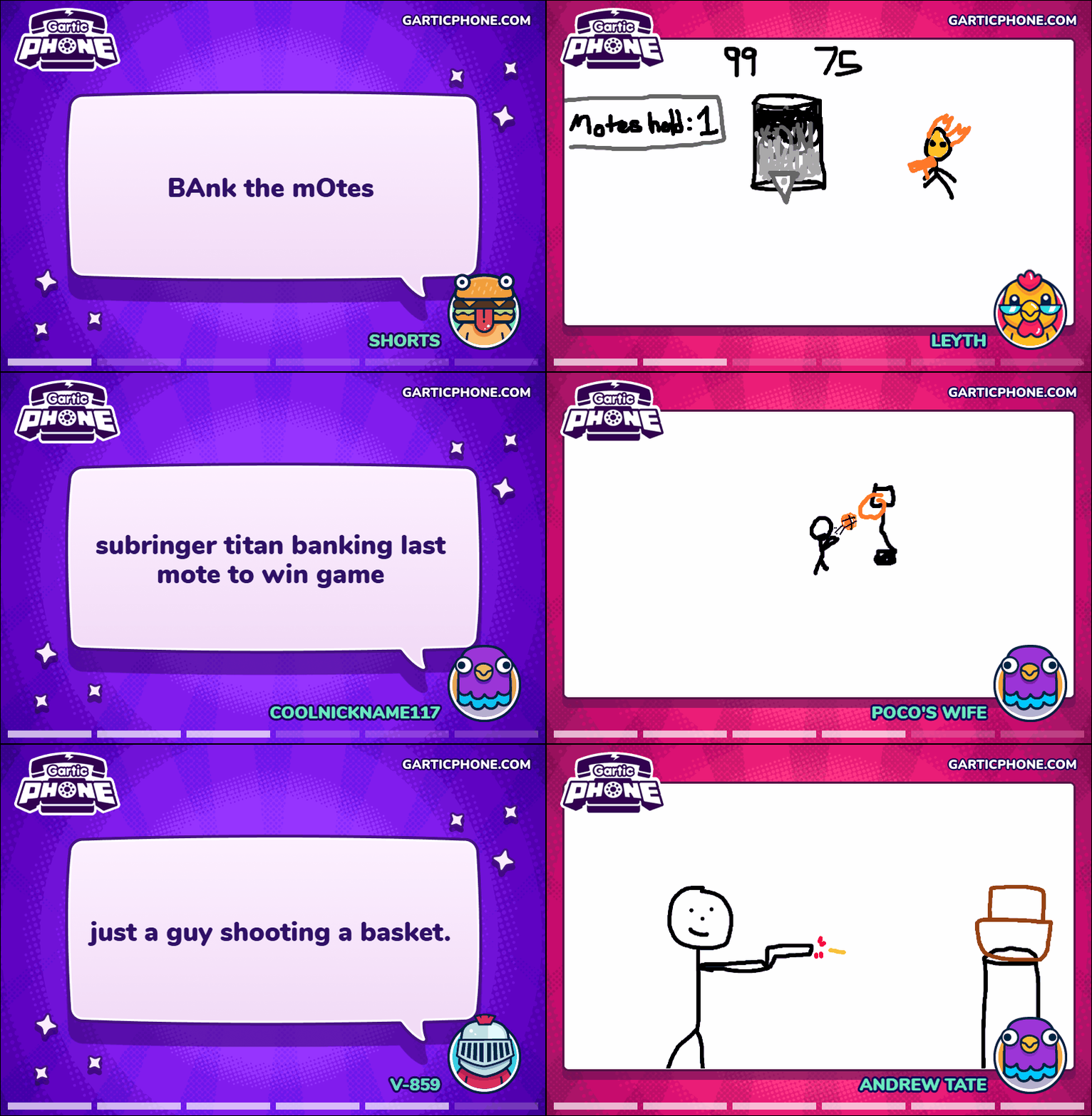
This gif is a perfect example of what I mean, (also sorry about the questionable usernames of my friends) “Bank those motes” is a meaningless sentence to someone who hasn’t played Destiny 2. Yet, in my drawing, even the small details I added were enough to not only communicate the banking of motes, but also a ton of extra details like the Sunbreaker titan. That hyper contextual prompt though was entirely meaningless for the person who hasn’t played a lot of Destiny 2, and we see that in the way we went straight to basketball.
I would imagine that the aesthetics created by the game were very different for this person than for the rest of us. The same social framework created by the mechanics and dynamics of the game that gave us a great sense of fellowship, probably made them feel excluded as opposed to more connected to the group. Receiving a prompt that you genuinely do not understand is something that can make people feel anxious or excluded, and knowing everyone will see that it was you who didn’t get the joke would be awful.
The broken telephone dynamic that Gartic Phone’s mechanics create can also have the potential to lead to inappropriate interpretations. I don’t think that this is necessarily an issue with the game , but it can make the game more uncomfortable. Even if the prompt start appropriate, it’s really easy for things to get out of control.
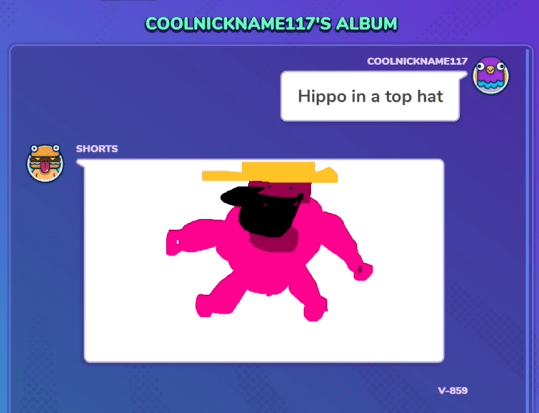
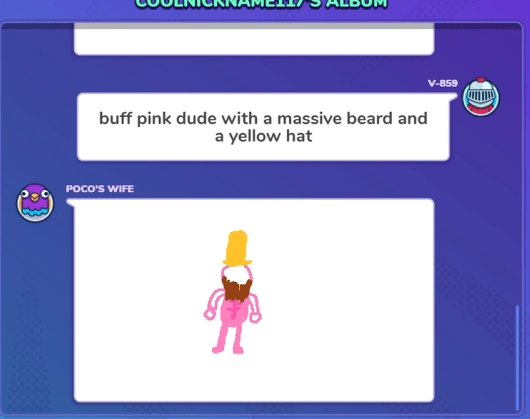
Seems relatively tame, but the next prompt guessed was Babe-raham Lincoln, which then somehow became a very badly drawn picture of Abraham Lincoln’s butthole.
For Y-D though, we hope that our game is playable by people who may not know each other very well yet. Our game has a relatively silly premise, everyone is a would-be entrepreneur pitching their next idea, but the twist is, they stole their idea off a coworkers desk. Each player draws a different prompt card and then draws a response to their card. Players then get another player’s drawing face down. On their turn they flip the card, and without ever having seen it, they need to give a 1 minute pitch on the idea. This at it’s core is a very similar mechanic to Gartic Phone, but the key difference is that the original prompt is not invented by the players and is designed to be widely understood. Additionally the prompt is independent every time, preventing the rabbit holes that can develop in Gartic Phone.
Through these variations in mechanics we see variations in the aesthetics our game creates. One key aesthetic is Fantasy fun, in our playtest we had people really trying to get into the role of the investor. In our rules we kind the name of the judge role to investor just for thematic purposes, but this led to people actually roleplaying as investors and entrepreneurs, and drew people further into the magic circle, encouraging people to separate themselves from their own personal identities. People become more comfortable sharing whacky ideas. This is different from Gartic Phone. In Gartic Phone, many of the jokes and ideas are predicated around the personal relationships between the players, but our mechanics are designed in order to instead prioritize creating a feeling of Fellowship that doesn’t leave players feeling excluded due to a lack of inside knowledge.
I want to clarify that I don’t think Gartic Phone made bad design choices, I only think that the mechanical differences and premises of the two games create dynamics which lend themselves to different player populations. Where Gartic Phone is highly friend group and context dependent, Y-D constrains creativity a bit more, in an attempt to make the game play more similarly regardless of the existing relationships between players.