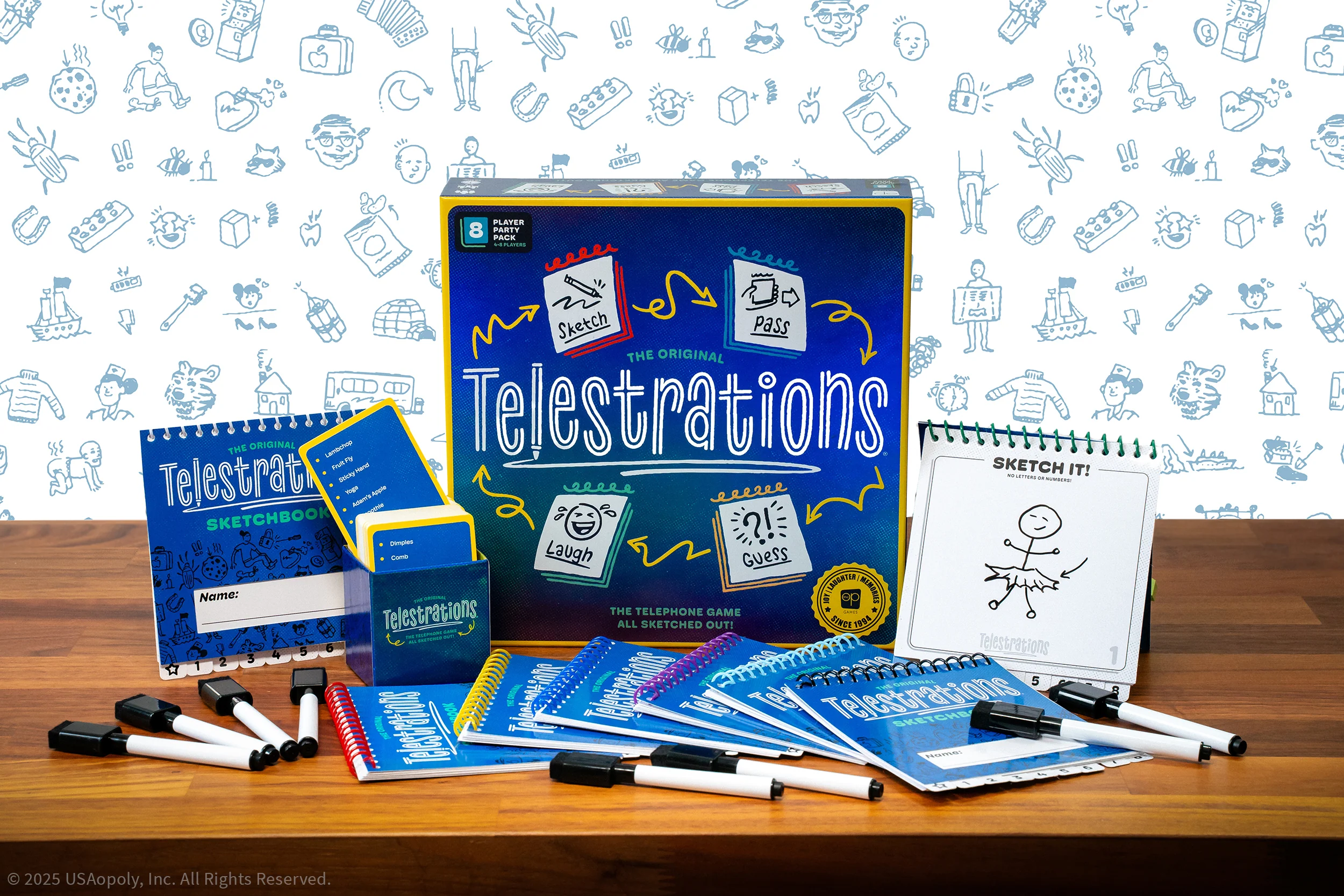
Telestrations, a physical game created by Hervé Marly and published by The Op Games, is a fun twist on the folk game, Telephone, where players must decipher each other’s drawings and draw new prompts as they get passed around the group. This makes the perfect party game, as it is designed to include players of most ages (10+) and requires minimal prior game knowledge. I played this game with 3 friends and chose it since my group’s game, On Display, also uses sketching and interpretation as a core mechanic in the gameplay. Similar to Telestrations, On Display is a drawing and judging game designed for social, creative groups. However, instead of letting meaning unravel, it asks players to be intentional: to draw under constraints, pitch their work, and try to impress a rotating “curator.” While both games revolve around translating ideas into sketches, they create completely different experiences through these differences in intention and authorship. Telestrations thrives on accidental comedy and shared accountability, but On Display turns drawing into an individual performance shaped by persuasion and social judgment.
Both Telestrations and On Display are fundamentally games about how visual information is communicated under uncertainty, but they structure the visibility of that information, and therefore the social dynamics around it, very differently. In Telestrations, drawings are passed anonymously through a chain of players, and meaning degrades through hidden transformations. Through these mechanics, players never have to account for or defend their intent, and the resulting dynamics emphasize fellowship through miscommunication and collective humor as well as low-stakes expression since there is little pressure to perform well. On Display, by contrast, makes that information fully visible and attributable; players must not only produce a drawing under constraints, but also publicly pitch and justify it to a curator, adding in dynamics of performance and persuasion. This shift produces a different experience that deepens creative agency while introducing new forms of social pressure, bias, and evaluation.
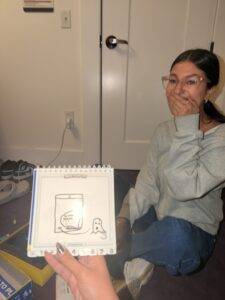
Rounds with blank prompts incited the strongest reactions.
An interesting variation emerges with the game’s blank prompt cards, which allow players to invent their own words. While playing with my friends, these rounds became the most engaging, as the blank cards allowed us to introduce inside jokes and personal references into the game. As seen in the screenshot above, these rounds using blank cards always ended in shared laughter and increased excitement around the game. This clever design choice shifts the dynamic from interpreting random prompts to building on shared knowledge, further strengthening fellowship and interpersonal connection between the players. However, I anticipate that this effect depends on the group, for without shared context, players may default back to generic prompts. The blank cards therefore function as a flexible mechanic that allows different social dynamics to emerge without enforcing them, especially between close friends. On Display builds on a similar idea through its “Curator’s Choice” cards, where the curator selects the prompt. This shifts the source of information from the system to a specific player, creating a dynamic where artists begin to interpret not just the prompt, but the curator’s preferences. Players may strategically tailor their drawings to appeal to the curator, introducing a new form of fellowship and narrative into the game, as each drawing becomes part of an ongoing social interaction.
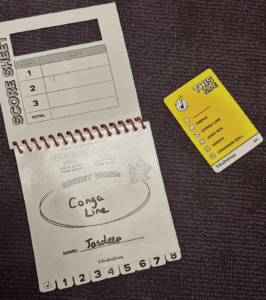
Despite playing many rounds, the score sheet was never used.
Another important distinction between the two games lies in how their mechanics frame the idea of “winning.” In Telestrations, although the rules technically award points when a player’s original prompt is guessed after the full cycle, the core mechanics make authorship so distributed that it becomes difficult to attribute success to any single player. Each drawing is shaped by multiple people, and the most memorable outcomes are often the most incorrect ones. This creates a dynamic where hard co-op is key and scoring feels secondary to the experience, reinforcing fellowship as the dominant form of fun. In my own experience, my group quickly abandoned the scorekeeping entirely, finding that the collective humor of the reveal was more engaging than tracking points. This contrasts with other party games like Pictionary or Charades, where team-based mechanics clearly define winners through accuracy and speed, emphasizing challenge and competition. On Display, by comparison, reintroduces a clear structure of individual achievement through its ribbon system. Because each player creates and presents their own drawing, points are directly tied to individual performance, making success more legible and meaningful. This shifts the dynamic toward challenge and competitive expression, where players are motivated not just to participate, but to stand out. As a result, On Display creates a more individual and performance-driven experience, while Telestrations deemphasizes winning in favor of shared, emergent play.
Ultimately, while Telestrations and On Display share the same foundational act of sketching, they diverge in how their mechanics structure visibility, ownership, and evaluation, leading to fundamentally different player experiences. Telestrations distributes authorship and obscures intent through heavy collaboration, producing dynamics centered on miscommunication, shared humor, and low-stakes participation. This leads to fellowship, discovery, and expression dominating the gameplay, while winning becomes almost irrelevant. On Display, in contrast, makes creation visible and attributable, using constraints, pitching, and judging to extend drawing into a deliberate act of performance and persuasion. This shift introduces stronger challenge, expression, and narrative forms of fun, as players actively shape and defend their ideas within a social context. Together, these games demonstrate how even a single shared mechanic of timed sketching can lead to entirely different forms of play depending on how information flows through a system and how players collaborate.