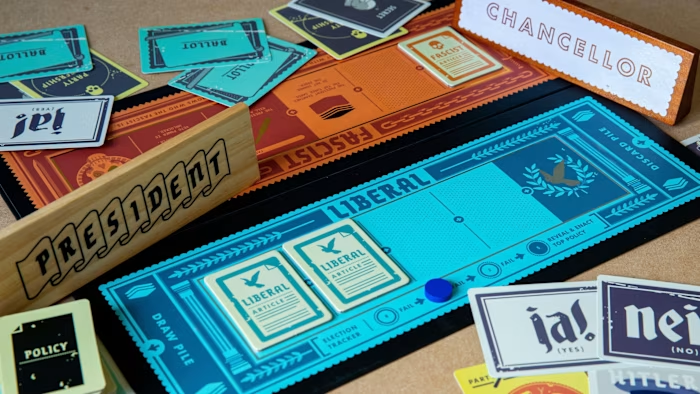
Secret Hitler is a 5–10 player social deduction game of political collusion and betrayal. The target audience is anyone who is 13 and older. The tabletop/board game was created by Max Temkin, Mike Boxleiter, and Tommy Maranges. Players are secretly divided into Liberals (majority) and Fascists (minority) roles, including one secret Hitler. Liberals win by enacting five policies or assassinating Hitler. The Fascists win by enacting six policies or electing Hitler Chancellor after some number of Fascist cards have passed.
My experience playing Secret Hitler showed that in a group setting, my communication is usually out-of-sight, reactive, and more on managing perception than dominating the conversation. The game’s formal elements include hidden roles, rotating leadership, public voting, incomplete information, and two different team goals. From my experience, the loudest person usually was not the person who got their way, but the players that were believable enough to avoid the center of suspicion. That fit my natural role in a group. I am not someone who dominates discussion, and in this game that backseat approach actually became a strategic advantage.
From an MDA perspective, the mechanics of Secret Hitler directly shaped my behavior. The most important mechanics were the hidden role system, the President/Chancellor legislative process, and the fact that policy draws cannot be fully verified by the rest of the table. Those mechanics created the dynamics of uncertainty, suspicion, and bluffing. Also, these dynamics produced the aesthetics of paranoia, tension, and last-minute turnaround that define the experience of the game. Because players cannot confirm exactly what cards were drawn and passed, I believe communication becomes less about telling a convincing story, but more about creating just enough doubt to stay alive. That is exactly how I played.
When I was a Fascist, my communication stayed neutral (backseat). I made sure to speak at least once each round to avoid suspicion and over explaining. I would often cast suspicion on a random player or cast suspicion on my own Fascist teammate. That was not just random behavior, it was a response to the game’s structure. Since everyone is looking for patterns in our speech, votes, and accusations, speaking too much can make you easier to track. The game encouraged me to weaponize ambiguity. In the first round of a new game, a Liberal President chose me as Chancellor and passed me one Liberal and one Fascist policy. I discarded the Liberal card, enacted the Fascist one, and claimed that I had been given two Fascist cards. The room imploded with chatter as players grew confused about why I would lie, which is exactly why I lied. It did not make sense for me to lie in the first round, so suspicion fell on both of us. Later, instead of doubling down too hard, I softened the lie and said I might have checked too quickly and made a mistake. I was only able to do so because the mechanic of hidden card information gave me plausible deniability, and I used that uncertainty to turn a direct accusation into confusion.
Another game showed me even more clearly how the game’s structure shaped my decisions. I was Hitler in a five-player game, which meant the Fascist and I knew each other’s identities from the start. Right away, I started accusing my Fascist teammate every round. Eventually he was killed, which made me look more trustworthy. By the time electing me as the Chancellor would end the game, only three players remained, and the President trusted both of us as Liberals, even though that did not fully make sense. The game ultimately elected me as Chancellor and when I was asked if I was Hitler, I could not help, but to just smirk. That move only worked because of the game’s win condition: once enough Fascist policies are enacted, social trust (between the Liberals) becomes more important than logical consistency.
What makes Secret Hitler effective is that it does not rely only on conversations. It creates a formal record through votes, enacted policies, and executive powers. This makes it different from other bluffing games in the genre, where deception can feel more purely social. Here, I argue the design mixes social reading with procedural evidence. My biggest takeaway is that the game revealed how often I operate as a quiet observer in groups. In everyday settings that can make me seem passive, but in Secret Hitler the mechanics transformed that passiveness into a powerful social strategy.
I would not say that lying is a wrong action here because it exists inside a space where lying does not directly affect the real work and everyone agrees to different rules. In the game Secret Hitler lying or deception is the core mechanics, so everyone playing the game is aware that bluffing is a part of the game’s experience. Because this is made known, there exists an ethical boundary around the lies. The lies do not harm someone outside the game’s space, but only to encourage participation in the challenge the rules created. Everyone accepts the Magic Circle of play, where lying would normally not be accepted outside this space, it becomes a part of their strategy and becomes fun.
However, playing Secret Hitler does not justify that all in-game lying is harmless. It depends player to player because the game’s mechanic rewards deception, but also creates paranoia and pressure moments that can feel targeted for some players. My view would be that lying in games is not wrong because it is permitted and everyone is aware of it, but like many things there exists a line. The ethical line is crossed when deception is no longer about the game, but starts damaging trust in relationships.