Name of the Game: The Resistance: Avalon
Game’s Creator: Don Eskridge (Designer)
Platform of the Game: Physical Board Game
Target Audience:
-
- Player Count: 5 to 10 players.
-
Age Range: 13 +
-
Player Profile: Fans of party games, social deduction, and debate-oriented gameplay.

Figure: The Resistance: Avalon
Game Experience
Today, I experienced Avalon in class. It’s a highly renowned social deduction game: in China, Avalon and Werewolf are widely considered the two most popular social games. I’ve played Werewolf many times before, but today was my first time experiencing Avalon.
My role was Mordred: he belongs to the Evil team, but to Merlin, Mordred appears Good. This character trait led me to formulate two strategies:
-
In the early game, I could blatantly do some suspicious things, such as playing a “Fail” card on a mission with a small number of players. Because Merlin sees me as Good, the suspicion would likely be deflected onto others.
-
In the late game, I needed to try my best to gain “complete trust,” giving me the opportunity to get on the final mission (whereas the other two Evil players had a much lower chance of being picked for the final mission since their identities were known to Merlin).
Fortunately, I executed these two strategies perfectly. During the game, I tried to forget that I belonged to the Evil team. I presented pure logic in my discussions; of course, all of this logical deduction was built upon a false premise—that I was Good.
These strategies worked. During the second mission, I was suspected by the table because I played a Fail card. But later, because my analysis was highly logical—and I even dared to vote “Reject” on team proposals that included me—the players gradually began to rebuild their trust in me. One player (who was Merlin) even said to me, “Now I believe you’re Good.” This trust allowed me to successfully infiltrate the final mission (while my two Evil teammates were excluded). When the final card—the Fail vote I had cast—was revealed, I shouted in excitement. The Evil team claimed victory.
Game Analysis
In this game, I showcased the area I excel at most: persuading others with logic rather than emotion. Avalon’s mechanics facilitate this.
In Avalon, the discussion focuses on: Should we approve a proposed team? Or, are there any Evil players in a specific team combination? Centered around this topic, a variety of social dynamics emerge: bluffing, arguing, and cooperation (such as the coordination among the Evil team to help their teammates get on missions without blowing their own cover).
The most fascinating aspect is that these discussions are not based purely on gut feeling, but rather resemble a mathematical set problem. Players deduce or strategically “narrow down the suspect pool” based on public information on the board—such as the success or failure of previous missions and the voting history of the players—as well as secret information, like Merlin’s subtle hints. For instance, I made this argument during the game: In a previous 4-person mission, there were two Fail cards; therefore, in a subsequent 5-person mission, because it includes 3 of those original four people, there will absolutely be at least one Fail card. Therefore, I am rejecting this team proposal.
Furthermore, the speaking mechanics influence the social dynamics: in Werewolf, everyone speaks sequentially, and others are not allowed to interrupt. In Avalon, all players discuss simultaneously at an open table. Under sequential speaking conditions, “orators” have an easier time gaining trust; they can fully utilize their speaking time to incite emotions and win confidence. In contrast, under an open discussion format, “logicians” have an easier time gaining trust because they can help other players sort through information and provide a framework for thinking, serving as a starting point for others’ arguments. At the same time, when an Evil player acts as this “logician,” it becomes much easier for them to implant false premises.
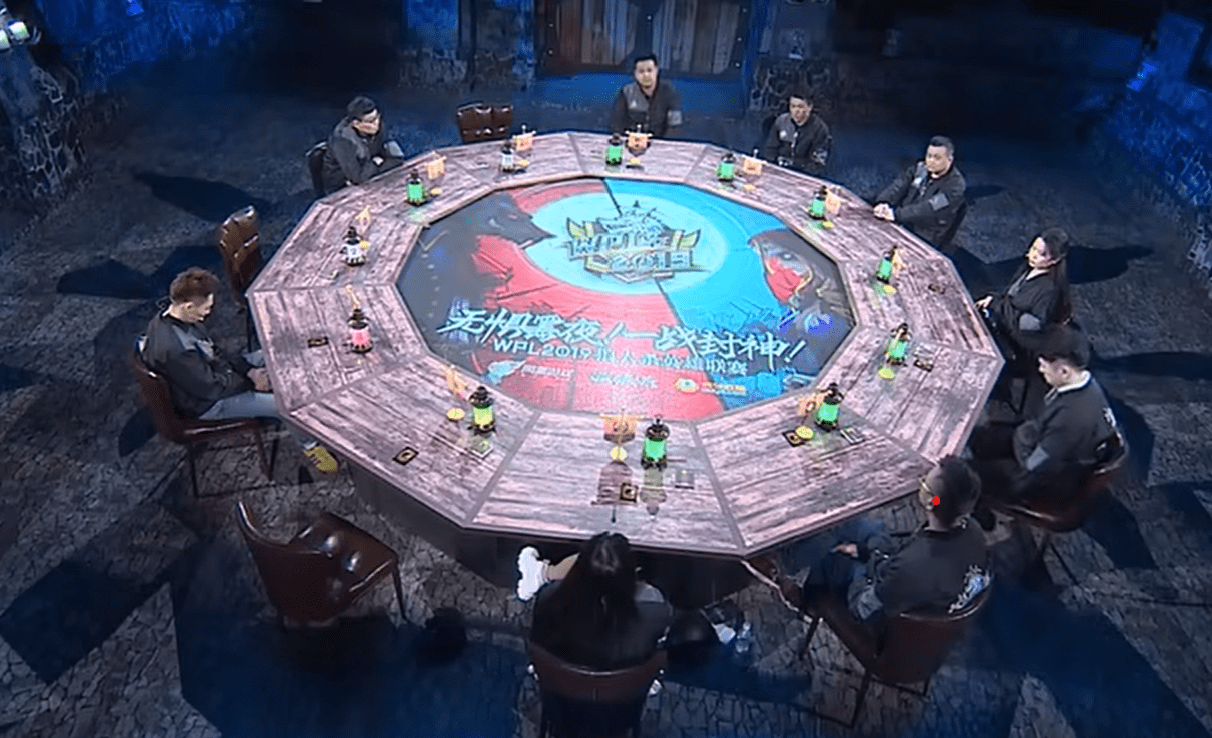
Figure: Group playing Werewolf
On Ethics
I have a friend who strongly resists lying in games, so he never plays Werewolf. However, he is fine with playing Avalon. I believe the difference lies in whether the lie is directed at “individuals” or the “system.”
In Werewolf, you often have to throw dirt at others, earning trust for yourself by framing specific people. When a player is a werewolf themselves, this process inherently involves a moral dilemma. However, in Avalon, the biggest difficulty in “lying” isn’t “how to pretend to be Good,” but “how to forget you are Evil.” My lies were completely objective deductions based on existing information, under the premise of “assuming I am not Evil.” Because this type of lying targets the “system” rather than “individuals,” my psychological burden was much lower.
As a “magic circle,” a social deduction game inherently contains the rule that “lying is permitted.” As long as the lies don’t bleed outside the circle (for example, using personal attacks to achieve in-game goals), it is legitimate. Of course, within the circle, the extent to which you deceive others also depends on your own choices (and you must be prepared to bear the risks). I am a player who enjoys games of deception, but I was once criticized by a friend after a game for a backstab in a war game. The betrayal during the game brought me great joy, but I felt very down afterward. Was that my problem, or my friend’s problem? Was it just “playing to win” or did I cross a line? I am still thinking about it.