


My brother David and I have been thinking about a hot pot game for years. We first had the idea at a family game jam a few years back, and every year after that when we came home for the holidays, we’d game jam again and dream up new ideas, but always found our way back to hot pot. We’d talk about what the pieces would look like, what fun diner cards could be, and how fun it would be to come back from a hot pot dinner and then play a hot pot game! For years we would leave after New Year’s saying, “We should make that hot pot game someday.” Coming into this quarter, I decided that this was gonna be that day.
Even then we had a clear vision: a table of people leaning over a shared pot, fishing for ingredients with chopsticks, racing to build colorful bowls of food. We wanted the game to feel like hot pot actually feels to us, a chaotic meal where you are not really, but also definitely really, fighting each other. In real life, hot pot is all about reaching into the same space, wanting the same things, waiting your turn, stealing the last piece of meat, laughing when something slips (probably those dang noodles) and somehow feeling more connected because of the messiness of it all. Part of why the idea stayed with me is because eating hot pot together has always felt like a kind of communion. Hot pot is all about the relationships around the table and the small ways people take care of each other, since everyone builds their own bowl from a shared pot. Even when it’s chaotic, the act of eating together becomes a way of being together.
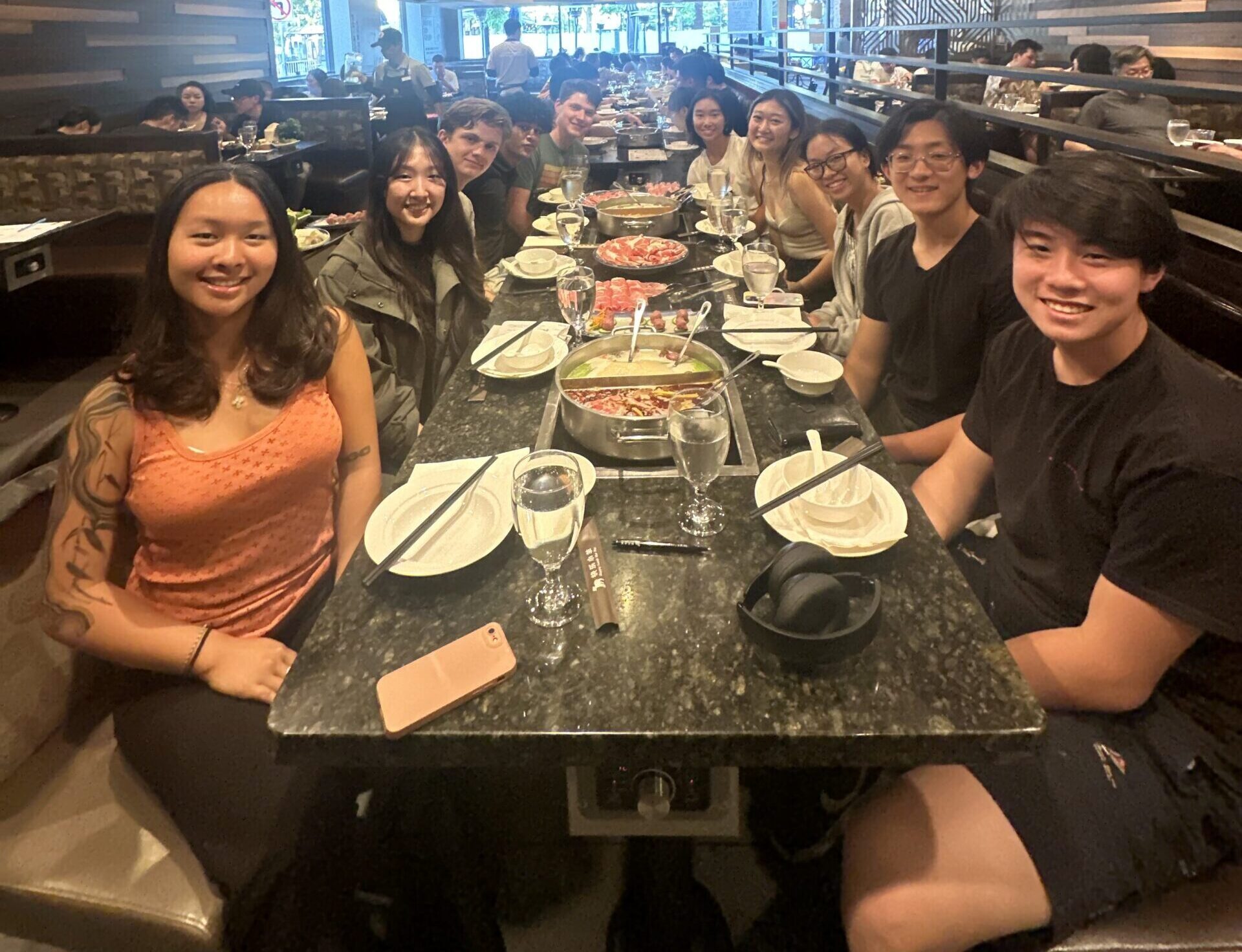
[Image from a surprise hotpot party back in 2023, for my first birthday at Stanford.]
Our hot pot game (name pending, we have placeholders but we don’t love any of them yet 😶) is a family and party puzzle-dexterity board game! You play as diners gathered around a pot in the center of the table, and within a very short amount of time, have to use chopsticks to grab ingredient pieces from the pot and place into a gridded bowl. The goal is to fill your bowl efficiently while satisfying soup bonuses and diner goals before the ingredients in the pot run out. In playtesting, we found the sweet spot to be ~30 minutes with 4 players, but the game also plays well with 3-5!
Our target audience has always been all ages and particularly families. We wanted to resemble real life hot pot in feeling “together” without being purely cooperative or purely competitive. I thought a lot about luck during this stage, especially because family games need some elements of luck to stay fun across ages and skill levels. In our game, luck comes from what ingredients are surfaced and visible. No one can guarantee they will get their perfect piece, even if it is in the pot. We also thought about the dexterity aspect carefully, as chopsticks can easily become a barrier for people with less experience. At the same time, we also did not want players to give up and switch to something easier like a spoon. So, we adjusted things like the timer length and encouraged house rules to make the challenge forgiving enough for beginners while still keeping chopsticks central to the game.
We also did some competitive analysis early on and looked at other puzzle and grid-coverage games like Patchwork for the puzzle and scoring aspect. We also looked at other hot pot games and what makes them fun and what they’re missing. Moreover, down the line in our playtesting process we found ideas from other games brought up, such as the idea of public bonuses from the nobles in Splendor and longest road in Catan, and those influenced some of our mechanics as well.

At first, I thought the central challenge of making this game happen would be turning the concept into a playable prototype. We needed pieces, boards, rules, goals, scoring systems, timers, and enough structure for people to understand what they were supposed to do. But over the course of the quarter, I realized that even with a solid core idea, there is so much tweaking needed to make an idea into a fully fleshed out game. We had to rewrite the rules and balance piece counts and goals SO many times. Each playtest, we would bring a version we thought was close, watch people make mistakes or assumptions within minutes, and leave with a long list of things to fix.
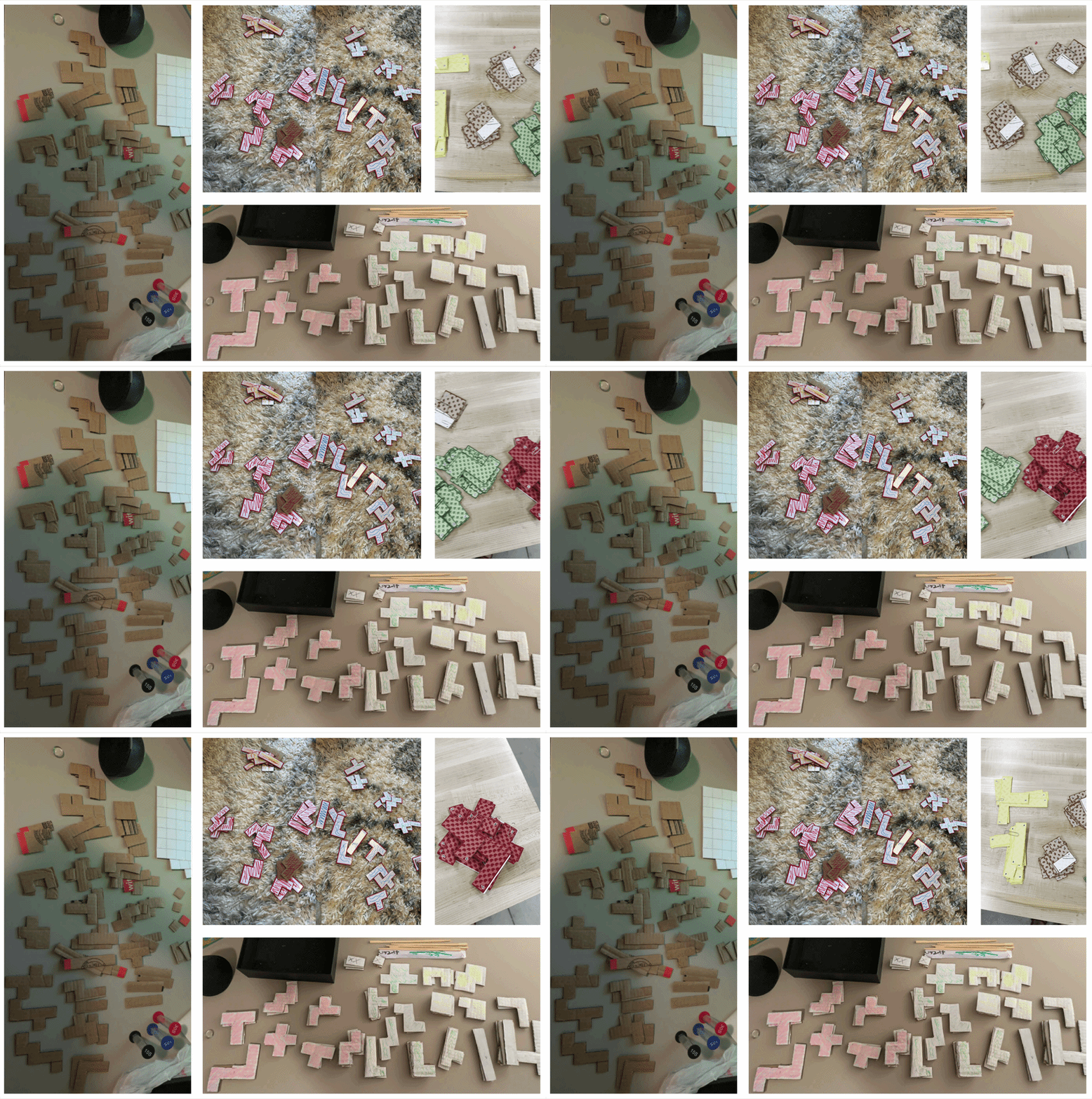
[Image of old playtest pieces.]
The earliest sessions were about getting the basic things right. We settled the timer at around 7.5 seconds, which felt fair to people with good and bad chopstick skills to keep it competitive. For ingredients, we had playtests with too few, and then too many ingredients, but we have now settled on a happy medium amount of ingredients and variety in their shapes and sizes.
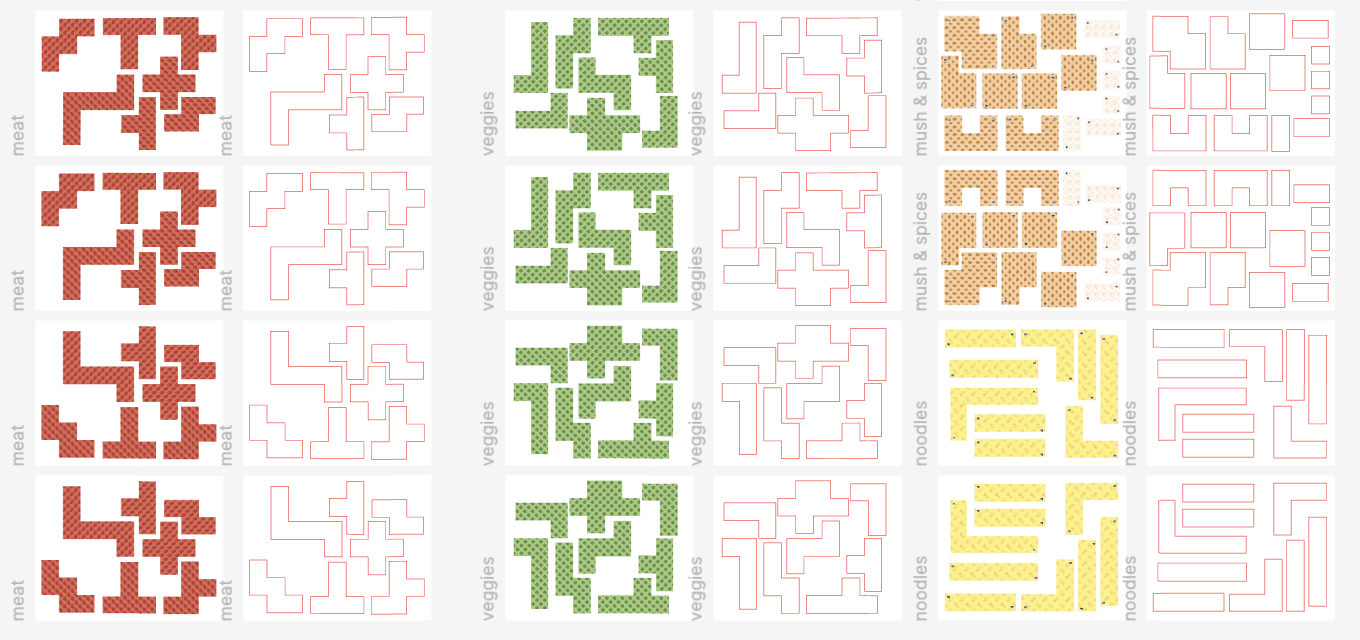
[Image of pieces for print & play.]
The scoring was a big source of balancing problems. At one point, big pieces kept going unused because players rationally prioritized small pieces that could fill the gaps in their bowls, which told us our scoring was rewarding the wrong behavior. Players also started grabbing spices early just to plug holes, even though spices were never meant to be a primary ingredient. We used the empty-square penalty to push back on people who chased only big pieces, but when we tried making each empty square cost three points instead of one, the game became too punishing. I already knew people are generally punishment-averse, but it is hard to balance certain things you want in the game without some punishment. For example, we spent a lot of time thinking about how to make fun diner cards that were also balanced. Ultimately, we had to keep them simple because it was too difficult to make sure people could get what they needed if their card was too specific or too weird. (RIP to the picky eater, who got -2 for every unique food on their plate.) We loved these kinds of ideas and will probably return to more balanced iterations of them with more time, but for now they were too difficult for playtesters to deal with fairly.
Overall, I’m really happy about the evolution of interaction that this game has had. For example, early playtesters mentioned feeling kind of solitary while playing the game, which is definitely not the feeling we were going for. Because of this, we implemented shared Soup Goals, which are public objectives that any player can go after. In one playtest, this goal forced people to go after all the mushrooms since the mushroom-adjacency bonus was so powerful. Suddenly everyone wanted the same pieces, and the table was more willing to fight for pieces in the 5-second rule. This was a small addition overall but had a really great impact on the flow of the game and made people interact more even when it’s not an inherently interactive mechanic.
Moreover, we also added the “Secret Menu,” inspired by Haidilao’s secret menu of goodies you can get if you say certain phrases in the restaurant. These are pattern-based powerups that players could claim by arranging their bowls a certain way. In theory, they would make players fight over certain pieces to build patterns, but in practice, players could barely track them while also physically scrambling for pieces under a timer, and they kept getting overshadowed by the chaos of grabbing. This made it seem like it was an unnecessary addition, but in a playtest we did with people who had played the game before, they were more familiar with the mechanics and one of them actually used the Yoink secret menu card to secure a win. From this, we realized that we shouldn’t really change the game entirely based on a group’s first play, and it’s actually repeat playtests that offer a better picture of how real players will interact with all the different pieces.
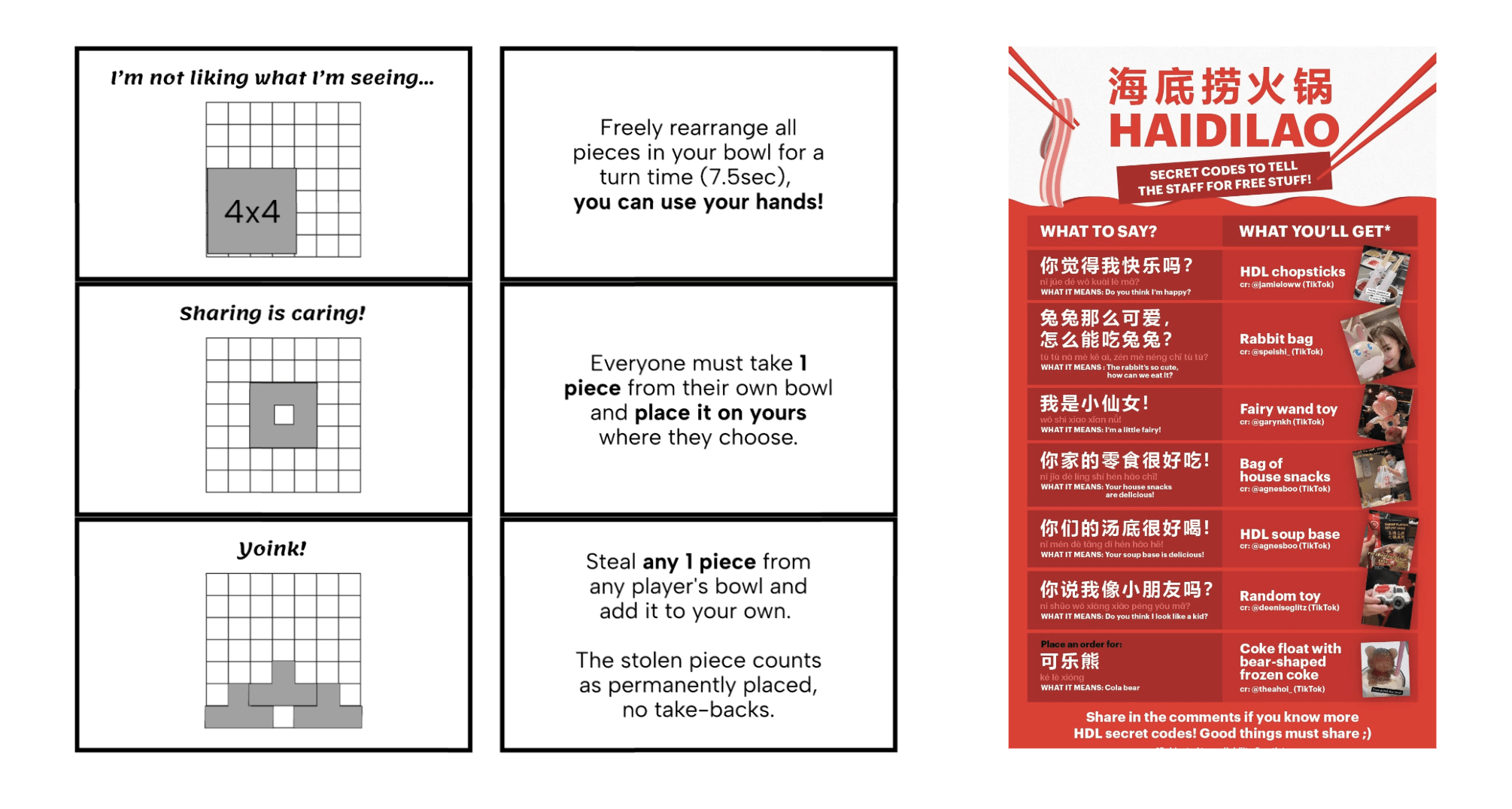
[ Image of secret menu cards and haidilao’s secret menu goodies ]
Some of the hardest lessons from playtesting had nothing to do with the rules themselves. The first was that it is really difficult to explain a playtest to someone who was not in the room. So much of what matters happens in small moments. I wrote these down in the notes but it doesn’t fully capture the feeling of the game. I started to understand why watching playtests and having a moderator matters so much. The feeling of a game is also an important thing to keep in mind, and can’t really be summarized for someone else through Zoom.
The second lesson was that good feedback can contradict itself. We had an interesting situation where most of my brother’s playtesters were friends around his age or people at local board game stores, while my playtesters were mostly college-aged. These are not outside our target audience by any means, but they were surprisingly very different from each other. Specifically, his playtesters tended to play the game as laid out, making assumptions about the rules that supported the playing experience. My playtesters, on the other hand, made assumptions about the rules that were game-breaking. With the same instruction sheet, my playtests were more chaotic and more likely to go against the spirit of what we intended, while his playtests went almost ideally. This made it difficult to adjust the instructions together, because we could not always agree on what needed to be clarified. My brother would sometimes say the table could decide for themselves, but clearly our tables were very different. In those moments, we had to decide very clearly what words to add that point more in the direction of the kind of game we want to make, who we want to design for, and what kind of fun we want people to have. One thing that this quarter emphasized is that feedback is not a to-do list. I learned that sometimes you have to sift through a lot of great feedback and focus on what players are not saying, to see what mechanics they’re responding well/badly to.
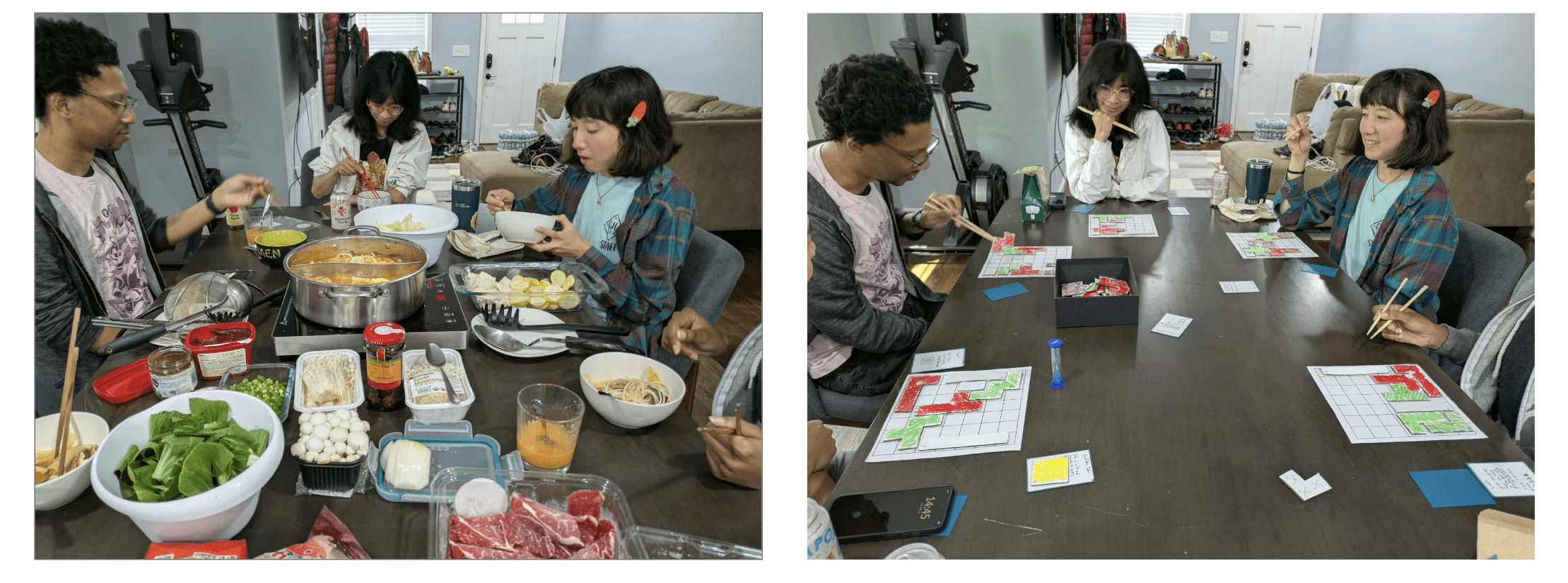
[ Image of playtesters having hotpot and then playing hotpot. 🤭]
I also kept noticing the gap between watching the game and playing it. From the outside, watching playtests felt repetitive and even a little boring to me. For example, it was mostly people counting quietly and watching the timer. But the players themselves kept saying they were having fun and that they were planning their turns in their head. It reminded me that a party game may not always be loud at every moment, and I’m not always the best judge of my own game from the outside.
I expected this project to go more like 247G, where we worked quickly and arrived at a prototype within ~3 weeks. Instead, this project moved slower in ways that frustrated me during the quarter, because it felt like I was not progressing as quickly. Now I understand why. First of all, one and a half people—my brother is half because he was helping from afar—are not the same as four people dedicating a full 15 hours a week to something. Second, I realized that 247G felt lower-stakes because it was primarily for a class and I was working in a group, so I was very willing to compromise on ideas and let the game take directions I had not necessarily envisioned myself. This time, I came into the project protective of the idea. My brother and I shared a clear picture of it, and even though I accepted things would change significantly with playtesting, I felt a need to defend that picture against everyone. For example, a lot of people wanted plastic pieces or 3D pieces with texture, but we had both already agreed that we wanted flat cardboard pieces for manufacturing and aesthetic reasons. This might have hurt us, to be honest, but at some point you do have to balance player input with your own vision. (To be fair, I did try a 3D version with polymer clay, but the pieces were so heavy and slow to make that it did not feel worth it. We also couldn’t see a way to make a mass produced game with such detailed textured pieces.)
Even so, some of my favorite parts of the game, like the 5-Second Rule that lets another player claim a dropped piece, came from suggestions. I personally love the 5-Second Rule because it feels so true to actual meals. In play, people drop things and everyone swoops in to take it and come away laughing from the mistake. Players always seemed to love doing it and it makes the initial mistake feel less serious and punishing.

Looking back, I also think we spent a little too long trying to make the rules perfect. We were always meeting about the rules and spending hours talking over small wording changes. While it was a very rewarding experience to work on this game with my brother, it does change how it feels to build. Working with someone who shares your references and your instincts lets you move quickly, but it also means you can reinforce each other’s blind spots, including the protectiveness I described earlier. When two people already agree about what the game should be, there is no one else there to disagree. We kind of treated the rulebook as the thing to optimize, when some of the most promising directions, like giving the ingredients physical texture, were about feel rather than the rules. I think I under-invested in those directions and realize now that I gravitate toward solvable problems, like exact piece counts and scoring formulas, and away from fuzzier ones, like texture of pieces, even when those might matter more to the fun of the game. I don’t regret the time we spent, because the game in its current state really is fun, but next time, I want to be more honest with myself about which problems I’m avoiding because they are genuinely lower priority and which ones I’m avoiding because they’re harder to measure progress on. Ultimately, the version of this game we ended with is far more fun, fleshed out, and comprehensive than the version we walked in with, and it is better precisely because we let other people in iterate alongside us. I think believing in your concept is important, but openness to new ideas is absolutely also needed, and knowing when to switch between the two is a skill I am still building.
A surprising amount of the feedback was not about mechanics at all, but about legibility and prototype fidelity. I usually think of low-fidelity prototypes as a way to avoid getting too precious too early, and that was true for us in some ways. But this project also taught me that sometimes the fidelity of the prototype really does matter, especially when the game is physical. Players had trouble because the hot pot box was too small, so they could not always see or reach the pieces in the way we imagined. The pieces were too thin, which made them harder to grab cleanly with chopsticks and changed the difficulty of the game. Since our ingredient pieces had art on only one side, players were hesitant to flip them over and use the blank side, which changes how the whole game is played. And when the instructions did not include enough clear pictures, people interpreted words like “adjacent,” “overlapping,” and “valid placement” in completely different ways. This changed how I thought about visual design, as I realized that all these small differences from the overall vision influenced our playtests. For this game, whether the pieces are colored on both sides is a rule. The size of the pot is a rule.
All of those things shape what players believe they are allowed to do and what the game feels like in their hands. I came in thinking visual design meant the art of the game and the pieces, but a lot of it was needed to make the rules we already had in mind visible so that first time players could actually play the game we thought we had designed.
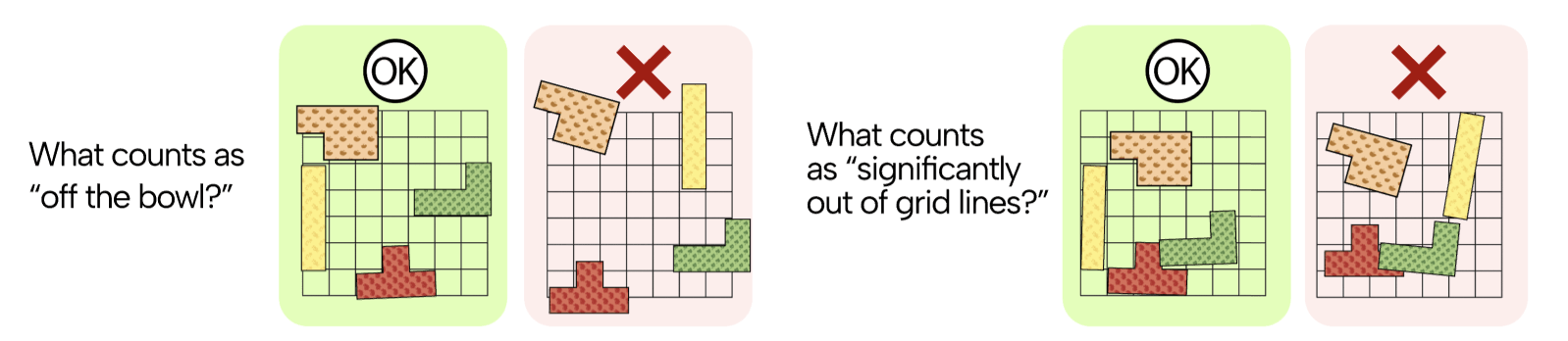
[ Updated rules pamphlet with clear rulings on pieces. ]
One thing of note is that we did not make it to packaging. I spent a lot of time on polished art that we didn’t end up using in our final prototype, mostly because I was kind of debating whether it was necessary. So I’ve heard, a demo does not need to be fully polished and packaged to prove that the game works, so most of our main effort went into playtests this quarter. I have mostly made my peace with that. Still, part of me wishes we had gotten there, because Hot Pot is such a material, visual, tactile game. Like I mentioned earlier, I think packaging is not just polish for a game like this but part of what will make people want to grab it off the shelf and play. I have so many ideas about it but didn’t want to get ahead of myself and waste time that could go into fixing up the rules or the polish of the instructions booklet. Going forward, I do want to focus on whatever it takes for a successful demo rather than get too caught up on those details that can get ironed out later.
On top of playtesting and iterating on the rules, it was very much slow work making the physical thing real: cutting ingredient pieces, sourcing components (the right bowls, chopsticks that don’t snap in half), and experimenting with materials. Since laser-cutting cardboard wasn’t an option (or so I thought until week 9 🙁), we ended up cutting pieces by hand with scissors, which was much harder than I expected. I also felt hesitant about putting a messy prototype in front of players, because I worried it would distract from what I wanted them to focus on, which was the grid patterns. That’s why I only made two cardboard prototypes before switching to stickers. What ended up helping most was reaching out to people who knew more than we did. I learned how to print stickers in the Makerspace, prepared CAD files for the first time, and even talked to someone from a cardboard company (yeah those exist and it’s their job to just test cardboard ?!) about what types of board that might work better in the future. Those conversations became one of the most unexpected and rewarding parts of the project.
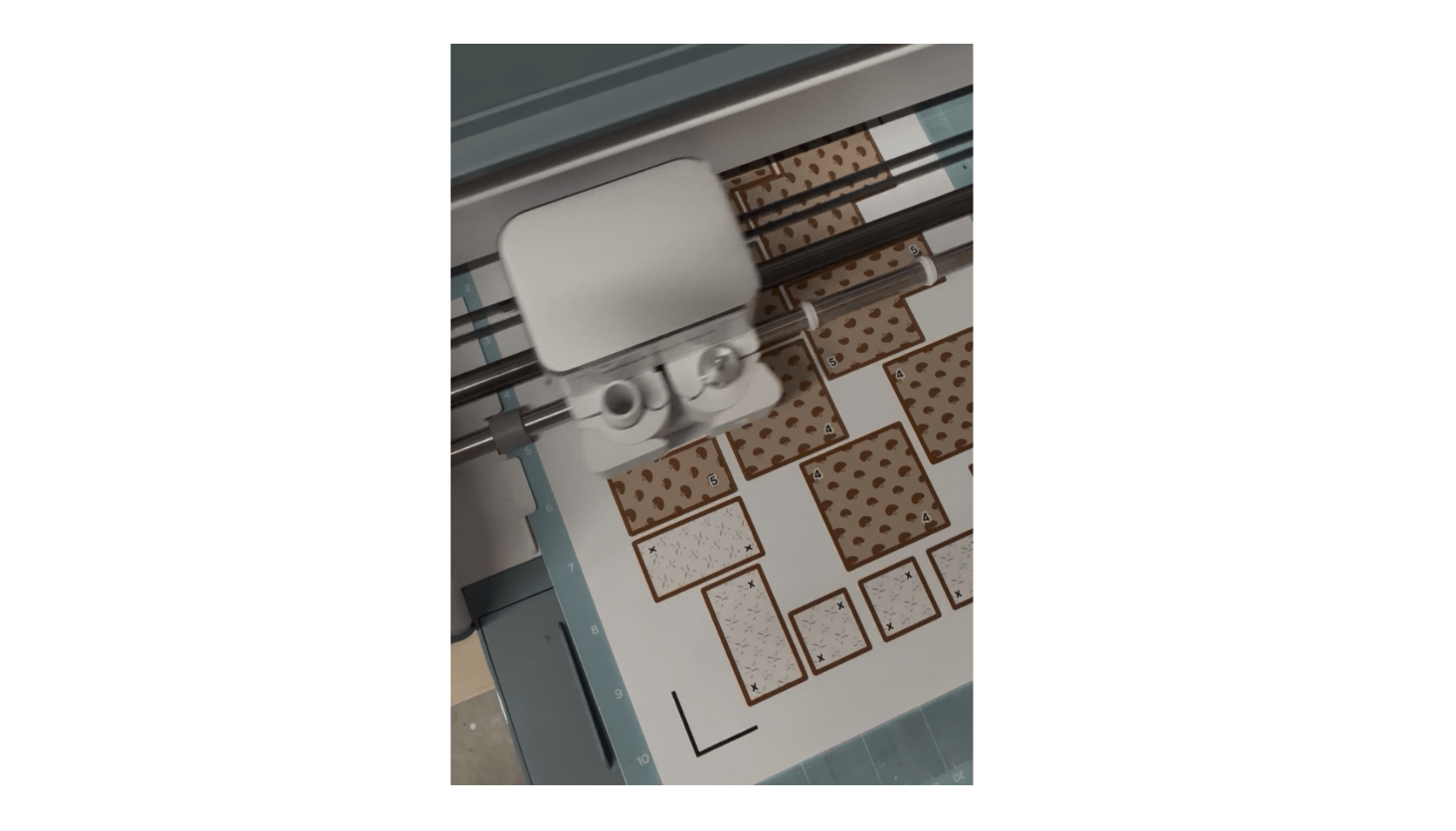
[Image of sticker printing with the cricut for the first time.]
Ultimately, I am so appreciative of this independent study for pushing my brother and me to bring this game to fruition. It feels like a full circle moment to end my undergrad career with a game that I’ve been thinking about for such a long time, especially since, in my first reflection for 247G, I wrote about how much my brothers have shaped my relationship with games and why I play them in the first place. I’m grateful to have had the opportunity to return to my roots in a way and work on this with my brother this quarter, because at the end of the day, games bringing people together is what it’s all about!

[face reveal of my brother :D]
–
Thank you to everyone in independent study this quarter who offered helpful feedback getting the game to this state, especially Christina, Butch, Ngoc, and Leo for playtesting! Thank you to all of our other playtesters who gave their time and suggestions. Special thank you to Amaru for being color deficient and awesome for giving incredibly helpful design feedback to help hotpot stay accessible. Also special thank you to the Video Game Development Club and Lucas especially for making demo day happen and helping us get supplies!
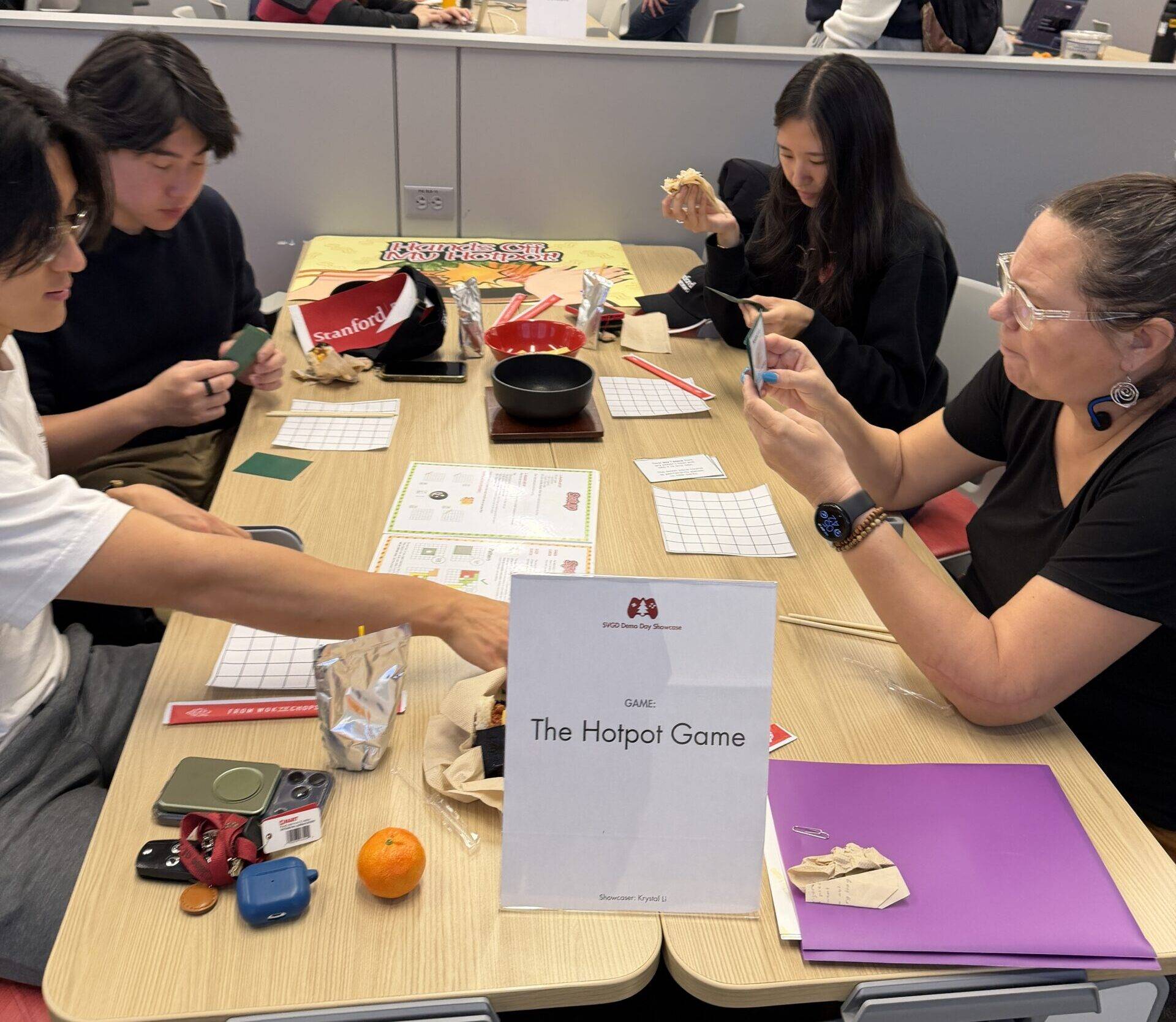
[ Image of demo day playtest. ]


Wonderful, very thoughtful (and thought provoking) write up. Congrats on making the game happen!