Artist’s Statement
The Letter is a 2D pixel-art vertical slice of a larger narrative game about depression, grounding, and reaching out for help. I chose this because it allowed me to focus on a smaller environmental storytelling with focus on added detail, and realistic conversations people with depression may have. The player begins outside their house, tries to walk to a mailbox, gets pulled back by the fog, sits on a bench to ground themselves, passes through a difficult thought, and finally sends a letter asking for help. It’s a game on how depression can make a simple task feel impossible, yet the road is covered in fog (a symbolism of the foggy mind, numbness of emotions) , the player moves slowly (the inability to perceive oneself as strong/capable), and trying to rush forward causes the world to loop back (it exhausts the depressive mind and you begin anew).
The game is not about getting rid of depression. My focus was to communicate through a mailbox the struggles many out there undergo, and the grounding technique necessary of even stopping for a brief moment to relax, to be able to complete this simple task. I hoped for a quiet, melancholic, but hopeful experience, where the fog remained to demonstrate the ongoing battle of the mind.
Core Mechanic
The main mechanic is a fog loop. If the player tries to walk straight to the mailbox before grounding themselves, the screen fades and they return near the house. This creates a feeling of rumination where there is movement but no progress
The bench breaks the loop. When the player sits down, the game slows down and gives them a moment of grounding. After that, the player can move farther down the road, pass the streetlamp, and eventually reach the mailbox.
System Model
Start: the player receives the letter and sees the mailbox in the distance.
Ungrounded: the player can walk, but trying to continue too far causes the road to loop.
Grounded: after sitting on the bench, the fog lightens and the first loop is disabled.
Thought Encountered: near the streetlamp, the player experiences a depressive thought sequence.
Ready to Send: the player can now interact with the mailbox and send the letter.
The player’s progress is not based on collecting items or defeating enemies. It is based on changing emotional state.
MDA
Mechanics: walking, interacting, sitting on the bench, looping back, fading to black, triggering dialogue, and sending the letter.
Dynamics: hesitation, repetition, frustration, noticing the environment
Aesthetics: loneliness, heaviness
You shouldn’t feel powerful like the solo-leveling games, rather you should feel the difficulty in a small task. The intended type of fun is discovery and emotional resonance, not challenge or mastery.
Level and Puzzle Design
The level is one street. The house is the starting point, the bench is the grounding point, the streetlamp is the emotional confrontation point, and the mailbox is the final goal.
The puzzle is simple: walking straight forward does not work. The player has to understand that progress requires stopping first. This makes the bench meaningful instead of decorative. Sitting down becomes the key that changes the state of the world.
The space is designed to communicate the story without needing much explanation. The house feels safe but stuck. The road feels long and unclear. The bench gives the player a pause. The streetlamp creates a moment of exposure. The mailbox becomes the destination and symbol of asking for help.
Narrative Architecture
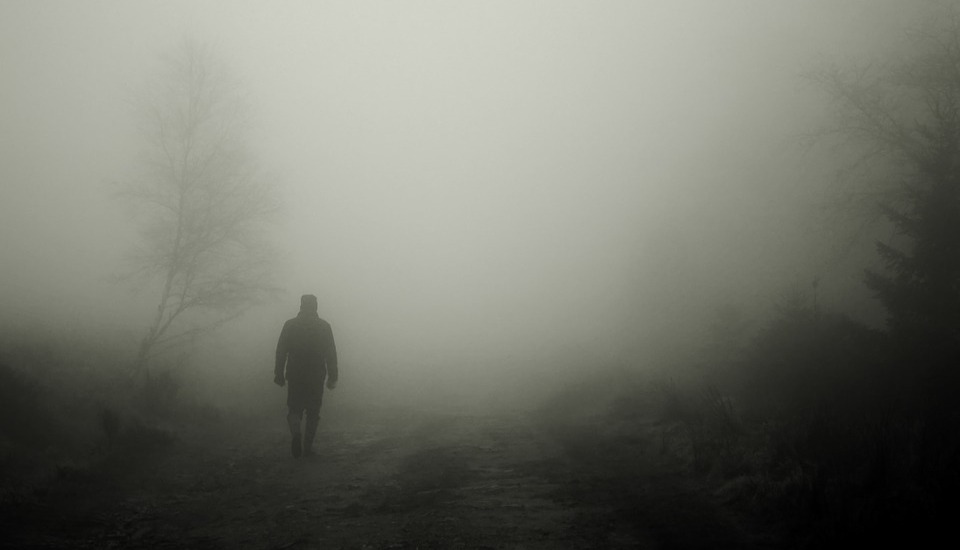
Most of the story is told through the environment. The fog limits visibility. The rain slows the mood. The warm lights from the house and streetlamp contrast with the dark blue-gray world. The mailbox is visible but distant, reminding the player that help is close but still hard to reach.
The dialogue is written as internal thought rather than exposition. Early lines are short and repetitive:
“I’m back here again.”
“I keep walking.
It doesn’t feel like I’m getting anywhere.”
The bench dialogue becomes more honest:
“It’s just a letter.
It’s just a mailbox.”
“Maybe I don’t need the right words.”
“I need help.”
The ending stays intentionally small:
“Not better.”
“But not alone with it.”
Iteration
The project originally began as a larger idea with multiple scenes, but I reduced it to a single scene that was more detailed, making everything more manageable.
Another major iteration was the dialogue. Early versions were poetic, but not usually what people would say. I revised them to be more self-critical give the psychology/contemplative classes I’ve taken, thus some of the borrowed language is inspired from such courses. Over the scene construction, I moved varying trees around, changed the vantage point, and tweaked player movement.
What I Would Add in a Full Release
If expanded, Fog Walk could include more one-scene emotional spaces: a bedroom to demonstrate how difficult it truly is for some individuals with depression to wake up, and would hope to include more contemplative practices including breathing. The core design would stay the same on the topic of depression.