

What Games Teach Us About Loneliness
My little bug employees had been working all day. By the time I got home from school, the clothes were finished: little fairy dresses, stitched by friendly insects while I sat through second grade. This was Disney Fairies Fashion Boutique. Nothing in the game paused when I put it down. The bugs kept sewing, the customers kept arriving, and the shop kept its tiny lights on without me. Every afternoon, I returned to a world that had continued in my absence and had, in some small way, been waiting for me.
I played many games like this growing up. In Fashion Story, I arranged furniture, stocked racks, and waited for friends to visit and leave heart ratings on my boutique. In Dragon City, I bred new species and designed habitats with the serious care of a child curating a museum of pretty dragons. These games did not ask very much from me. They asked me to enter for a while, make a few choices, leave, and trust that time would keep moving in the background. What I could not explain then was how satisfying that rhythm felt. The world had registered my absence. The world was ready for me now.
Looking back, I think I was looking for a place where presence among others felt easy. Games have always quietly attracted people who needed somewhere to be. You can see this in the way children colonize Roblox not always to play a particular game, but to hang out in one: wandering around, dressing up, telling jokes, doing nothing in particular with other people. You can see it in how people return to Animal Crossing, Minecraft, or any game where a small world waits for them. These games do not announce themselves as remedies for loneliness, but they just happen to be full of worlds that notice you.
This is where the issue becomes more complicated. We are, depending on who you ask, living through a loneliness epidemic–more connected than any generation in history and somehow more alone. The obvious answer has always seemed to be more connection. More people. If loneliness is an absence, fill it. And yet anyone who has sat in a lobby of strangers in an online game, surrounded by a hundred other players moving through the same world without once registering that you exist, knows that feeling a sense of connection does not work that simply. You can be extraordinarily surrounded and still feel the specific loneliness of being in a crowd that is not with you.
Bokura Planet, a game about two alien children trying to communicate across a language barrier, is one of the most frustratingly lonely experiences I have had in front of a screen, and it is explicitly about two people working together. Meanwhile, Animal Crossing, which millions of people played through the pandemic, is primarily a single-player experience and yet remains one of the most companionable worlds ever designed. None of this makes sense if loneliness is simply a population problem. Something else is happening in the design of these worlds: in how they handle presence, response, and memory.
Games make connections possible when they specifically design for forms of recognition. Loneliness begins when that recognition fails, when another consciousness–a player, a character, a voice, or even the trace of one–feels unreachable.
On Loneliness
Before getting to games, it’s useful to define loneliness more carefully. Experts broadly agree that loneliness has become a serious social and public health concern. In 2023, the U.S. Surgeon General issued the advisory “Our Epidemic of Loneliness and Isolation,” arguing that chronic disconnection can harm the body at a level comparable to smoking up to fifteen cigarettes a day. Vivek Murthy, who wrote both the government advisory and the book “Together,” treats loneliness not as a private weakness but as a public health emergency. Many of us have also heard that “third spaces are dying,” but what does that really mean? A third space is not simply a coffee shop or a park, but an ordinary social environment outside of home and work where people can become familiar with one another without needing a formal reason to meet. Robert Putnam had already been sounding this alarm in “Bowling Alone,” where he argues that the leagues, lodges, and clubs that once stitched Americans to one another had quietly come apart, leaving us to bowl, as the title suggests, alone. In this framing, loneliness becomes a crisis of infrastructure: fewer shared places, fewer shared rituals, and fewer ordinary excuses to be around other people.
But infrastructure is only part of the story. Loneliness is not only what happens when social life disappears around us. It is also what happens when social life is technically present but fails to reach us. John Cacioppo, who spent much of his career studying the neuroscience of loneliness, found that loneliness has little to do with the sheer number of people surrounding a person. It is instead the gap between the connection one has and the connection one wants: perceived isolation, which can be more damaging than the literal kind. Olivia Laing arrives at a similar place in “The Lonely City,” a book that explores urban loneliness through the lives of artists such as Andy Warhol. For Laing, loneliness is not cured by company alone, but by the sense of being seen. What the lonely person wants is not simply more bodies nearby, but the feeling that their inner life is legible to someone else: that another mind is capable of reaching their own. This is the definition of loneliness I want to hold onto because it explains what games can do especially well, and what they can also fail at.
If we return to games with this definition in mind, the question shifts. Instead of asking whether games put people together, we can ask what makes a player believe they are being noticed. Is it dialogue? Is it memory? Is it the sense that another player has made a choice in response to you? Conversely, what makes a player feel abandoned? Is it silence? Is it the inability to communicate? These questions matter because so much contemporary technology mistakes contact for connection.
Sherry Turkle’s “Alone Together” names this problem directly: networked technologies often offer the illusion of companionship without the demands of friendship. This raises an unfortunate problem in modern social life: we are more reachable than ever, but not necessarily more present to one another. For example, A like, tag, or notification can prove that someone interacted with us without proving that anyone really saw us.
Games inherit this contradiction. They can put people near each other without making them matter to each other. They can also, strangely, make fictional or half-fictional presences feel meaningful. That does not mean games replace friendship or that an NPC is equivalent to a person. But it means that games are unusually good at revealing the small mechanics through which true recognition is built: repetition, memory, response, shared ritual, and the fragile belief that some other mind has noticed us back.
The Problem with Multiplayer
At first, it seems that the most obvious answer to this problem of loneliness in a game setting would be multiplayer. With multiplayer games, you can join massive lobbies and interact with tens to hundreds of other players. However, given our new understanding of loneliness as an unreachable connection, we know this is not necessarily going to be a perfect solution. Not all multiplayer games promote player interaction in beneficial ways. For example, playing couch co-op games with someone beside you is not quite the same as wandering through an anonymous lobby in Among Us; the first offers shared presence, the second merely offers shared space.
The reality is, some multiplayer games intensify loneliness rather than relieve it, often by keeping connection just out of reach. For example, consider a game like Bokura Planet. You are playing this game with another person, relying on their presence to progress. You know that they’re always nearby, but during puzzles, your screen frequently splits off, and the game doesn’t really offer a way to meaningfully interact beyond frustratingly working towards puzzle solving.
In some ways, this is more painful than playing a single-player game where you know you can’t interact with anyone and aren’t expecting to. When I play a two-player game, I expect to strengthen communication and find new ways to understand each other. In the case of this game, it can be deeply frustrating when that expectation is not met, and all of its mechanics serve to emphasize the gap between being present and truly reaching one another. The other person is right there, their understanding matters, your progress depends on them, yet you can’t share any of your story scenes and can’t even physically see what they are working on. I appreciate Nagel’s argument from “What Is It Like to Be a Bat?” here, specifically the point that another consciousness can never be fully understood from the outside. Bokura Planet turns that distance into gameplay. You are not wondering whether the other player exists; you are constantly reminded they do. Their perspective, however, remains partly sealed off. You infer, guess, misread, wait, try again. The loneliness comes not from being alone but from needing someone whose inner world you cannot quite access.
Similarly, Don’t Starve Together presents another version of loneliness than can happen in a game. Unlike Bokura Planet, it does not center on miscommunication as a theme. It is a game built for company. You and your friends spawn into a hostile wilderness and survive by dividing labor: someone forages for food, someone fights monsters, someone keeps the fire fed against the dark, and so on. On paper, it should be one of the warmest premises imaginable. A small group of people depends on one another to make it through the night. Yet it can feel isolating in a different way than single-player games: the wordless efficiency of it, a teammate stepping over your skeleton body to grab loot, three people looking at different screens without much communication passing between them, not logistics. There is a specific loneliness in dying beside people who are technically your teammates. Your ghost hovers near the campfire. Everyone can see you. Everyone knows you are there. But the game’s needs keep moving: the fire is low, the food is spoiling, winter is coming, someone needs to mine stone. Your death becomes one more task in the queue. Should someone revive you now? Is it worth the resources? You are not ignored because your friends do not care about you. You are ignored because the game has made care and survival compete. The coldness here is, of course, key to the game. The survival loop makes you see the other players as either tools for building camp or potential liabilities to your survival. The game gives you many ways to use another player and few ways to meaningfully interact with each other. Unless you install mods, you cannot even find each other on the map easily. When one person is crossing a massive sea for a solo island hopping experience, there’s not a lot of feeling like we’re in this together. Emotionally, they may as well be playing alone since their experiences are so different. As a result, the world of a game can have people, even your own friends, and still leave the player profoundly lonely.
So does this mean all multiplayer games make people lonely? Of course not. Watch a child on Roblox and the picture changes immediately. Millions of players enter these worlds not because every game is beautifully made, but because the worlds offer a place to be near other people. Half the time, they are not playing so much as loitering about lobbies, doing mini-games to collect gems and coins, emoting, and drifting through digital space with the casual intimacy of kids at a mall. Minecraft works similarly, though often more quietly. Its multiplayer is not just social when players are standing beside each other, and in fact, sometimes it is most social when the other player is absent. For example, a half-built house or item labeled with a joke. These small details say, someone was here, someone thought about the next person, and altered the world in a way another person would later encounter.
This is why successful social game spaces often resemble third spaces more than traditional games. They provide shared rituals, low-stakes repetition, and room for non-instrumental presence. In these spaces, people can simply be there with you. That distinction is the difference between contact and company. A lobby gives you bodies. A third space gives those bodies time to become familiar.
In this way, games can help combat Marc Dunkelman’s idea of the disappearing “middle ring” of social life, where people who are not intimate friends or total strangers, but familiar near-strangers, the people one simply lives beside, recognize, and are recognized by. Digital spaces can sometimes recreate that middle ring, though unevenly. A Minecraft server, a Roblox hangout, or an Animal Crossing island visit can give players ordinary excuses to be around one another without the pressure of performing deep intimacy. That does not make these spaces automatically good. They can be toxic, shallow, commercialized, and exclusionary. But at their best, they understand something many social platforms forget: connection is not only made through disclosure. Sometimes it is made through repeated, low-pressure presence.
This opens up a stranger possibility. If a server packed with people can leave a player cold, then the reverse should also be true: the most companionable place one visits all week might have no other players in it at all.
The Single-Player Case
Single-player games are often imagined as solitary by default. The phrase “single-player” itself adds emphasis to the point. And yet, many single-player games are better understood not as lonely spaces, but as carefully designed systems of response. They create the sensation that a world has noticed the player, remembered them, and made room for their return.
Animal Crossing is perhaps the clearest example. In it, players can find escape from the stresses of the world with gentle mechanics. The player fishes, gardens, decorates, and speaks to neighbors whose problems rarely rise above lost items. Nothing about this should feel profound. And yet the game is built around the intimate power of being expected. Villagers greet you by name. They comment when you have been gone. Weeds grow, and mail arrives. These small details are what help make the game companionable. Animal Crossing does not simulate connection through intensity. It simulates it through continuity. Its neighbors are not deep, but they are dependable, attentive, and routine. They create the feeling of familiar near-strangers, the middle ring of social life that Dunkelman argues has been disappearing. Animal Crossing turns that lost middle ring into a game structure.
Of course, this is not the same as being known by a real person. A villager in Animal Crossing is not conscious in the way another player in Journey is conscious. But games are emotionally strange because scripted attention can still matter. An NPC can’t truly know you, but they can be designed to respond to you, remember your absence, and create the feeling that your presence matters somewhere. That feeling is not the same as friendship in the real world, but it is not nothing either.
The fact that a designed world can feel companionable reveals how much loneliness depends not on the literal presence of humans, but on the experience of meaningful response. A clearer example of this comes with A Short Hike, an adventure game where you travel around as a bird, meeting people and completing tasks as you hike to the top of a mountain. A short Hike is able to create a world where moments of solitude are the focal point. As you play, there is a sense of wandering that brings peace. And as you play, you encounter other characters along the way: a runner, a painter, someone who needs help, someone who simply has something odd to say. These interactions are brief, but they change the emotional texture of the island. The world is gently populated, and the people you bump into mainly just give you fun side quests, they don’t talk with you that meaningfully. And yet, A Short Hike creates feelings of wonder and adventure despite being alone. It emphasizes how Lonely is not the same thing as being alone. Being alone can be restful, even luxurious, when the world around you feels responsive. Being lonely is different: it is the gap between wanting connection and not getting it. A Short Hike avoids that coldness by making the island and the connection to other characters feel accessible. Moreover, A Short Hike does something even more special, as it feels like a game made by someone who cares a lot about the player’s experience. Knowing that players typically want to optimize their play and progress as quickly as possible, the developer uses those habits against us. For example, coins sit in places that lead you to appreciate a beautiful view. Feathers make you curious about routes you wouldn’t otherwise take. The game gives you little signs of progress, but mostly to guide you toward experiences that are not really about progress at all. The catered nature of your paths in A Short Hike exemplifies the care the developer put into the game. As a player, you can feel their influence on all of the small environmental details. This care is what helps A Short Hike not feel lonely when the player is technically alone.
Ian Bogost’s argument in “How to Talk About Videogames” helps clarify why this matters as design. Games do not mean only what they say; they mean what they make us do. Thus, the social feeling of these games does not come only from their stories but from their routines. Animal Crossing prompts you to check in, while A Short Hike makes you wander. One world remembers your absence, while another gives you small encounters as you move through it. In both cases, connection is not just represented but enacted through play.
It’s worth noting that this kind of designed recognition is difficult to balance. The line between being expected and being summoned is thin. Particularly, to be expected is to feel that a world has made room for your return. In contrast, to be summoned is to feel that a world has placed a claim on you. Games that allow players to feel seen understand the difference.
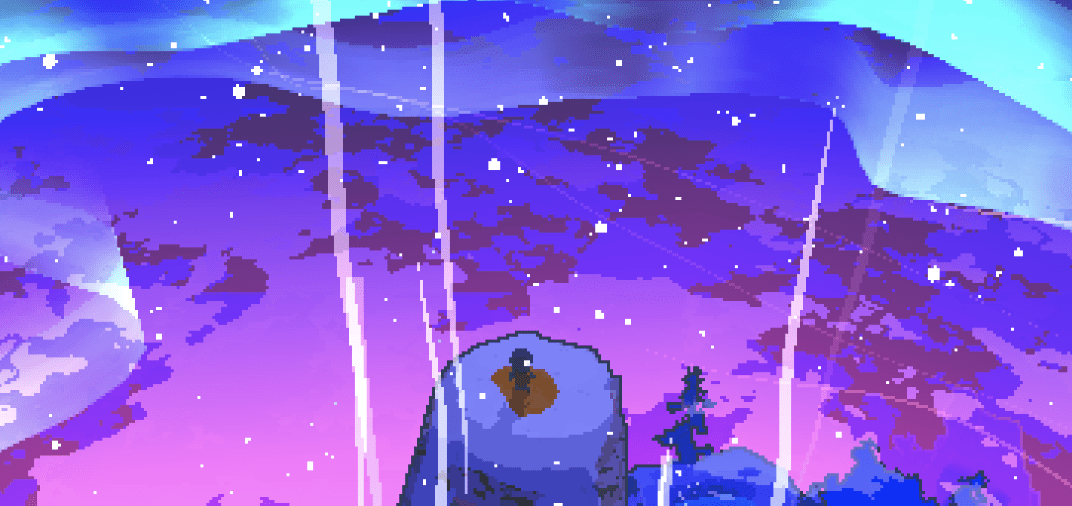
Journey illustrates this balance beautifully because it sits somewhere between the previous examples. In the game, you move through a vast desert as a single player until, suddenly, you are not alone. Another robed figure appears. No visible name, no profile, no chat box, no voice. They can only move, jump, and chime. You do not know who they are or where they are from or whether they are trying to help you, follow you, or simply finish the game on their own.
And yet the encounter can feel startlingly intimate. Not despite the limits of communication, but because of them. Most online multiplayer games give players an identity before they give them presence. Journey withholds almost all of that. The other player is encountered first as movement: waiting at the edge of a platform, circling back when you fall behind, walking beside you through the snow. The relationship cannot be consumed as a bio or profile, but has to be read through attention to their behavior.
The game gives players just enough to become meaningful to one another: proximity, vulnerability, shared direction, and a small sound that says I am here. The chime is barely language, but it becomes expressive anyway. A quick chirp can mean follow me. A repeated call can mean to wait. You can’t mistake them for an NPC because they move randomly like a real player. The snow section near the end makes this especially clear. Progress is slow and the wind pushes against you, your scarf loses its energy, and the mountain becomes almost hostile. If another player is with you, the two of you stumble forward together, hiding behind stones, sometimes waiting because leaving the other behind would feel wrong even though the game does not require loyalty. Nothing in the interface forces you to care about this person, but that feeling comes from the fact that they are there, suffering through the same designed difficulty, responding to the same wind.
Multiplayer fails when it gives us people without recognition. Single-player succeeds when it gives us response without people. Journey does something even more interesting: it gives us another person, then removes almost everything except their presence. The result is probably too brief and anonymous to call friendship or community, but it still matters. It shows that meaningful social connections in games do not require crowded servers, constant chat, or endless disclosure. Sometimes it only requires a world carefully designed so that one player can notice another, and choose not to move on.
What does this all mean?
Ultimately, games help shed light on the problem of loneliness by showing that connection is not a simple matter of people and proximity. More people do not automatically produce more intimacy, and more communication channels do not automatically produce more connection. A player can be surrounded by avatars and feel invisible, or sit alone with a console and actually feel accompanied. Games make this visible because they are built systems: they show us the design choices underneath social feeling, and how small changes can turn mere presence into company.
This matters because the loneliness epidemic is, at the root, partly an infrastructure problem. Third spaces are closing, middle rings are thinning, and the ordinary excuses people once had to be near one another are going away. Games can’t fully replace the difficult work of knowing and being known by real people. But at their best, they can approximate something of what those spaces offered: shared time, low-stakes interactions, and the feeling of being expected somewhere. The worlds that do this well are not necessarily the most ambitious ones, but rather those that understand presence as a relationship between action and response and design accordingly.
As a kid, I knew the little bug employees in Disney Fairies Fashion Boutique were not “real” friends. But they taught me something about why a small game world can feel less lonely without ever interacting with a real person. They eagerly awaited my return to the shop, signaling in small ways that they noticed I had been gone. Games can’t cure the loneliness epidemic on their own, but they can help us understand what connection feels like at the level of design: that being with others requires more than shared space. It requires response, memory, attention, and the sense that some other mind has noticed you back.

That was gorgeous. It should be submitted somehwere. Killscreen? Game Studies Magazine? I don’t know, but it was just lovely.