Skip to content
The Mechanics of Magic

The Mechanics of Magic

Game Design Writings by Students at Stanford taking 247G and 377G

  • Library
    • CS247G Community Game Design Resources
    • Game Design Resources
    • Graphic Design for Game Designers
    • Graphic Design Resources
    • Chapter 11 from Game Balance
  • Read Write Play
    • Hollow Knight: RWP 4 2023
    • Mystic Messenger: RWP 6 2023
    • Undertale: RWP 3 2023
    • What Remains of Edith Finch: RWP 5 2023
    • Catan: RWP1 2023
    • 80 Days: RWP 2 2023
  • 247G Syllabus
    • The Formal Elements of Game Design
    • Design for Play | Week One | Lecture A
    • Design for Play | Week One | Lecture B
    • Design for Play | Week Two | Lecture A
    • Design for Play | Week Two | Lecture B
    • Design for Play | Week Three | Lecture A
    • Design for Play | Week Three | Lecture B
    • Design For Play | Week Four | Section A
    • Design For Play | Week Four | Section B
    • Design for Play | Week Five | Class A
    • Design for Play | Week 5 | Class B
    • Design for Play | Week 6 | Class A (no class)
    • Design for Play | Week 6 | Class B
    • Design for Play | Week 7 | Class A
    • Design for Play | Week 7 | Class B
    • Design for Play | Week 8 | Class A
    • Design for Play | Week 8 | Lecture B
  • Serious Play Study Group Overview
    • Study Group Week by Week Breakdown
      • Formal Elements of Games
      • Final Reflection Essay
    • [Optional Material] What is fun?
    • Project 1: Those Who Play, Teach
      • READING Visual Design of Board Games
      • Pitch Your Teaching Game
      • Sketchnote: Playtesting Boardgames
      • Sketchnote: Erin Hoffman // Wind, Not Sand: Mapping Dynamic Emotion Across a Product Landscape
      • SketchNote: MDAO
      • Critical Play: Write up your game of FLUXX
      • [Optional Material] Playtesting
      • OPTIONAL Board Game Usability
    • P2: The Future We Deserve
      • Critical Play: A Mechanic and a Story to Tell
      • Interactive Fiction: Tiny Playable Prototype
      • Introducing Interactive Fiction
      • Map and Premise
      • Critical Play: Story AND Storytelling games
      • Essay or Sketchnote: Rise of the Video Game Zinesters
      • Sketchnote: Art of game design- Story
      • [Optional Material] Emergence and Progression
      • Essay or Sketchnote: Rise of the Video Game Zinesters
      • Project 2 Reflection Essay
      • Share what you Learned: Writing Excuses Podcast
      • Values at Play & P2 Peer Grading
    • P3: The Game of Unexpected Consequences
      • P3 Concept Doc
      • Playable prototype
      • Working With System Dynamics (mindmap the reading, apply it to your game)
      • Mapping Systems
      • Sketchnote/Response for Rules & Tutorials
      • Project 3 Check-in
      • Project 3 Reflection Essay
    • P4: Refine a game
      • Sketchnote/Response for Playtesting with Strangers
      • Read: Mechanic is the Magic
  • On Sketchnotes
  • Printing at Stanford

Walking Sim: What Remains of Edith Finch

May 6, 2022

I played What Remains of Edith Finch and it turned out a lot scarier than what I thought it would be. The first person…

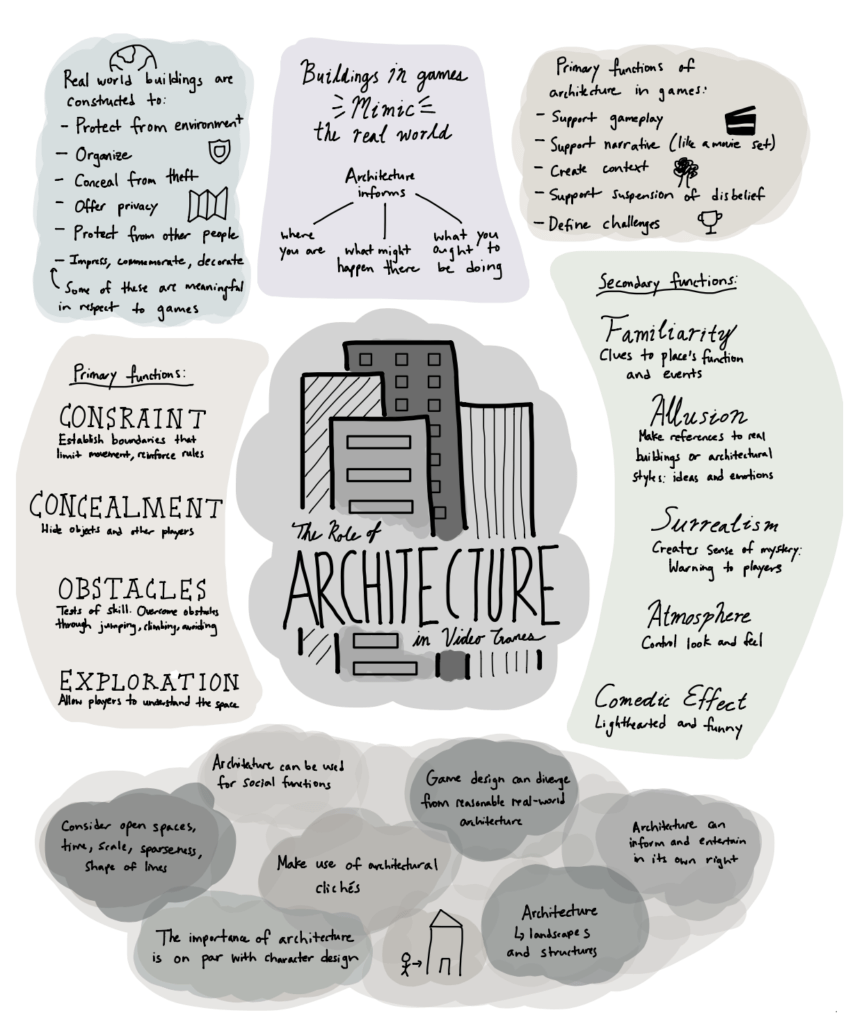
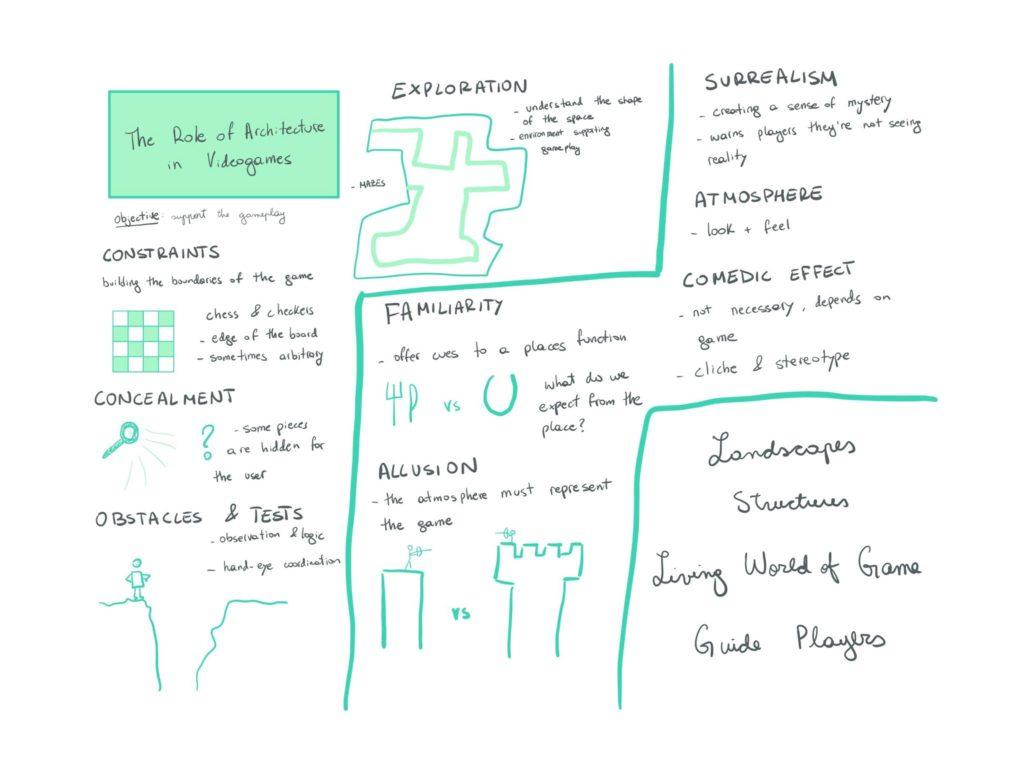
Sketchnote: Designer’s Notebook: The Role of Architecture in Videogames

May 5, 2022

Critical Play: Walking Simulators

May 5, 2022

I played Firewatch, created by Campo Santo, on my Macbook Pro. The game is targeted towards older teens and above. The story is a…

Mindmap: Narrative Architecture

May 5, 2022

Some of my favorite games that integrate narrative are as follows: Sims (emergent narrative), Five Nights at Freddy’s (embedded narrative), Pokemon Go (evocative narrative),…

Critical Play: Journey

May 5, 2022

The walking simulator game that I chose to play was “Journey” on iOS by Annapurna Interactive. The target audience for the game as stated…

Sketchnote: Game Architecture

May 5, 2022

Critical Play: Walking Simulators

May 5, 2022

This week I played Journey, a walking simulator game created by Thatgamecompany and Santa Monica Studio in 2012. The game has a wide audience,…

Sketchnote: Designer’s Notebook: The Role of Architecture in Videogames

May 5, 2022

Critical Play: Walking Simulators

May 5, 2022

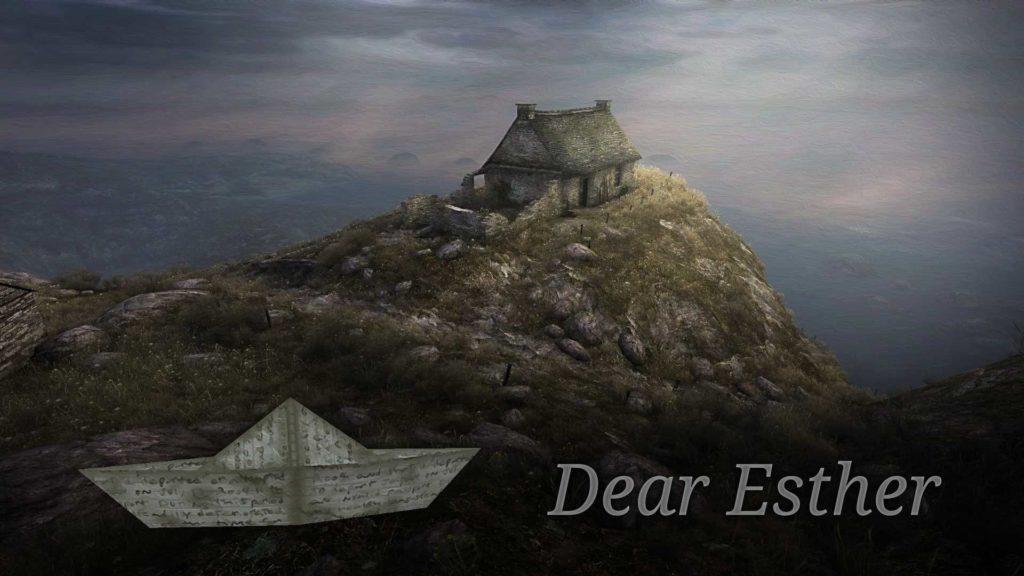
This week I played Dear Esther, a Windows/OS X/Xbox/PS4/iOS walking simulation game that was initially released by The Chinese Room in 2012. I decided to…

Critical Play: Walking Simulators

May 5, 2022

I played Dear Esther, a single-player, first-person exploration and adventure video game developed by The Chinese Room. It is available on Microsoft Windows, Mac…

Sketchnote – Roles of Architecture in Games

May 5, 2022

Critical Play: Walking Simulators

May 5, 2022

For my critical play, I played the game Dear Esther created by The Chinese Room and Robert Briscoe. During my couple hours of play…

Critical Play: Walking Simulators: The Stanley Parable

May 5, 2022

The game I chose to play for this critical play was The Stanley Parable, a popular indie game that uses the mundane walking around…

Critical Play: Dear Esther

May 5, 2022

Critical Play

Critical Play: Journey

May 5, 2022

Game: Journey Developer: Thatgamecompany Platforms: PlayStation 3, PlayStation 4, Windows, iOS Journey is a single-player game developed by Thatgamecompany, focused on the audio and…

Critical Play: Walking Simulators (Year Walk)

May 5, 2022

Name of game: Year Walk Creator: Swedish mobile game developer Simogo Platform: iOS mobile device Target audience: anyone who wants an adventure in ominous,…

Mindmap: Narrative Architecture

May 5, 2022

Use of Story in Assassin’s Creed Assassin’s Creed uses spatiality, evocative spaces, and embedded narratives to communicate its story. The overarching story of a…

Critical Play: Walking Simulators

May 5, 2022

This week, I explored a handful of environments via web browser from the collection Places. Specifically, I navigated Place 3, Sketch 1, Place 6,…

Ben Liao — Critical Play: Walking Simulators

May 5, 2022

Critical Play: Year Walk About the game For this week’s Walking Simulator Critical Play, I played Year Walk. The game was designed by Swedish…

Firewatch Logo

Critical Play: Walking Simulators (Wilmer Zuna)

May 5, 2022

After reading the Brief History of Walking Simulators, I was surprised at the influence of the government in the popular gaming genres. I am…
Posts pagination

Previous 1 … 581 582 583 … 694 Next

Welcome to the Stanford HCI Game Design Blog.

Currently this blog holds two formal classes being taught by Christina Wodtke as well as Independent Study Work. In winter of 2022, cs377g was cancelled because of covid-19 uncertainty, and became a study group. You can follow along by looking at the SGSG syllabus and weekly break down.

CS 247G: Design for Play(SYMSYS 195G)

A project-based course that builds on the introduction to design in CS147 by focusing on advanced methods and tools for research, prototyping, and user interface design. Studio based format with intensive coaching and iteration to prepare students for tackling real world design problems. This course takes place entirely in studios; please plan on attending every studio to take this class. The focus of CS247g is an introduction to theory and practice of the design of games. We will make digital and paper games, do rapid iteration and run user research studies appropriate to game design. This class has multiple short projects, allowing us to cover a variety of genres, from narrative to pure strategy. Prerequisites: 147 or equivalent background.

CS 377G: Designing Serious Games

Over the last few years we have seen the rise of "serious games" to promote understanding of complex social and ecological challenges, and to create passion for solving them. This project-based course provides an introduction to game design principals while applying them to games that teach. Run as a hands-on studio class, students will design and prototype games for social change and civic engagement. We will learn the fundamentals of games design via lecture and extensive reading in order to make effective games to explore issues facing society today. The course culminates in an end-of- quarter open house to showcase our games. Prerequisite: CS147 or equivalent. 247G recommended, but not required.

SGSG: Serious Games Study Group

  • Library
    • CS247G Community Game Design Resources
    • Game Design Resources
    • Graphic Design for Game Designers
    • Graphic Design Resources
    • Chapter 11 from Game Balance
  • Read Write Play
    • Hollow Knight: RWP 4 2023
    • Mystic Messenger: RWP 6 2023
    • Undertale: RWP 3 2023
    • What Remains of Edith Finch: RWP 5 2023
    • Catan: RWP1 2023
    • 80 Days: RWP 2 2023
  • 247G Syllabus
    • The Formal Elements of Game Design
    • Design for Play | Week One | Lecture A
    • Design for Play | Week One | Lecture B
    • Design for Play | Week Two | Lecture A
    • Design for Play | Week Two | Lecture B
    • Design for Play | Week Three | Lecture A
    • Design for Play | Week Three | Lecture B
    • Design For Play | Week Four | Section A
    • Design For Play | Week Four | Section B
    • Design for Play | Week Five | Class A
    • Design for Play | Week 5 | Class B
    • Design for Play | Week 6 | Class A (no class)
    • Design for Play | Week 6 | Class B
    • Design for Play | Week 7 | Class A
    • Design for Play | Week 7 | Class B
    • Design for Play | Week 8 | Class A
    • Design for Play | Week 8 | Lecture B
  • Serious Play Study Group Overview
    • Study Group Week by Week Breakdown
      • Formal Elements of Games
      • Final Reflection Essay
    • [Optional Material] What is fun?
    • Project 1: Those Who Play, Teach
      • READING Visual Design of Board Games
      • Pitch Your Teaching Game
      • Sketchnote: Playtesting Boardgames
      • Sketchnote: Erin Hoffman // Wind, Not Sand: Mapping Dynamic Emotion Across a Product Landscape
      • SketchNote: MDAO
      • Critical Play: Write up your game of FLUXX
      • [Optional Material] Playtesting
      • OPTIONAL Board Game Usability
    • P2: The Future We Deserve
      • Critical Play: A Mechanic and a Story to Tell
      • Interactive Fiction: Tiny Playable Prototype
      • Introducing Interactive Fiction
      • Map and Premise
      • Critical Play: Story AND Storytelling games
      • Essay or Sketchnote: Rise of the Video Game Zinesters
      • Sketchnote: Art of game design- Story
      • [Optional Material] Emergence and Progression
      • Essay or Sketchnote: Rise of the Video Game Zinesters
      • Project 2 Reflection Essay
      • Share what you Learned: Writing Excuses Podcast
      • Values at Play & P2 Peer Grading
    • P3: The Game of Unexpected Consequences
      • P3 Concept Doc
      • Playable prototype
      • Working With System Dynamics (mindmap the reading, apply it to your game)
      • Mapping Systems
      • Sketchnote/Response for Rules & Tutorials
      • Project 3 Check-in
      • Project 3 Reflection Essay
    • P4: Refine a game
      • Sketchnote/Response for Playtesting with Strangers
      • Read: Mechanic is the Magic
  • On Sketchnotes
  • Printing at Stanford

Archives

  • August 2026
  • July 2026
  • June 2026
  • May 2026
  • April 2026
  • March 2026
  • December 2025
  • November 2025
  • October 2025
  • September 2025
  • June 2025
  • May 2025
  • April 2025
  • February 2025
  • December 2024
  • November 2024
  • October 2024
  • September 2024
  • June 2024
  • May 2024
  • April 2024
  • December 2023
  • November 2023
  • October 2023
  • September 2023
  • August 2023
  • June 2023
  • May 2023
  • April 2023
  • March 2023
  • February 2023
  • January 2023
  • December 2022
  • September 2022
  • August 2022
  • July 2022
  • June 2022
  • May 2022
  • April 2022
  • March 2022
  • February 2022
  • January 2022
  • June 2021
  • May 2021
  • April 2021
  • September 2020
  • February 2017

Recent Posts

  • Final CS247G Reflection
  • Critical Play on WorldBuilding: Cyberpunk’s Night City Doesn’t Have Races — It Has Lifepaths
  • Critical Play: Puzzles — EXIT: The House of Riddles
  • Critical Play: Mysteries & Escape Rooms — Cube Escape: Paradox
  • Protected: Independent Study Final Reflection

Recent Comments

  • Christina Wodtke on Personal Reflection
  • Christina Wodtke on Final Class Reflection – Nicholai K.
  • Christina Wodtke on 247G Final Class Reflection
  • Christina Wodtke on Final Class Reflection – Joseph Gu
  • Christina Wodtke on Final Class Reflection

Categories

  • P2: The Empathy Machine
  • Featured
  • Project One
  • milestone
  • P2: The Future We Deserve
  • mindmap
  • P1: Social Games
  • CS247G
  • Assignments
  • P1: those who play, teach
  • Lectures
  • P2: Games In Space
  • Critical Play
  • P3: The Game of Unexpected Consequences
  • Project Two
  • Project Four REFINE
  • P4: Refine a Game
  • Sketchnotes
  • Project Two: The Future We Deserve
  • From the Instructor
  • Project Three: The Game of Unexpected Consequences
  • ReadWritePlay
  • 377G: Serious Games
  • SGSG

Meta

  • Register
  • Log in
  • Entries feed
  • Comments feed
  • WordPress.org

Meta

  • Register
  • Log in
  • Entries feed
  • Comments feed
  • WordPress.org
Copyright The Mechanics of Magic. All rights reserved. | Theme by SuperbThemes