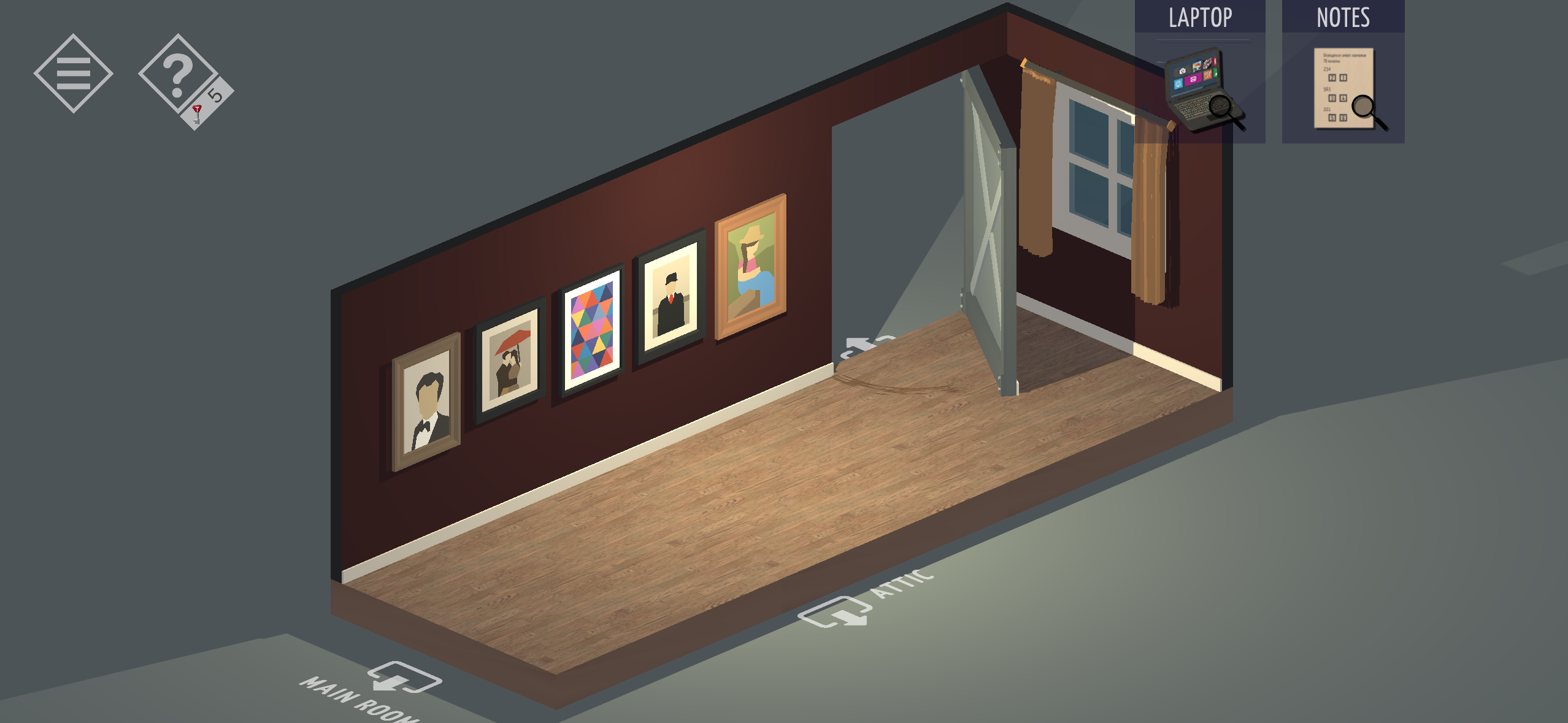
I played Tiny Rooms Story Mystery, a singleplayer game on the iOS App Store developed by Kiary Games for sleuths and detectives aged 9+. At a glance, Tiny Rooms Story Mystery did not seem like a narrative game to me. It reminded me of a traditional, CoolMathGames-esque “escape the room” type game, which, in some senses, it is. However, I quickly realized through its mystery elements that there was some subtle story going along, a plot point for the player to follow. I played through two levels and left with a lot of questions about the plot, not only through explicit narrative storytelling, but also through the mechanics of obstacles and puzzles. In this sense, I believe that Tiny Rooms Story Mystery uses mystery mechanics, such as architecture-driven obstacles and puzzles, to slowly unravel an embedded and an enacted narrative between each successful “escape.”
First, the key motivation in Tiny Rooms Story Mystery is competence, highlighted through the aesthetics of discovery and exploration in solving obstacles such as locked doors, flooded rooms, etcetera, but also narrative. When you solve a room, you have instant gratification, which motivates you to continue on, solve more puzzles, and piece together more parts of the story. You are already motivated when you see the state of things in these rooms, revealed through both an architecture of obstacles and environmental storytelling: spoiled food, overturned furniture, almost a rush to escape some threat. You want to understand the story, but to do so, you must piece it together.
In the game, the first key mechanic revealed to the player is re-orientation, or the ability to change their POV on a scene by swiping left or right; these swipes reveal new information which are accompanied by embedded narratives. For example, in the prologue level, I was able to fix the power generator and open the computer to find the roof padlock password. However, after the fact, I didn’t know where to go, and therefore encountered an obstacle to progression via the non-obvious architecture in the room. Then, I remembered that I could swipe to re-orientate the room, and then I found a ladder leading up to the roof. Only through interacting with the environment, encountering an obstacle in the architecture, and solving it, could I progress and learn the narrative of the game. In the first level, there is a couch which the player is hinted at has something behind it. You can only interact with the couch when you swipe, and from there you reveal a book, key to solving the level’s mystery.
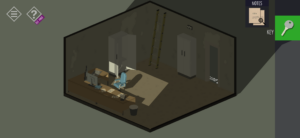
Furthermore, there are key embedded narrative elements, or story progressions, that are revealed through the mechanic of interaction and puzzle-solving with architecture as an obstacle, one of its primary functions in games. In that same scene with the ladder, only through unlocking the passcode was I able to see that the remote connection to the gate was disconnected, which revealed that someone had deliberately unplugged the connection and locked the way up to the roof, indicating foul play. In this sense, solving the puzzle and moving through the architectural obstacle of a locked hatch helped me connect the pieces of the story together, realizing that someone didn’t want me to go further into the city. From this, we see that the core loop is that the player enters a room, notices things are off and blocked through intentional architecture, clicks things to find clues via mechanics, and then puts those clues into context using passcodes or locked things, which will open another room that the player will hopefully walk into. This pattern tesserects through the game in many examples. For example, in the first level, you can place a painting on a wall to unlock a hidden room. You are hinted that there is a room through embedded elements like the scratches on the floor, and when you reveal it, you are able to uncover a flooded basement, which brings you to a suspicious key to a bank vault, again progressing the story to the next level.
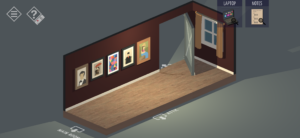
Because I played Tiny Rooms Story Mystery on my iPhone, the interface was really small, and I had to click several times on certain more-obvious objects before I could acquire them to progress. For players with motor disabilities, I could imagine it would be difficult to press on the finer objects in the game; however, I did notice there was a two-finger zoom-in (like how one would zoom into a photo in their Library). I think the zoom feature works and can help people with motor disabilities acquire objects in the game, but it could also be highlighted in the UI, since I discovered it by accident. Furthermore, for those who are unable to use their hands or fingers to navigate the game, there are no voice control features that would allow them to play the game at all (https://www.reddit.com/r/adventuregames/comments/1n4vaml/games_playable_via_voice_control_only_due_to/). Additionally, if players are struggling with the game, there is a hint feature, but it is accompanied by an ad or a paywall, which I am not a fan of, but free games must be monetized somehow.