

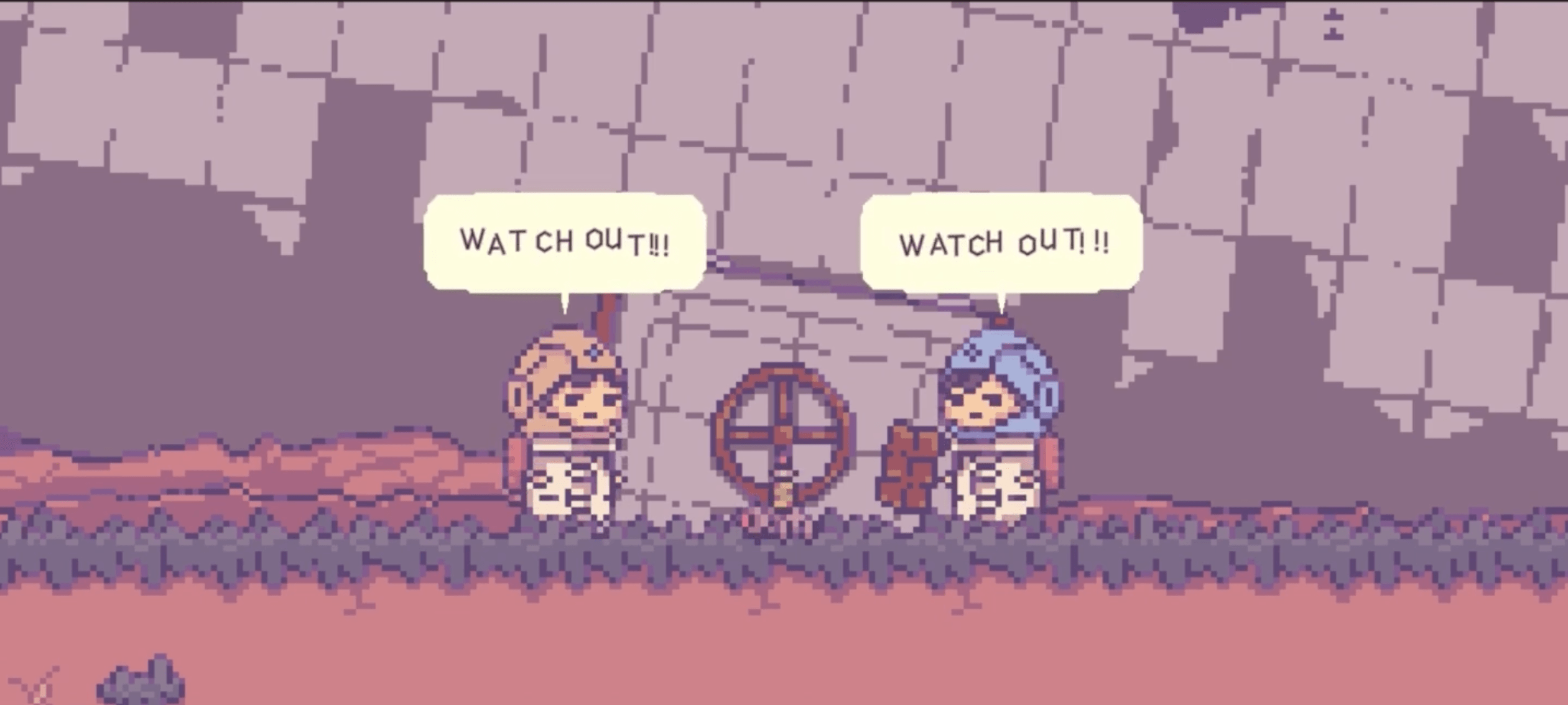
There is a small crossed-out microphone icon that appears on your screen at certain moments in BOKURA: planet. It means: don’t tell your partner what you’re seeing. In a game built entirely around communication, where progress is impossible without describing your screen to the person on the other side, I was confused as to why I would have any information that my partner didn’t. But I soon realized that our paths were made to diverge and expose darker motives on our journey. During the game, the puzzles require constant communication. But the cutscenes, which reveal the story’s deeper layers, are private: what Blue learns about himself, Yellow cannot know. What Yellow is becoming, Blue cannot see. Yet, each still has to trust and rely on the other to make it through the game. BOKURA: Planet is, on its surface, about cooperation. Underneath, it is about the irreducible privacy of inner experience and what we choose to do in the face of it. Trust is not built in spite of our inability to access another’s inner experience, but because of it. The very incompleteness of our perception of others is what makes the leap of faith necessary, and therefore meaningful.
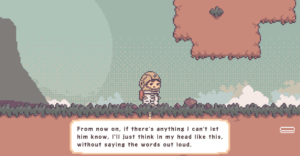

Nagel argues that conscious experience is defined by its subjectivity. There is always something it is like to be a particular organism, and that quality cannot be captured from the outside; no matter how thoroughly you study a bat’s neuroscience, you cannot know what echolocation feels like from the inside (“What is it like to be a bat?”). Every conscious being inhabits a first-person world that no third-person description can fully reach, and BOKURA: planet builds this insight directly into its mechanics. Blue and Yellow occupy the same physical space, face the same dangers, and work toward the same goal, yet each is living through a genuinely different story. The person standing next to you is having an experience you cannot access, but you continue to trust that they will help you reach your goal. The game does not treat the inaccessibility of inner experience as a reason to withhold trust. It treats it as the very condition that makes trust matter. Blue and Yellow do not cooperate because they have full information about each other, rather they cooperate in the sustained absence of it while their private screens quietly accumulate secrets neither can share.
The game’s most concentrated test of this argument comes when players encounter a figure known only as the Mother. A researcher, claiming to embody her father, tells Blue and Yellow that killing her would be a mercy. It may be true, but it is a claim made by a stranger, about an experience no one in the room can access, asking two people to take a life on the strength of his word alone. The players are then left with the moral weight of deciding whether to trust him. If killing the Mother were the objectively correct action to further our goal, it would be easy to click a button and move on. What makes this moment so heavy is not the act itself, but the conditions under which it must be made. If the game framed killing the Mother as clearly necessary for survival, the choice would collapse into strategy. If it provided definitive evidence of her suffering, the choice would collapse into obligation. But instead, it offers neither. The players must act without certainty, without consensus, and often without even fully understanding their partner’s reasoning.
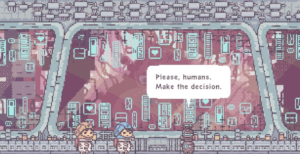
The weight of the decision comes from this gap: the space between what can be known and what must be done anyway. In this sense, trust in BOKURA: Planet is not about believing that the other person is right. It is about continuing to act alongside them even when you cannot confirm that they are. Blue and Yellow do not arrive at a shared understanding of the Mother’s condition; they arrive at a shared action. The game quietly suggests that this is what trust actually looks like: not agreement, not transparency, but alignment in the face of ambiguity.
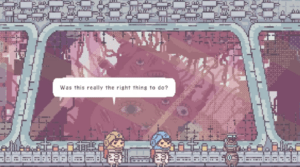
And yet, the game continues to require cooperation. What BOKURA: Planet ultimately reveals is that trust is not a solution to this divide, but a response to it. It does not eliminate uncertainty, but instead gives us a way to act within it. By the end of the game, trust no longer feels like a stable bond or a shared understanding. It feels like something more precarious: a decision that must be remade, again and again, in the absence of guarantees. And it is precisely this instability, this dependence on what cannot be known, that gives trust its meaning.


Hey! I really liked reading this, especially about how you connected the mechanic to Nagel’s reading. It made the game feel like a real-life application of his ideas. It made me really think about how the game doesn’t just show limits to understanding but pushes against trust. The private moments do help create subtle incentives to diverge as teammates, so trust becomes a choice to keep cooperating anyway and move through the different levels. I also liked what you said about Mother. The decision does feel unresolvable and not just unclear, which makes trust less about agreement and more about acting together despite not totally understanding one another. It did feel like in the thick of the puzzles, we forgot about the trust aspect a bit and were just focused on solving things as quickly as possible. Looking back, that feeling reinforces your point, that trust wasn’t something we were consciously thinking about but something we were relying on without realizing it.