

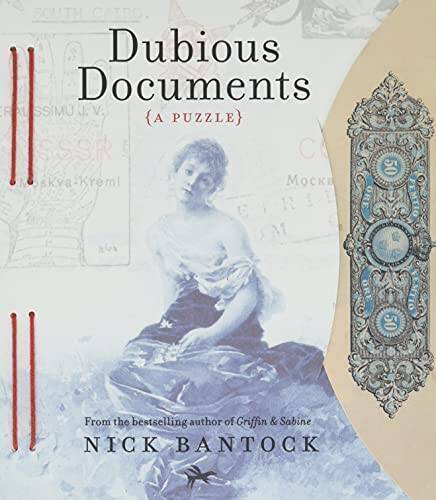
For this week’s Critical Play, I played Dubious Documents, an analog mystery game created by Nick Bantock and published by Chronicle Books. The game can, in theory, accommodate any number of players and is intended for an English-speaking audience. The game, which physically resembles a paperback book envelopes in place of pages, consists of sixteen documents belonging to “Magnus Berlin,” a fictional philosopher and artist who offers the reader a puzzle: follow the hints to find the word associated with each document, and arrange the results into a philosophical truism. The game uses mechanics like reading hints and parsing its strange and evocative documents to direct players through a simple narrative, and while the game’s surreal architecture helps evoke an atmosphere of mystery and intrigue, the actual narrative is loose and, unfortunately, very limited, which feels like a missed opportunity for a game that could have used its unique architecture to construct a more compelling historical narrative.
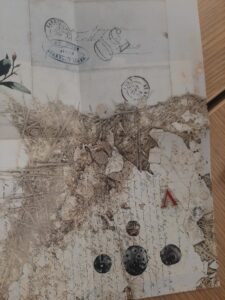
Dubious Documents begins promisingly, with suggestions of a concrete, historic narrative informed by its mechanics. Berlin tells us that he has discovered a philosophical statement that passed down to him by an ancestor of his, an outspoken Italian inventor whose musings angered the French crown. Berlin then says that he has turned the statement into a puzzle, turning his ancestor’s wisdom into a prize only available to the truly worthy. This opening address provided an intriguing enacted narrative about the Berlin family history, and I hoped that the story would be developed further through embedded details found within the documents themselves. As I began to examine the documents, however, it became clear that the game’s main narrative was the uncovering of the sentence itself. The game’s primary mechanics are following the hints and poring over the documents, and in some ways, this did help create fun through discovery. The hints were inspired and rewarding, using fun, cryptic turns of phrase like “Behind mortality, between a mountain and a tree, sits Leo’s encircled city.” I also applaud the visual construction of the documents, which contain many embedded details that the player must examine on their way to solving the puzzle. Consider, for instance, the document pictured in the first image, which contains details traditionally associated with historical documents, like handwritten text, as well as surreal elements like a bird nest that help evoke a sense of a hidden, enigmatic origin. These documents are not designed to read like real-world historical documents, for reasons that are understandable: as our recent reading on architectural design mentions, game environments are not designed to be “used” as real-world objects are. Rather, they exist to facilitate the player’s experience and sense of fun, and in this case, surreal architectural decisions where owls’ nests are layered atop handwritten documents serve to make searching for clues harder, increasing the sense of fun through challenge and discovery.
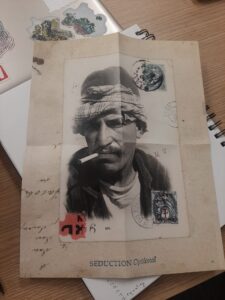
While the mechanic of examining these documents does allow the player to take in these evocative details, it is also clear that most of these details are intended to be primarily cosmetic. Consider, for instance, the second image, which shows another document prominently featuring a portrait of a man smoking a cigarette. It’s a striking detail, but one that is simply there to attract the player’s eye and guide the player to the hint when it could have been one piece of an overarching story in which that person is significant in some way. This is where the game falters in comparison to similar games, such as What Remains of Edith Finch, which also involve using mechanics like close examination to evoke narratives, but which are able to create atmosphere while telling dramatic, moving stories about the Finch family and its history. In Dubious Documents, the architecture of the documents primarily directs players toward deciphering the final message, which is, in a sense, the game’s narrative. While this dynamic does create fun in some ways, it also deprives players of the exhilarating feeling of discovering a drama in an epistolary fashion, and when the final sentence is uncovered, one cannot help but feel like there could have been more.
In terms of accessibility, the game hints all direct players to consider documents visually, looking for specific words or images that will reveal each document’s associated word. This could potentially mean limited accessibility for people with color-blindness or limited vision, but efforts are made to make the most important details more eye-catching, using size, texture, color, and shape to distinguish them from surrounding objects This, as well as the use of text hints to direct the player’s attention, means that being able to distinguish the finer details in the documents is less necessary. This helps increase the accessibility of the documents from a visual perspective, although the text hints also rely on cultural references, such as British currency and the names of Japanese cities, that mean that the game’s target audience must either be able to look these things up or have existing knowledge of these concepts, which may limit accessibility depending on the player’s background.