Cube Escape: Paradox (Paradox) is the tenth game in the Cube Escape series, a point-and-click escape room series developed and published by Rusty Lake. Paradox is available on Steam; it’s a single-player game for lovers of mysteries, puzzles, and psychological horror. The gameplay is primarily small puzzles accompanied by cutscenes, best for Explorers (who love to dig around) and Achievers (who love to conquer levels) from Bartle’s Taxonomy of Players. In this game, you wake up in a room as detective Dale Vandermeer, having lost all memories of your past. Paradox transforms a single enclosed room into a narrative system, where spatial constraints and puzzle mechanics direct player attention and sequentially reveal the mystery. Rather than allowing the player to freely investigate, the game tightly controls what can be known at any moment, using architecture and mechanics to regulate both pacing and interpretation.
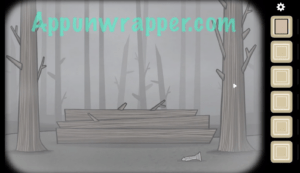
As the tenth game in an embedded narrative series, Paradox faces an onboarding problem: making a complex story understandable by new players. Rusty Lake’s solutions are clever: Dale’s amnesia justifies player ignorance naturally, a short film delivers backstory externally, and a single restricted room controls narrative pacing internally. Below: a still from the short film, then a late-story image from a walkthrough I consulted after playing a couple hours.

Paradox uses Adams’ four primary functions of architecture (constraint, concealment, obstacles, and exploration) to control narrative recovery. The main room can be quickly explored within five minutes; the player becomes familiar with each of the four walls and their objects. Every box, cabinet, and door is locked, creating a constraint and an obvious objective: to unlock them. Constraint ensures the room is never fully explored, keeping the player motivated to reveal more of it (and the narrative). The locked-cabinet mechanic produces dynamics of visible, but restricted, exploration, leading to aesthetics of curiosity and mounting frustration that mirror Dale’s amnesia. Similarly, the cabinets and doors also conceal what lies inside or beyond. Through the door’s keyhole, the player glimpses Laura’s ghost, using architectural concealment to provide partial narrative information and reinforce the fragmented nature of memory. At this moment, I gasped out of shock; the unveilment through architecture contributed to genuine emotion. Each lock is an obstacle, a test of skill, but the puzzles themselves double as hints. Mr. Crow, an integral character, watches from a photograph on one wall from the first minute, foreshadowing the narrative before the player can name him.
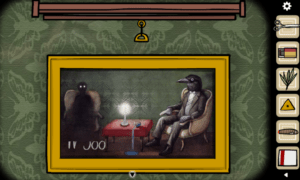
As Mr. Crow says, “You can’t escape the boundaries of your mind or the consequences of your actions, and neither can she.”
Mechanics support each architectural function. Every puzzle requires a different type of thinking and interaction to solve. Some are click-based (opening drawers to reveal hidden compartments), some require other objects (like the projector), and some require many puzzles to be solved first (like the cube slots on the dresser). The projector puzzle is particularly effective; the player must find slides, put them in the projector, find the projector screen/its handle, and uncover hidden images, mirroring the act of reconstructing memory through mechanical interaction. This moment highlighted the architecture most explicitly for me. I hadn’t realized until then that the projector wall sat directly across from the screen wall, that the room itself was the puzzle. Puzzle ordering is strict. One cannot be solved before another. You must get the key before opening the cabinet, step by step. Mechanically, puzzle gating enforces progression; dynamically, this creates a linear problem-solving loop; aesthetically, it produces tension and satisfaction through controlled discovery.
Paradox is expertly designed, using architecture to control a complex narrative. Unlike many games in the genre, the architecture creates a deterministic playthrough (at least initially, as it is said to have alternate endings). This style guides the player through the game, letting them infer what to do next from the clues they receive. However, it has a downside: if the player misses a clue, they are totally stuck. Puzzles like selecting the correct vial often rely on subtle symbolic clues; miss them and there’s no path forward but trial-and-error. I had a couple moments like this: I couldn’t figure out which number to call after cutting a piece of paper in half, or what to do after solving the first block puzzle and receiving no new evidence. Eventually, I was frustrated enough by too little progression that I stopped playing. Her Story sidesteps this by giving players a searchable video database; missing one connection doesn’t block progress, since the mystery can be approached from multiple angles. Gone Home distributes its story across environmental details in an open house, so any path through the space surfaces narrative. Paradox’s centralized narrative inside sequential puzzles differentiates it, but also creates the failure mode I hit. Rusty Lake could preserve narrative control while improving player resilience through redundant clue pathways or partial feedback systems that confirm progress, keeping the story linear without leaving the player blind.
Firsthand accounts from disabled players of Paradox are scarce, an absence that suggests the game’s design implicitly assumes an “able” player. Its tightly controlled mechanics drive narrative progression but also define who can access it. The barriers emerge directly from core mechanics, such as visual distinction and text-based clue delivery. There are color-based tasks (drinking the correctly colored vial), and textual clues not accompanied by sound that may impose difficulty for those with reading disabilities. The game does not require audio, so it is accessible to hearing-impaired players. A colorblind setting and a text-to-speech option would be simple to implement, and the same architectural control that makes Paradox’s narrative coherent makes its accessibility gaps tractable to fix. A finite, designed space has a finite, designable set of barriers.