

The game of Bastion unfolds like a story told by a drunk bard: a bit of memory, myth, and a few pieces left out. As the Kid travels the fallen Caelondia, Rucks mourns what was lost, revealing lore of the world he holds so dear. However, throughout the game, Bastion contrasts Rucks’ storytelling with the Kid’s unfolding adventure. As a result, the game warns that nostalgia can often function as a colonial fantasy, obscuring the violence and displacement of the past.
Even when I first embodied the Kid, I felt a sense of belonging. Coming from Rucks — with his rugged, yet oddly warm, tone — the “Kid” nickname carried a sense of rough affection that made me want to do him proud — the way a son may want to live up to his father’s expectations. With this, Rucks immediately positions the player as part of Caelondia’s story, someone who belongs to its past and is responsible for its future. The player is given a sense of valor, heroism, and — strangely enough — nostalgia for a world they never even knew.
That sense of purpose is reinforced with the game’s mechanics. As the Kid moves forward, the ground quite literally forms beneath his feet, piecing itself back together. The player is made to feel not like an intruder but a restorer — a healer, even — moving through a world that seems to want to be put back together.

However, as the game progresses, we begin to gather pieces that don’t quite fit that frame. We learn of Caelondia’s war with the Ura, its attempt to seal them underground, and how this led to the Calamity itself. As we collect pieces of the Core, and the Shards, players must commit violence and murder. The victims begin as mythical creatures of the “Wild” (such as little squirts), for which Rucks repeatedly minimizes the violence, framing it as necessary and even merciful: “best thing we can do for those beasts right now is put them down quick and clean.” He continues, “if we win, they win too. Our Bastion is everybody’s gain, not just our own.”
As Liam Mitchell argues in “The Political and Ethical Force of Bastion, or, Gameplay and the Love of Fate”, this rhetoric closely “parallels to settler attitudes to indigenous populations – the rationalization of slaughter; the declaration of intellectual and ethical superiority; the disregard for alterity in the extraction of world-improving resources,” (https://loading.journals.publicknowledgeproject.org/index.php/loading/article/view/189).


As the game continues, Bastion leans into this reading, slowly revealing the game’s colonial nature. While we initially fight stylized, cartoonish squirts, as we move “eastward” the enemies gradually become real animals (such as toucans) and, eventually, people. These later enemies — the Ura — are culturally distinct from Rucks and the Kid: they wear dresses and headbands; they have ponytails and masks; and they have darker hair and carry more traditional weapons like spears. This heavily contrasts Rucks’ and the Kid’s white hair; their massive flame throwers, guns, and industrial machinery; and their more western and colonial architecture. The game purposefully echoes real-world colonial encounters, where more western culture and technology is framed as “progress” and used to justify violence.

At the same time, the Ura are gradually humanized. They are not just enemies, but people with families and communities. Unlike the animals, whose bodies vanish upon death, the game leaves the Ura’s bodies behind as a visual reminder of the player’s violence. Furthermore, their deaths are not silent — each has a brief human groan, providing an auditory reminder as well. These details make the violence harder to ignore.
Overall, through revealing the cultural distinctions and humanizing enemies, Bastion “directly and indirectly comments on the problematic character of what is being done,” (https://loading.journals.publicknowledgeproject.org/index.php/loading/article/view/189) The game doesn’t just ask the Kid — and thus the player — to rebuild a fallen civilization but also pushes them to continue destroying in the very act of “restoration.” In doing so, it forces players to question what, exactly, is being “restored.”
Bastion’s message is ultimately punctuated following the player’s final choice: to restore Caelodia or evacuate it. If players choose to restore it, Rucks concludes, “So long, Kid. Maybe I’ll see you in the next one. Caelondia, we’re comin’ home.” While “Caelondia, we’re comin’ home” reinforces a sense of nostalgia, the line “Maybe I’ll see you in the next one,” is foreboding. Earlier in the game, Rucks himself admits uncertainty about whether returning would change anything at all, noting he cannot say how the Calamity might be prevented from happening again. That doubt lingers, and, in the subsequent option, “New Game +”, the world is not saved — just reset. In this way, the restoration ending reveals nostalgia as a kind of colonial blindness, as it, inevitably, leads to the same pain and displacement.
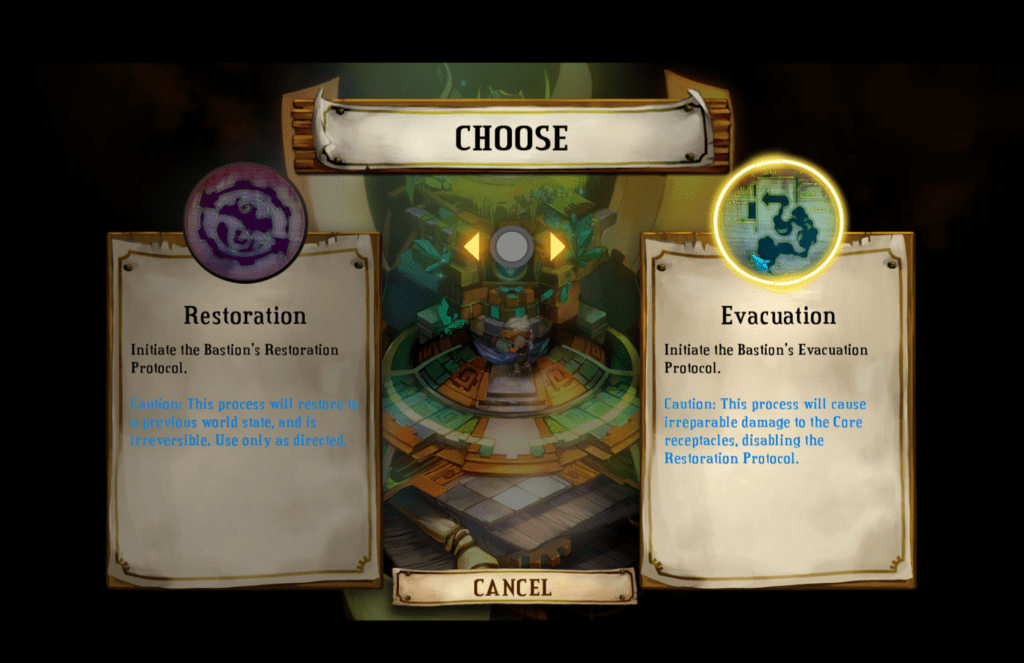
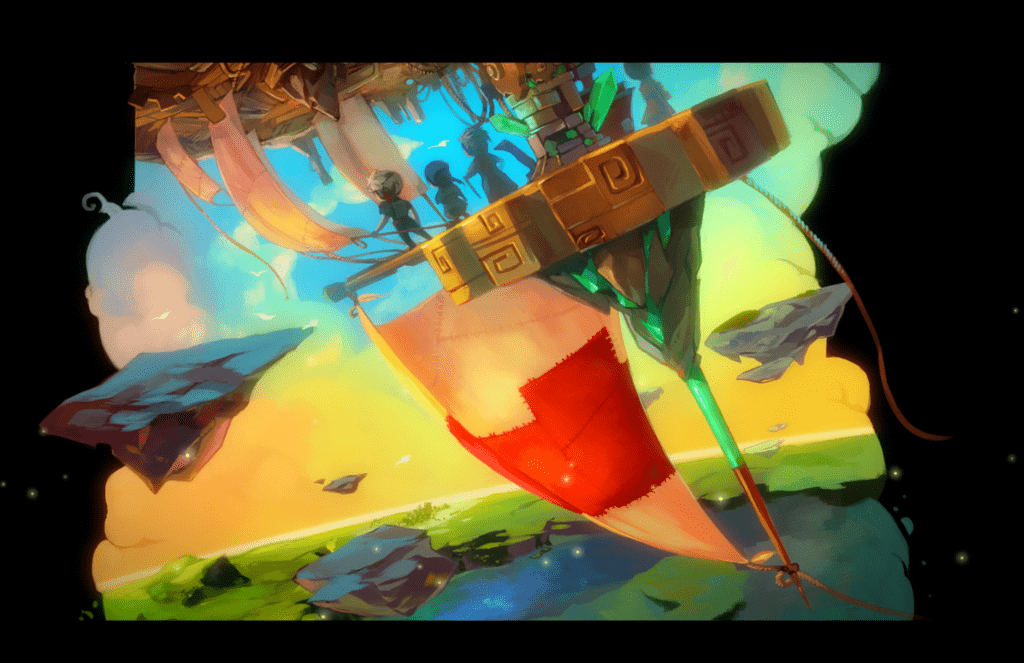
On the other hand, if players choose to evacuate, they are met with a beautiful sunset scene. While the scene acknowledges loss — the people who died and the violence that occurred — there is also an element of hope and possibility, standing in stark contrast to the foreboding nature of the “restoration” ending. As a result, Bastion reveals nostalgia not as a harmless longing, but as something that can distort memory and prevent equity, violence, and progress.

Loved this! The point about the choice being a wake-up slap makes a lot of sense; I can’t believe I only just realized this.
I love how you described Rucks as a “drunk bard,” 😄 I felt similarly since he sounds so warm and eccentric but also a bit unserious so you kind of underestimate his influence and how much he’s shaping your view of everything.
I also related to what you said about the game making you feel purposeful at first and making you feel like a hero and noble for rebuilding the broken Bastion. I didn’t fully look at the game through a lens of colonialism while playing, but I can definitely agree with your point about how they distinguish the Ura and Caelondians. Specifically, at one point fighting Zulf, I remember Rucks said “his countrymen don’t exchange pleasantries” or something along those lines, which made me feel a bit uncomfortable since it started becoming clear that we were getting an understanding of the Ura through a judgmental Caelondian perspective. I also thought your point about the Ura bodies staying behind was interesting and not something I took note of while playing. In my mind the game seemed to be dehumanizing the Ura, but the choice to keep their bodies makes me think differently, especially about what the narrator is saying vs what the story as a whole is saying.