

What Remains of Edith Finch (2017) was developed by Giant Sparrow and published by Annapurna Interactive. It is available on PlayStation, Xbox, PC, iOS, and Nintendo Switch. I played it on Switch. The game is a first-person “walking simulator” in which seventeen-year-old Edith returns to her family’s abandoned house and walks through a series of sealed-off bedrooms, each of which triggers a short story depicting how one Finch family member died. It is rated T for Teen and clearly targets adult and older-teen players who come to games for narrative and emotional experience.
Critics often call walking simulators “subtractive.” As Nicole Clark puts it in her Salon history of the genre, detractors frame these games by “categorizing a genre by its limitation, rather than its capability: in walking sims, according to critics, all you do is walk.” I want to argue the opposite, using Edith Finch as the strongest possible example. Walking tells the story by trading Challenge for Narrative. The walking frame suppresses the aesthetics of mastery and skill that dominate action games, leaving Narrative, Discovery, Sensation, and Submission to do all of the storytelling work. This is not subtraction. It is a deliberate aesthetic reallocation.
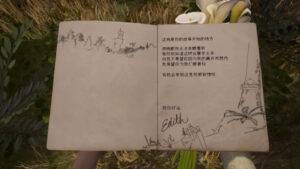
The Finch house is a museum. Sealed doors, handwritten memorials, photographs, and scale models fill every room. The player walks slowly through this space, with no sprint button for most of the game. The game asks almost nothing except that you keep moving forward and read what you see. Walking is the game’s procedure: the repeatable action the player performs. The objective is diffuse (“understand the family”), the resources are just the player’s attention, and the conflict is internal. There is no fail state.
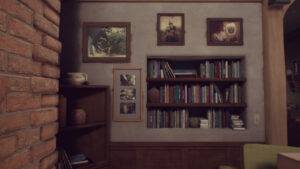
In MDA terms, the walking frame optimizes for four aesthetics: Narrative (the unfolding drama of each vignette), Discovery (sealed rooms, environmental clues, the dollhouse model of the house inside the house), Sensation (the handwritten text that materializes in the world as Edith narrates), and Submission (the meditative pace of wandering). It explicitly rejects Challenge, Fellowship, and Expression: you cannot fail, play with friends, or customize Edith.
Lewis’s Story
The clearest demonstration is Lewis’s vignette. Lewis works at a salmon cannery, beheading fish on a conveyor belt. The player is given a split interface. The right hand guillotines fish in a slow rhythm. The left hand guides Lewis’s imagined avatar through an increasingly elaborate fantasy kingdom shown in a picture-in-picture window. As the story progresses, the fantasy window grows until it swallows the cannery view entirely. The two finally unify in a coronation sequence. Lewis, crowned king of his imagination, lowers his head onto what the player realizes is the fish-chopping block.
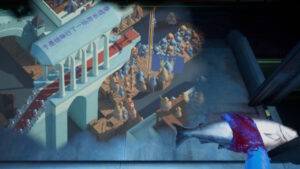
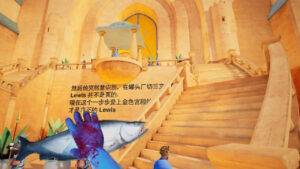
In MDA terms, the mechanic is two simultaneous inputs, one for real life and one for fantasy, with a picture-in-picture that slowly inverts in dominance. The dynamic is cognitive load: the player physically cannot give equal attention to both tasks, so the fish-work becomes automatic muscle memory, exactly as it did for Lewis. The aesthetic is a collapse of Submission (the habitual fish-processing) into Fantasy (the imagined kingdom), producing a Narrative aesthetic of dissociation. When the two screens merged and the sound of the chopping blade fell, I knew what was coming a half-second before it did, and that half-second is the whole game in miniature. This works because the walking-sim logic of the wrapper has conditioned you to observe, not act. When the mechanic you have been idly performing with your right hand becomes the thing that kills Lewis, the reversal lands with the weight of the entire slow, patient hour that came before it.
Ethics
I have played The Legend of Zelda: Breath of the Wild before, also on Switch, which is saturated with violence. I kill hundreds of Bokoblins, Moblins, Lynels, and Guardians across Hyrule. But the violence in BOTW never scared me. The violence in Edith Finch did. Molly’s story was the one that got me. Watching her transform into a sea monster and tear into the sailors, seeing the blood from her own first-person point of view, I had to put the controller down and walk away for a while.
The difference is not how much violence each game contains. BOTW contains vastly more. The difference is at the design level. BOTW builds violence into a system of Challenge with resources, rules, and outcomes. Violence is something you practice and get better at, and the dominant MDA aesthetics (Challenge, Expression, Fantasy) wrap every act of killing in a layer of mastery. Violence becomes a resource for self-actualization.
Edith Finch strips all of this away. Molly’s transformations use different mechanics for each form, but none are skill-based. You hold forward, and the eating happens. The aesthetics driving the scene are Narrative and Sensation only. The horror is uncut by any Challenge layer that would let you process it as accomplishment. Edith Finch uses the absence of violent game systems, not the absence of violent content, to make violence feel meaningful again. Action games desensitize players to violent imagery by wrapping it in mastery. Walking sims re-sensitize by removing those wrappers. The walking frame establishes the contract that there will be no Challenge, and therefore no buffer.
Critique
The game is not flawless. Navigation suffers from a lack of signposting. I spent a long time wandering the house before realizing that climbing the rock-climbing wall in the children’s room was the way up to the second floor, which unlocks Milton’s and Lewis’s stories. In a game this committed to Submission, a stuck player is a broken player. A subtle cue, a faint light, a piece of chalk, a line from Edith, would have preserved Discovery without letting players stall out. This is the walking-sim designer’s hardest problem: Discovery requires that the player find things, but Submission requires that finding feel effortless.


