Astra
Creators: Nolawi Ayelework, Evan Hsu, Zander Majercik, Kai Ssempa
Artist Statement
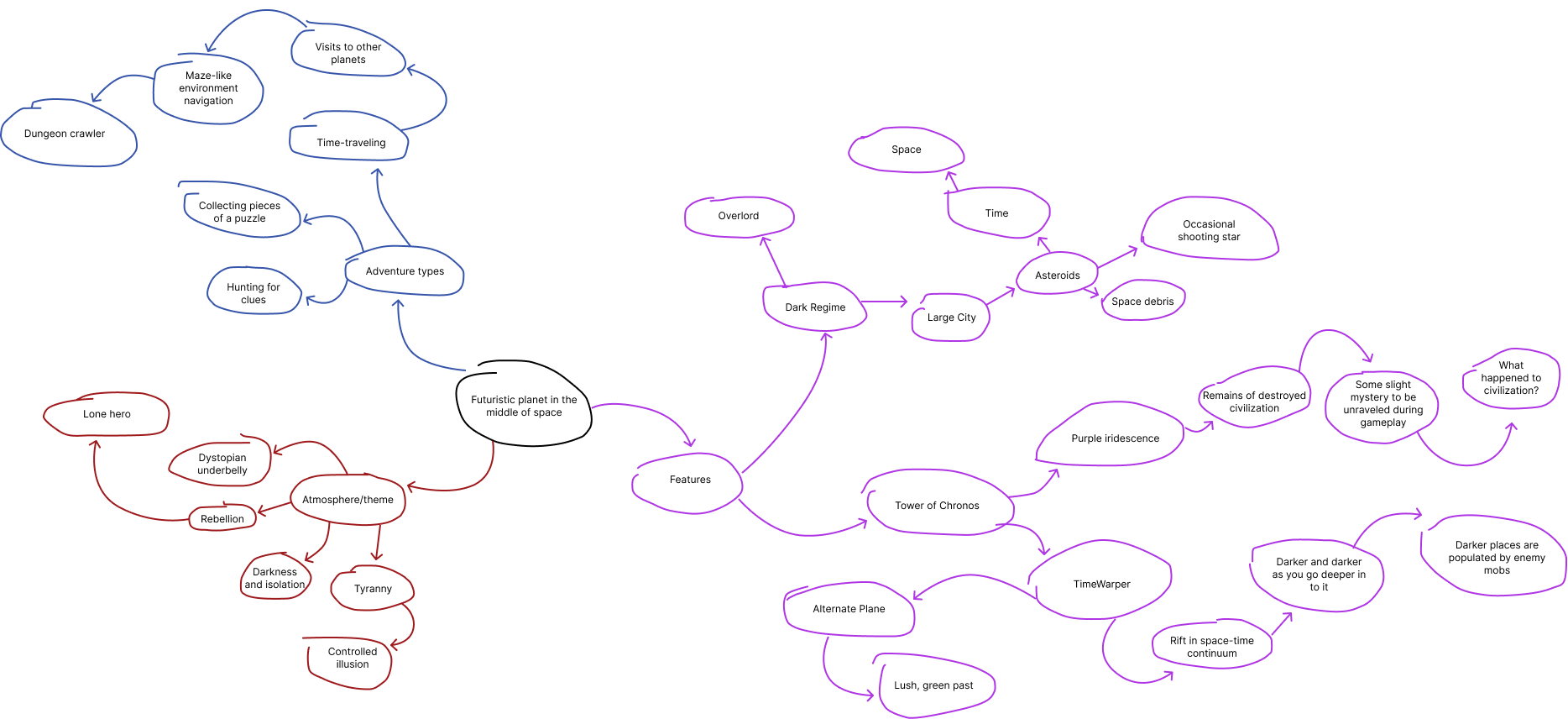
Our game explores the fragile relationship between time, choice, and consequence. Set across two contrasting worlds—one futuristic and neoteric, the other stuck in the past—we wanted to create a narrative experience that encourages players to think deeply about how small actions in the past can ripple into the future. Through Astra, a lone traveler capable of moving between timelines, players confront environmental puzzles that reflect the interconnectedness of both worlds. The Tower of Chronos stands in the background, looming above Astra as she traverses both the past and the present. The tower is a sort of anchor for the game, representing humanity’s attempt to control time—and the cost of losing that control. Our intention was to design a game that balances exploration and storytelling, where each player’s journey feels both personal and impactful. Our group built Astra in Unity–this project challenged us technically and creatively, and we hope it invites players to reflect on the power they hold in shaping their own worlds.
Concept Doc
Formal Elements and Values
Values
-
- Problem-solving
- The primary purpose behind the game is using it to solve puzzles. We thought that being able to switch between worlds is a cool functionality that undergirds the experience, but in some sense we wanted to use that to do something, and this came to mind pretty early for us.
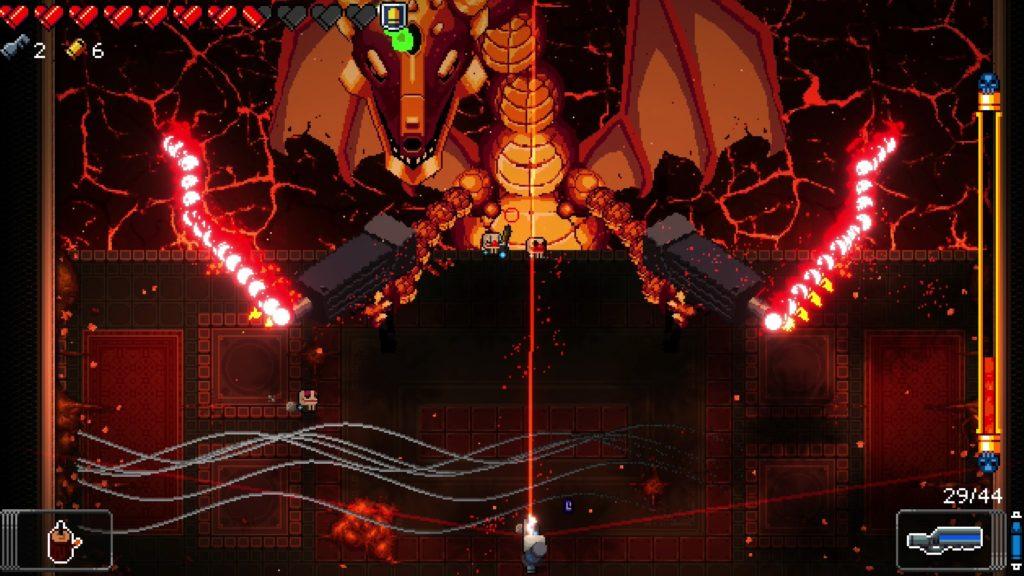
- A consistent model from the beginning what exactly we wanted out of the game was Monument Valley, and although that game uses impossible objects and optical illusions, we saw ourselves as fitting into a common overarching theme – that of using the functional and aesthetic possibilities afforded by moving beyond reality in order to solve puzzles.
- The primary purpose behind the game is using it to solve puzzles. We thought that being able to switch between worlds is a cool functionality that undergirds the experience, but in some sense we wanted to use that to do something, and this came to mind pretty early for us.
- Problem-solving

Scenes like this from Monument Valley gave us inspiration not only in terms of aesthetic capabilities but also thinking about what story might be built from the game.
-
- Exploration
- The secondary idea of the game, in some sense, is that we wanted a game where the user can use this ability to move between worlds as a path to getting through the game as it is currently situated. In some sense, then, the value of the game is in allowing players the ability to explore across these two worlds, and from there figure out what exactly is needed to solve the puzzles and advance in the current world.
- Exploration
Mechanics
-
- Moving between worlds
- This was the mechanic that engaged us in debate the most, regarding what exactly moving between worlds might look like, how players should be able to do so, and when exactly to allow players to move. We at first created a version where players could move by pressing a button (here, the space bar). This had the advantage of being easy for players to do, while also making aspects of the puzzle more complex: if players could do it at any point, when should they do it?
- Moving between worlds
-
-
- At the beginning, we valued that complexity, but we realized pretty early that it just made the game incredibly more confusing, especially if someone did so accidentally, where they could not figure out or in places where maybe we hadn’t coded that functionality to work in.
-
-
-
-
- To be more specific, one problem that we ran into pretty early was that as players switched between worlds, depending on their location, there was a chance that the player could fall off of the entire stage. This was an unfixable glitch we did not appreciate, and one that we would rather not deal with in the future.
-
-
-
-
- Thus, we decided to make the mechanic a portal that switches between worlds, and we believe that made it a mechanic that was less confusing and gave players a hint: if a portal was near an obstacle, maybe going through it would be helpful. To our surprise, it didn’t really impact the difficulty of the game, but it definitely helped players to have more clarity on what exactly they were expected to do.
-


Our portals, made to look like rips in a time continuum.
-
- Interacting with Objects
- The objects in the game were a key part of what we wanted to build the narrative of the worlds. In the later iterations of our game, we saw that even if users could figure out that the portals were moving users through time, they had a hard time figuring out temporal distinctions between the worlds.
- Interacting with Objects
-
-
- In our goal to make the game exploratory, however, we also saw a need to not only have objects that were visible, but objects that could also tell a story, and the best way to do that was to have objects that were able to be interacted with.
-
-
-
- We had some considerations that we wanted to make sure of in the creation of these objects, however. First of all, we wanted to make it obvious for a user which objects were interactable, but without necessarily spoiling it for them without them having to explore at all. We also wanted to make this information optional – the user shouldn’t have to explore these in order to complete the game, at least in this early iteration of the product. Last, we wanted to make sure that the information itself was interesting, even if it was optional – that’s how the best games grow the story and the side characters.
-
-
-
- With all that in mind, then, we settled on a version of the game where optional messages would be indicated with an exclamation mark when a user gets close enough to the object, and then users have the option to press to see the information.
-


Example sequence of interacting with objects. From a far enough distance away, nothing pops up. When the player gets close enough, an exclamation mark appears, signaling something is there. When the player presses ‘M’ to interact, a message appears.
Aesthetics
-
- Light vs. Dark
- From the beginning of our game, we had a pretty good idea about the general aesthetics we wanted from our two worlds. We wanted one world that was bright and happy, and one world that was dark and mysterious, and this was something that we wanted to be immediately clear to the player.
- Light vs. Dark


Same world, definitely different moments in time.
-
-
- As we worked through what exactly that might look like in terms of the aesthetics, and as our general plot idea changed, a couple of key ideas came to us.
- First, we decided to make the “present” world – the one that the user came from – as the dark one, techy and dystopian, with dark purple undertones over the entire map that made it clear that this was a bad place. With that in mind, then, we decided that the other should be the bright world, almost a utopia in response, with objects in nature and elsewhere, to make it clear that this was the better world.
- As we worked through what exactly that might look like in terms of the aesthetics, and as our general plot idea changed, a couple of key ideas came to us.
-

Present world, very much dystopian and needing to be saved.
-
-
-
- Second, we decided that the second, bright world should be the past, to bring about a general idea of the world being a better place pretty recently before this change happened. What that meant, then is that we saw it as important to make that clear with the object choices that we had. Where there were rocks, there was now a cyber box. Where there was a massive windmill, now there was just recently destroyed rubble. We did this to bring up questions in the player as they explore: why did these changes happen? What exactly is the main character saving these worlds from?
-
-

Past world, in all its natural splendor
-
-
- One interesting idea that came up in terms of this color scheme from our tests is that objects from each world should be able to be identified as such. This was most obvious for us in terms of the keycard itself. Although situated in the past world, the keycard is to be used in the present world, and so having it be of the color scheme of the present world makes logical sense and keys the player into its usefulness in the present world.
-


Previous color of keycard (seen above, to the top right) was out of place in either color scheme, but the current keycard color (seen below) fits with the present world.
-
- Rift Perspectives
- We thought a big part of showing the changes in the worlds aesthetically had to do with the rifts, especially once we decided that it would be the mechanism by which players could truly interact with the changing of the worlds. Being That’s why aesthetically, we thought the coolest part of the game was our ability to show an accurate glimpse of the other world through the rift. This is of course not necessary for the functionality of the rift, but being able to show this through the player’s point of view, for us really brought together this belief of the rift being truly a portal that moves players across time and space.
- Rift Perspectives

Examples of our portal being able to show a glimpse of the other world from the player’s perspective.
Scope:
- For our game, we decided to do a mix of both ideas. In terms of the actual gameplay, we have a slice of the general idea, since we believed that we could best show the idea of the final project through a detailed example of what the game might look like. We have a puzzle that we’d like the user to solve, and in doing so, we can better understand how the user interacts with the game and their interactiveness with the concept, and from there sketch out what next steps might look like.
- In terms of the scope of the design and the story, we wanted to flesh out that entire idea such that users can understand the reasoning behind such a flexibility – why can their characters switch between worlds? This involved us sketching out the entire storyline, and then bringing that to the user so that they understand the purpose in solving these puzzles as they are doing it. Of course, someone could solve the puzzles without necessarily being invested in the game’s story, but having a reason that users can and do switch between worlds was something that we thought would be helpful in terms of immersiveness.
Testing and Iteration History
Over the course of eight playtests conducted between May 15, 2025, and June 3, 2025, our team gathered valuable feedback to refine the gameplay mechanics, interaction design, and narrative structure of our environmental puzzle-solving game. The playtests involved a mix of players, including a few casual gamers and players who were unfamiliar with PC games. We aimed to answer questions related to navigation, interaction with objects, narrative clarity, and user experience. Each iteration provided valuable insight into improving the overall player experience. Below is a summary of our playtesting history, including major findings and changes based on player feedback.
Playtest 1: 5/15/25
In the first playtest, we had a very basic prototype that aimed to test the concept of moving between two worlds. At this early stage, lots of questions arose, including “What is the objective of the puzzle?” and “How does the past and present intertwine?” The narrative was still in development, and we had yet to incorporate key narrative elements. Players faced difficulties with navigation, especially when switching between the two worlds. The spacebar functionality for world switching was buggy, and the control system, using the ‘a’ and ‘d’ keys to turn left and right, was unconventional and difficult for players accustomed to Minecraft-style controls. From this playtest, we realized the need to further develop the narrative to situate the player, and we switched the turning mechanic to cursor-based movement for greater ease of use.

Playtest 1 was our first proof-of-concept, and it provided us with valuable information!
Playtest 2: 5/20/25
By the second playtest, we had a working puzzle mechanic where a keycard from the past world opened a door in the present world. Although we had refined the narrative, it had not yet been implemented in the game; we explained it verbally to the playtester. One playtester, who was new to PC gaming, had trouble understanding the movement mechanics. To address this, it was suggested that text instructions be displayed at the start of the game to guide players on how to move. In response, we added a starting screen that clearly describes the WASD controls. During the puzzle, players expressed a lack of clear objective, suggesting the addition of in-game text like “How can I get past the door?” to guide them. Feedback about the keycard indicated that it wasn’t visible enough, so we decided to rotate the keycard and increase its color contrast against the world’s surroundings to make it stand out more.
Playtest 3: 5/22/25
The third playtest showed that players benefitted from the navigation changes we made. However, the world size was still problematic; players were able to access areas that weren’t intended for exploration. Players were also still confused about the primary goal of the game. Based on this feedback, we decided to restrict the player area of the world to prevent confusion and added a beginning screen to give context and better explain the objective.
Playtest 4: 5/27/25
At this point, the playtester provided valuable feedback regarding some specific details that needed attention. First, the portal seemed to indicate entry from both sides, but it only worked for one, leading to confusion. Additionally, the playtester wasn’t sure if they had picked up the keycard and suggested adding a popup or sound indicator to confirm item collection. These issues were addressed immediately after the playtest. The iteration also saw the addition of narrative elements and further refinement of the environmental design to improve the overall experience.

Playtest 4, done in section, revealed valuable information!
Playtest 5: 5/29/25
During this playtest, the feedback revealed that players didn’t recognize that they were in the same geographical location when moving between worlds. One player initially thought they had entered an entirely new world. This feedback was instrumental in designing the worlds to better emphasize the change in time periods while maintaining the same geographical location. We introduced visual cues, such as alive and dead trees, broken and erect pillars, and built and broken barrels, to signify time changes. The vibe between the worlds was further defined: the present world was made to feel post-apocalyptic, dark, and industrial, while the past world was vibrant, colorful, and natural, helping make the distinction clearer.
Playtest 6: 6/2/25
By the sixth playtest, our prototype had mostly completed working mechanics and environmental design. The feedback from a game night playtest with a TA revealed the need for clearer interaction indicators for objects, which could also serve as a narrative element. It was also suggested to fix object collisions and add sound effects to help immerse players in the game. Additionally, the skybox design was adjusted to improve visual distinction between different areas. These changes helped further refine the game’s interaction system and environmental design. Last, the playtester mentioned that the color schemes should be used further to help make clear what items belong where; this advice led us to change the color of our keycard, located in the past world, to a color that more reflected its rightful place, which was in the present world.
Playtests 7 and 8: 6/3/25
The final two playtests provided important insights into how players interacted with the game’s mechanics. One key issue was that the keycard was too high up and out of the player’s sight. After making the adjustment by lowering the keycard’s position and platform, it became much easier for players to spot. Another issue identified was the need for more interaction feedback—players were unsure when they could interact with objects. A suggestion from our TA Annie was to add a confirmation system for interactions, where players would need to press a key to trigger an interaction instead of proximity-based auto-interaction. This change helped improve the clarity of object interactions. These final playtests allowed us to make necessary adjustments and fine-tune the game before completing the prototype.
Link to video of our final playtest feedback!
We are really grateful and appreciative of all the people who took the time to review our game – without their invaluable feedback, we could not have gotten to this final product!
Future Iterations
We had a couple of ideas of how to potentially move the idea forward in the future. Here, we go into more detail below:
- One idea we had, coming off of our interaction schema, was to have a puzzle where interactions were actually key to solving the puzzle, rather than optional. This would give us puzzles that were more like escape rooms, which would be a really interesting concept to have within the dynamics of switching between worlds. We would be curious to figure out how exactly to best design such a puzzle in order to allow players to figure it out without being too complicated and confusing.
- Another idea we had was bringing in interactions with NPCs to further the creation of the world. We’ve introduced an evil empire’s existence as the inciting incident of the world, but bringing in characters that reflect that would be an interesting addition that we feel might enhance the immersive qualities of the game.