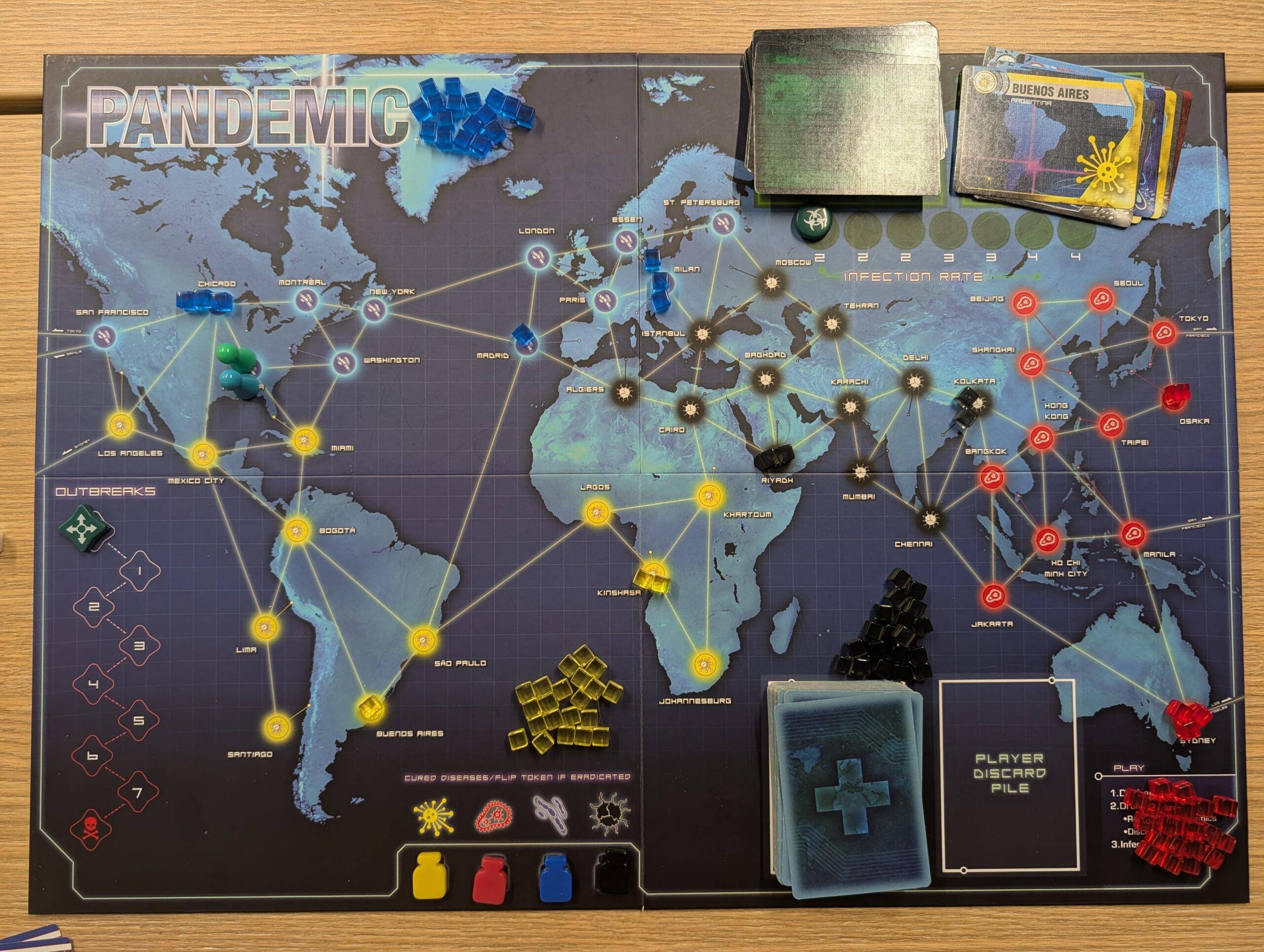
Matt Leacock’s Pandemic is a staple in the world of cooperative board games. Designed for two to four players, it targets families and strategy gamers ages eight and up with a straightforward goal: save the world from four deadly diseases. I think Pandemic is a fundamentally excellent game, but what really stands out is its replayability. This lasting appeal comes directly from its asymmetrical player roles and how they force players to interact.
Looking at the game through the MDA framework, the design of its core loop becomes pretty obvious. The basic mechanics give players a limited number of actions to travel across a static global map, clear out disease cubes, and manage a hand of city cards to discover cures. But the real engine driving the game is the unique, rule-breaking abilities assigned to each player.
Because these asymmetrical abilities dictate how the team behaves, the group’s dynamic shifts constantly based on which roles are active, increasing the overall replayability. You might find yourselves funneling all your resources toward a single player or in our case have someone setting up infrastructure to allow the other player to prevent outbreaks. A team with a Medic and a Dispatcher is going to play an aggressive, highly mobile game focused on rapid containment. If you swap those roles out for a Researcher and a Quarantine Specialist, your overall strategy has to shift toward careful card-hoarding and defensive posturing. You can’t just win through brute force or a single optimized strategy. You don’t get to pick your roles, so you have to adapt to the tools you are dealt.
This direct pipeline from mechanics to dynamics is exactly what creates Pandemic’s core aesthetic of fellowship. The game makes it impossible for one role to do everything. For example, the basic mechanic for trading a card requires two players to spend actions to be in the exact same city at the exact same time. This simple rule creates a dynamic of constant communication, mutual reliance, and logistical planning. You are constantly setting up your teammates for success rather than taking the spotlight for yourself. The result in an aesthetic experience of fellowship where the players are united against a relentless board, sharing the heavy weight of every defeat and the massive relief of every narrow victory.
Despite how brilliant the system is, this open-information design leads to Pandemic’s most glaring flaw: the “Alpha Player” syndrome. Since all cards are played face-up and there is no hidden information, a single experienced player can easily calculate the optimal moves and dictate what everyone else should do on their turn, which I did end up doing. It can easily turn into one person playing a solitaire game with other people’s hands, which while it was fun for me resulted in a less engaging experience for others. However, it became more fun when we worked together on finding the optimal turns for each other.
The most elegant design decision in Pandemic, and the one most relevant to our own work on our game Summit Rush, is the dread of an increasing pace of destruction. The structural parallels in how both games degrade the board state are striking. Both utilize a dedicated threat deck that maps to every available location. In Pandemic, these are cities, and in Summit Rush, they are the board tiles. Both systems systematically dismantle the players’ safety.
Playing Pandemic also heavily validated our implementation of a Blizzard mechanic. When you draw an Epidemic card from the player deck in Pandemic, you are forced to shuffle the infection discard pile and place it directly back on top of the draw pile. This brilliant move replaces random, unpredictable chaos with a profound sense of guaranteed devastation. You know exactly which hot zones are about to be hit again, but the precise order remains a secret.
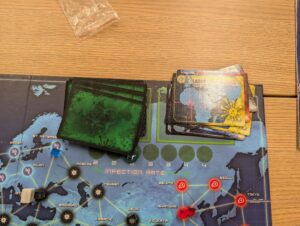
Summit Rush mirrors this exact cadence of dread. By embedding our Blizzard triggers directly within the player’s draw deck, the very cards required to advance and survive also serve as a timer for the environment’s collapse. Just as Pandemic forces players to draw Epidemics while searching for cures, our players accelerate the destruction of their own tiles simply by taking their turns. It creates a tightening noose of familiar, cyclical hazards that escalate as the game goes on.
Ultimately, Pandemic stands as a masterclass in cooperative tension and replayability. Anchoring its gameplay in distinct roles that demand constantly evolving strategies ensures that no two sessions ever feel identical. Its ingenious method of recycling the infection deck to compound existing threats provides a perfect blueprint for escalating difficulty without relying on sheer randomness. As we finish up Summit Rush, the lessons I learned from Leacock’s relentless, perfectly paced engine of global destruction will be invaluable in crafting our own mountain’s escalating peril.