Team Bilby: Xingyi, Ellie, Zicheng, Dana, Hazel
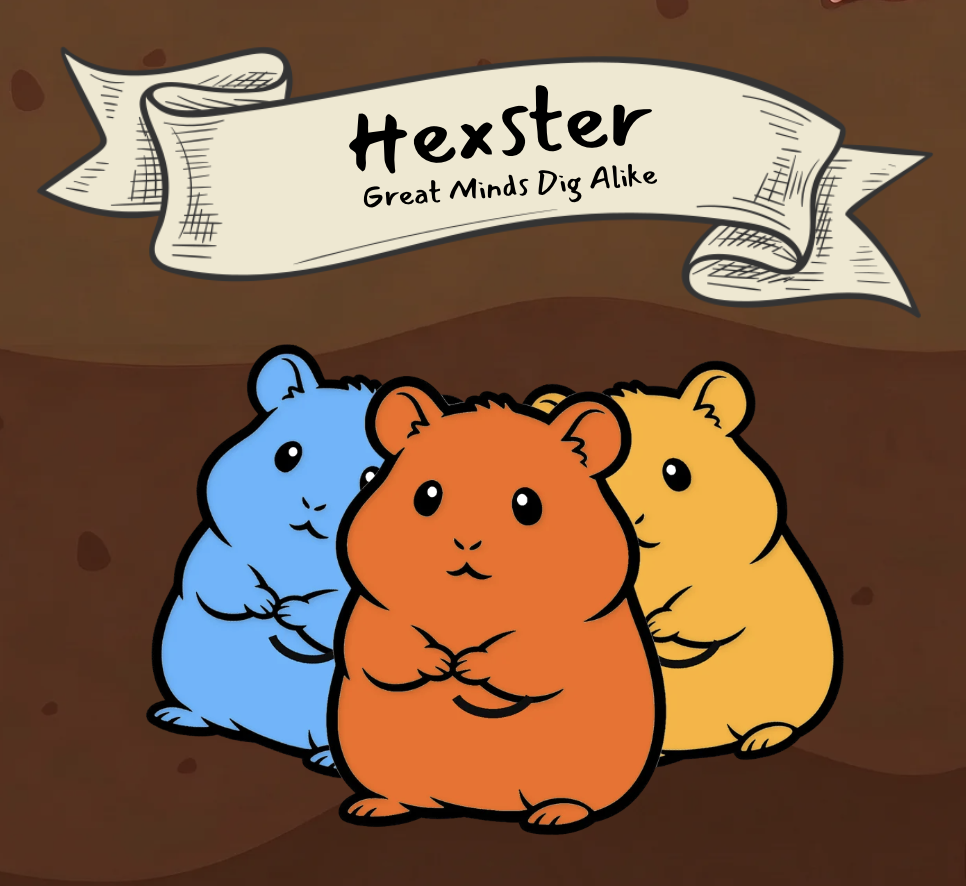
Hexster: Great Minds Dig Alike
Artist’s Statement
Hexster is a team-based route-building game that explores how people collaborate without words. Players play as hamsters digging an underground network, working in teams of two to meet with their teammate and build a continuous tunnel between their respective homes. While many strategy games emphasize individual competition, Hexster focuses on predictive coordination and shared problem-solving.
Our core mechanic is a single silent choice: each turn, without communicating, teammates must decide whether to move or dig. This deliberate synchronization creates a mind-reading dynamic between teammates, which produces aesthetics of Fellowship with real Challenge underneath. The hexagonal board provides only external structure, so tiles can be placed in any orientation, and every game develops its unique tunnel network tessellation.
We intentionally kept the objective simple—build a tunnel to your teammate—so the game stays accessible to a broad audience, then layered pressure around it: limited board space, food tiles that reward opportunism, bomb tiles that deconstruct tunnels, and hamsters that can immobilize each other. Cooperation is the goal; conflict is the terrain.
Ultimately, Hexster is a game about connection—both physical and metaphorical. By turning cooperation into the core challenge, we hope players experience the satisfaction of successfully reaching and understanding their teammate, even without saying a single word.
Concept Map
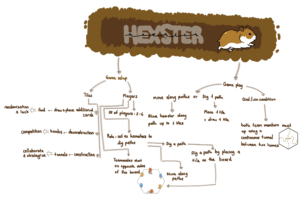
Initial Decisions About Formal Elements and Values
Initially, we wanted a game built around the quiet thrill of coordinating with someone without being able to talk—those raised eyebrows, trying to read each other’s faces, picking up on silent patterns. That set our primary types of fun—Fellowship first, with Challenge underneath—alongside three values: accessibility (an objective children intuitively grasp), connection over competition (your teammate, not your rivals, is the emotional center), and emergence (no fixed board, so no two games play out alike). Our biggest worries were structural: a purely cooperative game risked going stale, since without rivalry the predictive coordination would play out the same way every time; competition adds uncertainty and dynamism. We struck a balance with competitive-cooperative teams of two racing each other, holding your teammate central while the team rivalry keeps every game intense and unpredictable. To accomplish this, we came up with an idea containing the following elements:
-
- Objective: Be the first team to meet up by digging a continuous tunnel connecting your hamsters’s homes—instantly intelligible, so all the difficulty lives in execution, not in understanding the goal.
- Players: In either two or three teams of two, you cooperate with your teammate and race your rivals. Ages 8+, suitable for families, friend groups, and people getting to know one another.
- Boundaries: A hexagonal board with fixed edges; rhombus-shaped tunnel tiles orient freely inside the board, resulting in different tessellations every game.
- Resources: A bag of tunnel tiles, a hand of three tiles, and a hamster meeple for each player on the board.
- Procedures: Each round, both teammates simultaneously and silently place one tile to “dig” a tunnel. This is the load-bearing rule: synchronization creates the mind-reading dynamic.
- Conflict: Limited space and blockable tunnels lead to confrontation. At the start, we also lightly considered extensions like neutral “rock” tiles or “bomb” tiles.
- Outcome: One team wins by building a continuous tunnel between their hamsters’ homes and meeting on the same tile.
Testing and Iteration History
Initial Prototyping: June 30 (Team Members)
| Findings | Improvements + Decisions |
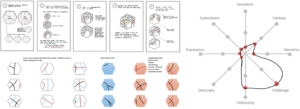
| Triangular tiles would produce too few tunnel variations while hexagonal tiles would result in too many. Rhombus-shaped tiles produced a manageable amount of tunnel variations while offering the added advantage of greater placement versatility. | Create rhombus-shaped tiles. |
| Not having a boundary surrounding the tiles led to misshapen tunnels that did not connect. | Create a fixed hexagonal bounding board. |
Playtest 1: July 2 (4 Players, Team Members)

| Findings | Improvements + Decisions |
| Rhombus-shaped tiles with hexagonal boards lead to clever and unique tunnels. | – |
| Having an even number of tiles on each side of the board made it impossible to locate each hamster’s home directly on the center. | Decrease the side length of the board from 6 tiles to 5. |
| Hamster meeples, while endearing, did not play any active role—their color indicated what team a player was on, but they stayed static on the side of the board. | Introduce the “move” mechanic: rather than simply building tunnels by placing tunnel tiles, players also move their hamster meeples along the routes, resulting in a conflict mechanic when they run into opponents. |
| The starting team seemed to have the advantage because they could speed towards their destination without much conflict. | Introduce an initial conflict mechanic where two hamsters that try to lay down tiles on the same spot fight via a coin flip. |
Playtest 2: July 7 (6 Players, CS247G Peers)
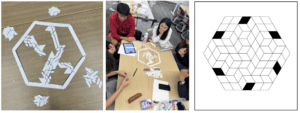
| Findings | Improvements + Decisions |
| Tested two versions of the rules: (1) the vanilla version and (2) a more complicated version with effort points. Players reported preferring the simpler version. | Prioritise simplicity with fewer additions. |
| Players struggled to align the tiles because the hand-cut angles and edges were not precise enough. | 3D print uniform rhombus-shaped tiles with fixed side lengths and angles of 60° and 120°.
(The tunnels were represented as grooves to speed up production in time for further playtesting, rather than being printed in a different color to maintain consistency in tile shape.) |
| Players got stuck because (1) they could not change existing tiles that blocked them and (2) the 3-tile hand restricted their actions too much. | Introduce bomb tiles to allow players to destroy existing tiles.
Increase the number of tiles held in the hand. Introduce food tiles to allow for faster tunnel-building with greater autonomy. |
| Players forgot to move their hamster because they could build regardless, and it did not serve any other function during gameplay. | Change movement mechanics so that each round is a binary decision: either dig (place a tile) or move the hamster. Also, enforce that players can only build adjacent to their hamster, which forces them to have to move their meeples rather than solely build. |
| Players felt silly tossing a coin in an otherwise strategic game. | Change conflict mechanics to location and order based: If one hamster lands on another hamster (moves to the same tunnel in a tile), the hamster below is incapacitated until the hamster above it moves. If a third hamster piles on top, the pattern continues and it incapacitates the second hamster, and so on. |
Playtest 3: July 8 (4 Players, Team Members)
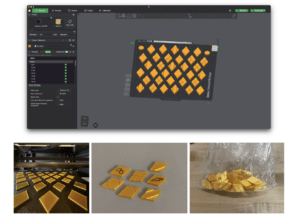
| Findings | Improvements + Decisions |
| The tiles sometimes shifted out of place so tunnels were not lining up when they should. | Print a new board with triangular guidelines to ensure tiles are placed properly and tunnels will align. |
| The six different hamster meeples added unnecessary complexity for teams of two. | Print six new hamster meeples in three different colors, with two of each color. |
| Too many bomb tiles led to chaotic explosions and difficulty finishing games. | Adjust the ratio of tile frequencies in the bag (remove some bombs to reduce chaos). |
| Players tried to bomb tiles that had hamsters on them. | Clarify bomb rules to specify bombed tiles must be uninhabited, but that players must return to rebuild their tunnel. |
| Gameplay speed increased to a much more comfortable pace due to players moving up to three spots at a time as well as digging. | – |
Final Playtest (July 9, CS247G Peers)
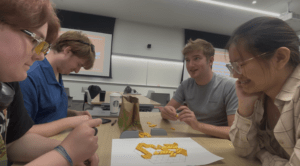
| Feedback | Response/Decision |
| Limited communication works well. | – |
| Physical tiles were a great sensation. | – |
| Gameplay was easy to learn and simple to remember, but had a high skill ceiling and felt balanced. | – |
| There was indeed one moment where a player forgot the “can only place tiles adjacent to where their hamster is” rule. | Add diagrams to the rulebook, and make this abundantly clear in both the rulebook and directly on the game board, in order to reduce working memory load. |
| Due to unclear language, players discarded used bomb/food tiles rather than returning them to the bag, leading to a low frequency of bombs. | Clarify instructions on returning tiles to the bag rather than discarding, so that the frequency at which bombs appear increases. |
| It was unclear whether players could choose to skip a turn. | After much discussion with the testers, we decided to clarify in the rulebook that skipping is not allowed. This makes collisions temporary and encourages players to dig more in order to cycle their hands. |
| The board helps with accuracy but can be improved. | Add color on board to indicate teams. Add basic rules on board to reduce working memory load. |
| Grooves on the 3D-printed tiles mean players can sneakily identify tiles by feel when grabbing from the bag. | Acknowledge this issue, accept it due to time constraints and focus on improving game mechanics for a better overall experience. |
| When landed on, the player is forced to skip their turn, which feels less engaging. There were also concerns about hamsters being sat on indefinitely. | Infinite sitting loop should not be a problem: Because turns cannot be passed, the top hamster will have to move soon in order to continue digging. Therefore the player underneath will lose few turns. |
Final Game Design
Overview
Background:
- Players: 2-6 (best played in teams of 2)
- Duration: 15-30 minutes
- Ages: 8+
Objective:
Play as hamsters tunneling to their friends! For each team of two hamsters, set up on the game board across from each other. Your goal is for your hamsters to meet by building a continuous tunnel between your two homes.
Component List
- 1 hexagonal game board
- 6 hamster meeples (one for each player, e.g. 4 hamsters if 4 players)
- bag of 90 rhombus-shaped tiles with lines representing tunnels

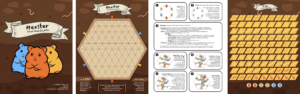
Rulebook
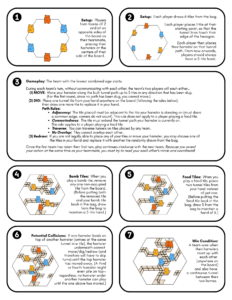
Video: Final Playtest
YouTube Link: https://youtu.be/wzQcdYXS2tw
Moments to Highlight:
- Examples of players trying to coordinate and mind-read, and how such dynamic leads to the fun of Fellowship:
- 6:16: “I know what I’m going to do…” – “And I know what I’m going to do…” – “I think you are smart. Let’s be smart together.”
- 15:50: “That’s why we are teammates!”
- 24:46: “Trust me, we are already winning.” – “Look into my eyes… We need to communicate.”
- 27:10: End-of-game high-five.
- Demonstration of conflict/competition mechanisms between two teams leading to the fun of both Fellowship and Challenge:
- 11:27: With limited space on the board, one player plays a tile in a space that would block the other team and laughs–Outwitting their competition brings on legitimate joy and fun.
- 13:58: The first bomb is placed. Even though this is a “conflict” between two teams, all players are laughing. When drawing afterwards, a player says, “Please give me a bomb… I want to bomb people,” showing how the game mechanism introduced uncertainty, engaged players, and brought on a feeling of inhabiting the characters.
- 17:08: Two hamsters sit on each other. One player reacted with joke and the other team laughed, or with Schadenfreude.
Testimonial Quotes
- “I love games with limited communication… this is so fun.”
- “This is really fun… you could sell this.”
Final Design: Print-and-Play
PDF Link: https://drive.google.com/file/d/10ps15jkKcZicLfNsqePlYupUH8dXN6st/view?usp=drive_link
AI Acknowledgement
AI helpers were used to create diagrams for the gameplay.