


Gavin, Zerui, Yunming, Cameron, Vivian
Artist Statement
Our original intention in creating Veil of the Throne was to break through the traditional board game framework of “death as elimination” and “fixed faction identity”, while preserving the core appeal of social gaming. To this end, we designed a “descriptive word resurrection mechanism”—the three words that each player writes at the start are not only a reflection of themselves and their roles, but also a “life code” that can connect them in critical moments, making death no longer an endpoint and extending social interaction from mere speech and voting into genuine emotional bonds. At the same time, Prince Jing’s choice of faction on the first night is unknown to other players—and even to himself—breaking the black-and-white identity paradigm and forcing players to constantly verify, persuade, and maneuver within a shifting landscape, greatly enriching strategic depth and engagement. We believe that these designs ultimately lead to a deeper goal: to transform trust and rapport in board games into real-life social connections and friendships. We hope that players can have more than just a win or a loss, but also a memorable social experience and an chance to encounter Chinese culture.
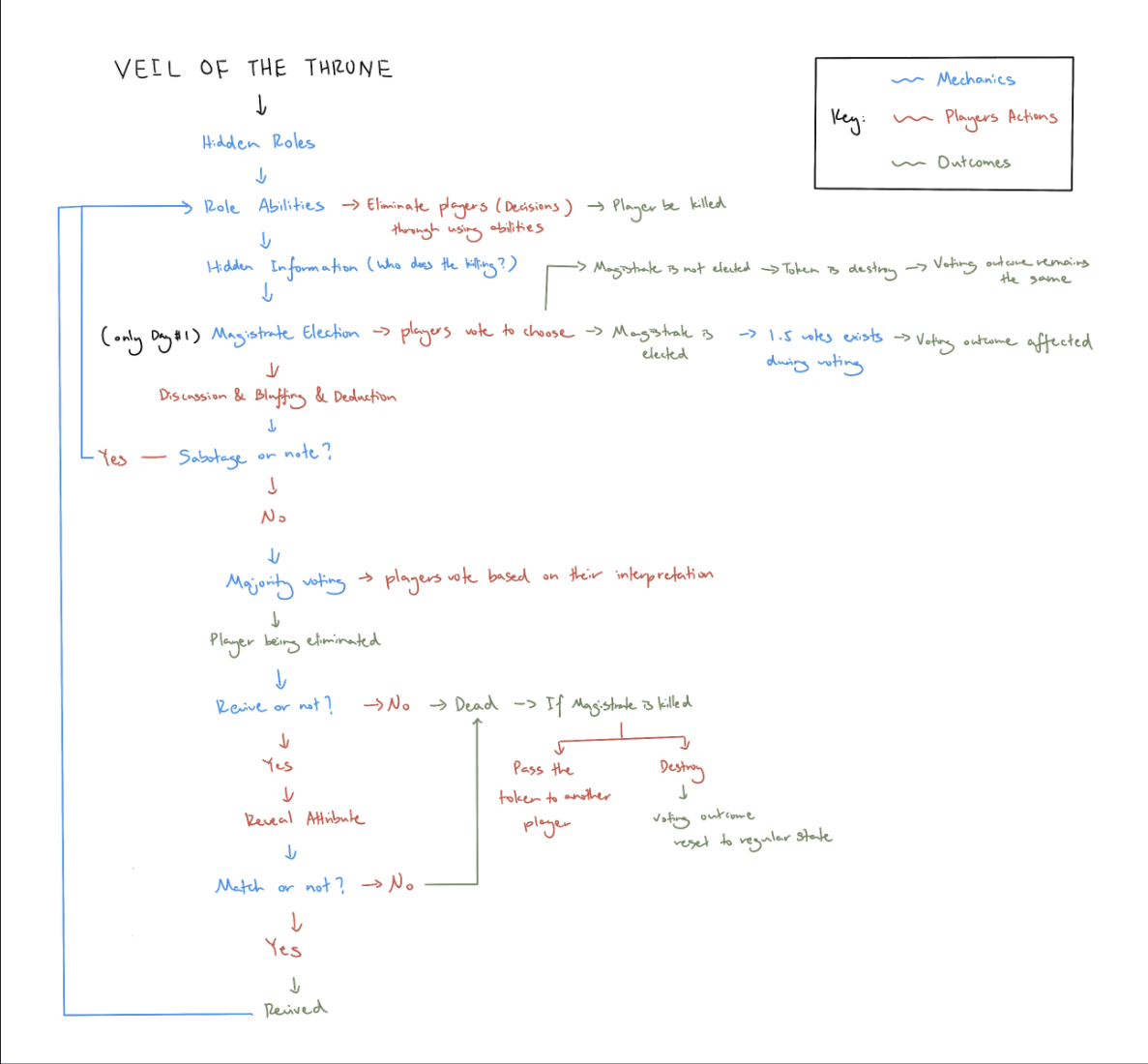
Concept Map
Iterative Process and Initial Decisions
To get to our first version we had a simple process. We had the idea for a social deduction game of some sort, and the suggestion that prevailed was to adapt a version found within a TV series into a playable game. There was some changes we made due to the change in format from a group of actors and a production to rules that a group of people can use. What we ended up with had some new mechanics of our own and was something we could call our creation.

There were roles for everyone save 3 of the 12 player amount that this game requires. The main mechanics seperating what we had was a way to revive people who died and a public hit list that changes each night, though at this point there was still major terminology issues with the mechanics and even given time to go over the rules it can be confusing. To find our problems we went ahead with our first playtest.

Playtest 1 – Testing the Core Mechanics
- Added more structured discussion and speaking phases.
- Clarified several role abilities and their timing.
- Adjusted some role descriptions to avoid confusion.
We saw how what we had was not exactly ideal, and this is also when we started feeling unsatisfied with how similar the theming of our game was quite similar to werewolf leading to inevitable comparison. That along with the advice to find a way to not make it a type of “werewolf, but” game started us on figuring out how to make it more of our own game. There were talks brought up from a member about a proposed theme with a unique vampire heirarchy focus at the time but it was completely ignored. This didnt lead to anything at the moment but with the changes and iteration where we defined the order and structured conversation we needed more information so we went ahead with our second playtest.

Determined and structured order of events for a game to follow
Playtest 2 – Improving the Game Flow
The second playtest focused on pacing and player interaction. We experimented with private discussions and free chat, hoping players could collect more information naturally. Players enjoyed having more freedom, but we found that long free discussions slowed the game down and sometimes distracted players from the main deduction process.We also noticed that players wanted a clearer leader during the day to organize the discussion.Changes
- Added the Sheriff election and Sheriff abilities.
- Reduced unnecessary discussion time.
- Organized the daytime sequence so each phase had a clearer purpose.
After this playtest we made one of the largest additions to the game with the Sheriff role which instead of being assinged at the beginning of the game is voted into office. This is also the time when the work to find a new theme came to fruition and we ended up with an ancient chinese court filled with infighting due to an ambitious prince yearning for a crown when the sucession has already been set. Everything gets rewritten at this point to fit the theme, except for the sheriff which had been overlooked. At this point we had a definite game that could stand by itself, although on legs that had trouble holding itself up. This would be shown with the next playtest.

Preliminary sheriff rules, quite unrefined and dense
Playtest 3 – Theme and Balance
- The role interactions created interesting deduction and teamwork.
- The revive mechanic encouraged players to stay engaged after elimination.
- A structured discussion order worked much better than long periods of free conversation.
- The themed version was more immersive and easier for players to remember than the original prototype.
- Intentional information design was almost nonexistant
After this one thing became apperent, the way we explained this game was not from a standpoint that was attainable. What was given to the players didnt include what the roles did, or any actual rules beyond the win conditions which were also laid out in a not so optimal way. So what had to happen was a complete rewrite of our rule sheet to include the needed information and to be less focused on the order of the day as that was for the narrator to control. As the day for the final playtest rolled around the parts were printed out and prepared, but some crucial pieces were found missing on the day of. Here is the findings of the final playtest.

New role card designs


The rule/role sheet prepared for the players
Playtest 4 – Kind of a Tragedy
There were a few main problems that arised during the playtest, one of the more apperent was dissatisfaction with the attriibute and revive system. It was unintuitive and the way we had attribute assignment was not really logical from a logistical and balanced design perspective and it became obvious as the questions kept rolling in. The second troubling part of the playtest was a general unpreparedness in the materials we brought. The narrator didnt have their own rule/role sheet, was expected to remember all of the players roles while there was no provided material to keep track of it, and the document made for the narrator to use and direct the game was nowhere to be found. Despite the drawbacks, once the game got into the swing of things it progressed more or less smoothly. However there was very little progress made even with a 45+ minute game session, mostly due to some major mechanics not being addressed in the narrator document which had to be seen off of a members laptop. The players had a generally entertained time but it wasnt really much different from any other social deduction game.
Final Conclusion
- The narrator needs accurate information to properly run a game
- The Attributes that inform the revive mechanic were problematic
- Things need to be explicitly addressed in most situations
- The ambiguity in some places had caused problems
- A lack of oversight on the materials made by each person caused inconsistancies
After this it was clear the base was now actually working with us being able to get people to understand and enjoy our game. There just had to be a Unification of the all the games parts, which all had to happen that night to allow a possible playtest the next day. Then to address the problem of the attributes, we made the decision to turn them into cards that get dealt out with a limited number of attributes to get a more reasonable overlap between players. Everything fell into place, and most things hinged upon the last playtest. However it was not to be as the constraints of needing 13 people to be able to commit at least an hour was not to be overcome this time, as what was set up by a member had not a single person show up. With the final day being halfway done and no playtest to show, the focus had to be shifted to polishing and trusting our final version. All of the trials informed the final version which is officially untested but available and functional.
Veil of the Throne Final Summary
Veil of the Throne is designed as a hidden-role social deduction game for 12 players and one Narrator. We chose this player count because it is able to create uncertainty to meaningful discussions while allowing each role to have a clear purpose in the game. Players are divided into two opposing camps, each with different objectives and unique role abilities, which encourages interactions, such as teamwork and deception, and practice skills like strategic thinking throughout the game.The game is run at a day and night cycle, where players use their role abilities during the night and participate in discussions, voting, and revival during the day. Unlike traditional social deduction games, we introduces Attribute Cards, allowing players to share parts of themselves, creates more opportunities for interaction and helps players build connections in real life, while providing a unique revival mechanic.In addition, the game takes the background of the Liang Dynasty and the Chinese imperial court because the historical setting naturally complements the themes of hidden identities, political intrigue, and succession struggles. Also, we hope the game encourages players to learn more about Chinese history and culture through its characters and setting, allowing them to experience a different historical background while enjoying the gameplay.Considering activating the participation, the game includes a Magistrate role who holds larger voting right that allows every player to influence the outcome. By combining hidden information, open discussion, the Attribute Card mechanic, and a historical setting, every decision can change the direction of the game and create a unique experience in each play through.

The updated rule sheet
Throughout the design process a member was working hard to get a distinct visual style into the game which really helps characterize it. With the use of Figma to work on the designs and a full website with, the result is quite striking and unique. The ending resources for the game included a basic rule sheet, a cheat sheet for players, cards for both roles and attributes, and a document with a bit more detail for the narrators.
Veil of the Throne Thematic Site
Veil of the Throne Download Site
the figma site along with an itch page with extra downloads that arent included in the base website(for now) should allow anyone to find and download the game for free. Some last words I want to say about the game is that there was some game design iteration that happened by a majority of the changes were for clarity and making the original idea understandable for a game to be played with the given rules.
Playtest #3
Important moments described in the description of the video on youtube.


