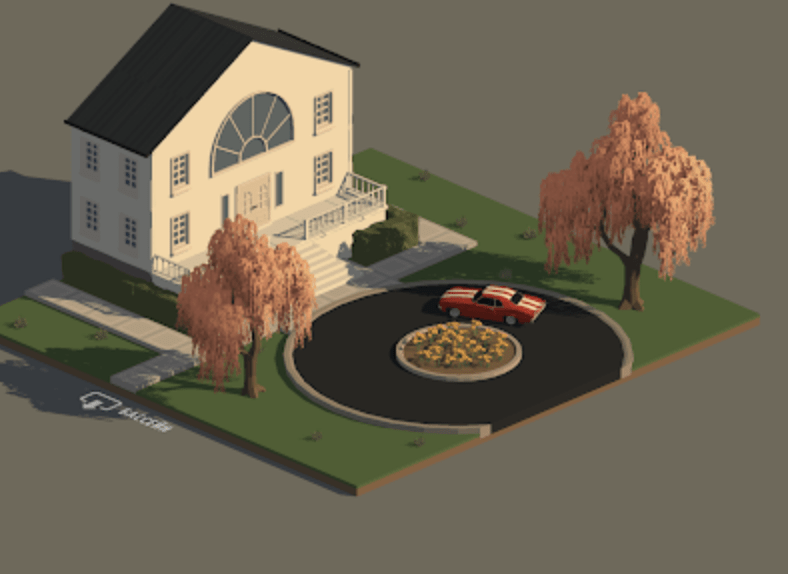
A detective receives a letter from his father and arrives to find the town of Redcliff emptied, every door and drawer locked with difficult puzzles. Tiny Room Stories: Town Mystery (Kiary Games, 2019), a mobile puzzle mystery on iOS/Steam (iOS here), targets casual puzzlers and escape-room fans. In TRS, narrative is woven through mechanics spatially rather than sequentially: the rotation mechanic makes the player perform detection, the architecture itself narrates what happened, and the puzzles pace the excavation. That attempt at embedded narrative still rings hollow at times, because the puzzles gate the story without being made of it, proving spatial storytelling requires more than distributing puzzles through rooms.

First, TRS weaves narrative into mechanics by making its singleverb–rotating the diorama–an act of investigation: detectives look at scenes from different angles, so the player performs detection rather than watching. Clues sit behind couches or on shelves only visible from opposite faces, so puzzles demand systematic sweeps and re-sweeps as new clues surface. “You know a character through the actions and choices he/she makes” (Chen, 6B), so the rotation mechanic and “inspection” characterize the narrative’s central detective character. In MDA terms, this rotate/tap/combine mechanic affects player experience by producinga dynamic of investigation for aesthetics of Discovery (LeBlanc).

Second, in classic embedded narrative fashion, TRS weaves narrative into mechanics by making architecture do the exposition, so the story arrives as rooms rather than as scenes or dialogue. Opening evidence documents distributed spatially around the town reconstructs the narrative. Characters normally reflect the built world (6B), but no Redcliff inhabitants remain, so the environment must reflect people who aren’t there (father, villains, etc.). This affects the player experience by making the player the assembler of the story.

Lastly, the difficult puzzles are mechanics to pace the narrative, but often feel unrelated to it, so solving feels more like arithmetic rather than storytelling. Each level’s beginning and end advance the plot (finding the ransacker’s identity, incriminating checks, etc.), but in between, the meat of each level is tens of puzzles with little narrative significance by themselves. In one moment of failure/struggle in the house level, I had three different four-digit patterns with no meaning to any of them–the codes were content-agnostic, leaving nothing but trial and error. Players should be taught chronologically close to when they need that information (George Fan sketchnote), but here the information arrives decoupled from its point of use. Worse, a wrong code gives no feedback or guide toward the solution, violating the “Help Users Recognize, Diagnose, and Recover fromErrors” guidance (6B). The player then fears they missed a clue, which is the designer’s mistake: If important elements sink into the background too much, it’s a perception problem, not a player problem (7A).
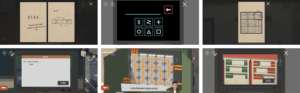
Portal answers the same mechanics/narrative question in the opposite direction. Portal‘s narrative is sequential, since solving a chamber triggers the next story beat. TRS‘s is spatial: the story already ended, and solving excavates it. Each carries a risk: Sequential risks feeling too linear, but spatial risks decoupling mechanics and narrative. Portal avoids this because its puzzle content is the story itself, but TRS‘s codes are content-agnostic, and the same four digits could work in any game and mean something completely different.
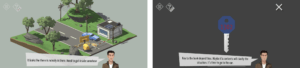
TRS offers few accessibility accommodations, and its one mitigating feature is sold rather than given. Apple’s listing shows no supported accessibility features, even though touch targets are small, and clues depend on fine detail on a small screen (e.g. Tiny keys violate the “If it’s not legible small, it’s not working” rule (7A).). Common Fate (7A) is also missing in a static diorama, leaving us to visual search. The hint system shows next steps, functioning as unintentional cognitive accessibility, but it’s gated behind ads. No firsthand accounts from disabled players exist for the title, which is itself telling. But when the core verb is seeing from the right angle, vision isn’t really a layer you can add options to, so the question is whether the central mechanic admits alternatives at all.

TRS’s design has both clever moments and flaws. Its onboarding follows “Learning by Doing” (6B): the first house gives you one room and nothing to do but rotate and tap, and highlights interactables to get the player to “perform the action once” (George Fan). That said, large blocks of text should be split up (George Fan). I also felt solution monotony: Too many puzzles resolved to “find key, then use key,” not more creative links. One solution would be to use more semantic codes (dates, room numbers, etc.), even non-numerical options. A peer game like Gone Home also tells a similar story of an empty house through objects, but without locks, so the player moves at the pace of their own curiosity rather than the puzzles.

In the end, the rotation mechanic tells the detective story, but narrative-through-mechanics isn’t just about having puzzles but having each individually contribute to the story.