Team Bathyergus (Xingyi, Ellie, Claire, Dana, Hazel)
Synopsis
The game is a dive into the mind, each level a deeper layer revealing clues and inspiration.
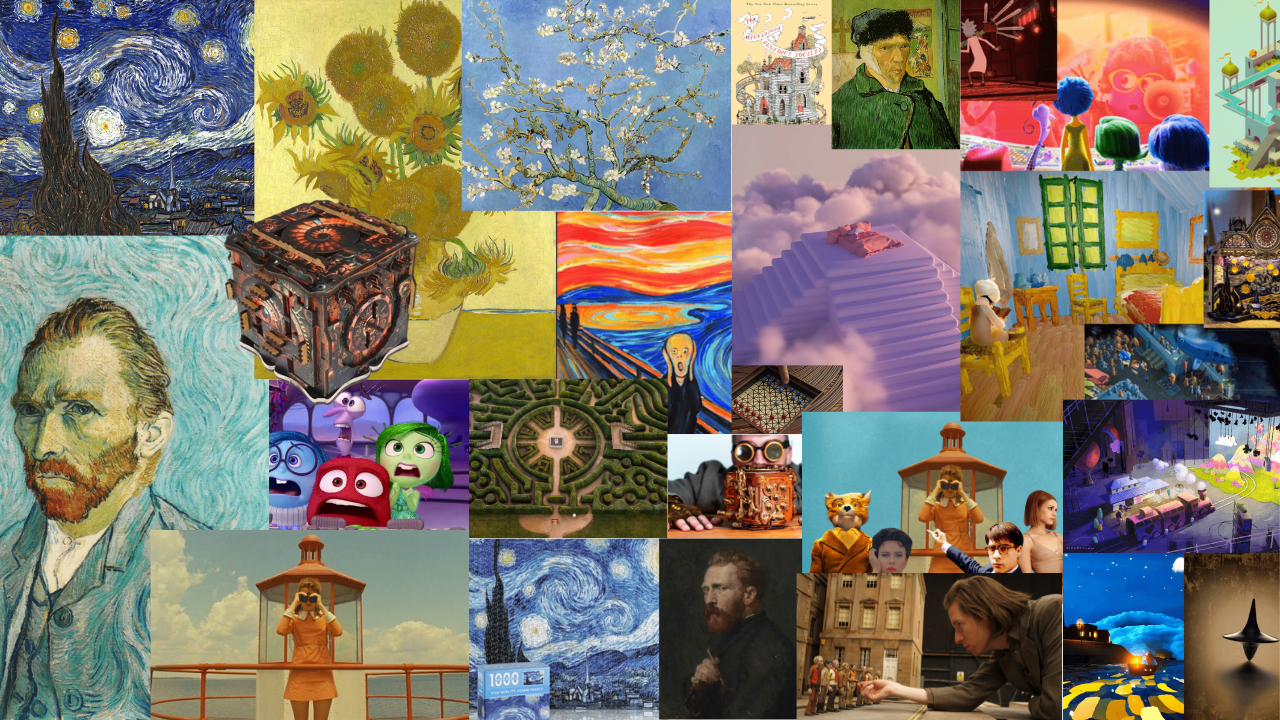
Our protagonist is Vincent Van Gogh. He sits cloistered away in the psychiatric hospital with nothing to do but fiddle with a mysterious puzzle box–the game is an adventure through the mechanical 3D puzzle box, each level unravelling closer to its core, each level drawing from a different work of Van Gogh’s, and each level giving him inspiration to paint something new.
Stories
We see a mechanical ear puzzle that at first simply seems like a maze, but at the end zooms out to reveal an ear, which falls off.
We see unreliable clues as the mind plays tricks. We play with reflections and shadow figures.
We see the character change shape, playing with scale. We see that things changed in one layer can affect subsequent layers, meaning you may need to go back and change decisions/toggles. We see that the character must change colors to interact with different objects, etc.
Tone
Reflective, introspective–The game doesn’t explore physical/geographic space but instead looks inwards, exploring the mindspace with an open outlook.
Curious, puzzle-y–Fiddling with a challenge or puzzle is a worthy and rewarding pastime because it reveals clues about the game and the subject itself.
Whimsical–The game doesn’t take itself too seriously. Just like Van Gogh’s art, everything is an impression rather than an absolute recreation. We want to play with scale, orientation, ears falling off, disorienting views, etc.
Setting
The mind space–more specifically, that of Vincent Van Gogh. In the mind space, the player navigates through painted scenes (e.g. Starry Night, Sunflowers, Irises, etc.) formulated as puzzles.
Gameplay
Our core gameplay is iterative puzzles, each unraveling a deeper layer of the 3D mechanical puzzle.
The specifics will vary based on the level’s associated artwork and puzzle layout. Some may involve overhead X-Y navigation of mazes, manipulation/rotation of Escher-like stair puzzles to escape, completion of Rube Goldberg-like setups, and more.
Using a PlayDate, X-Y navigation will occur via the Directional Pad, and manipulation of scenes will occur via the Directional Pad, A/B Buttons, and Crank.
Key Challenges
- For Tech:
- Programming for puzzles that involve manipulation/rotation: How to specify what portions to adjust, how to allow the player to adjust them, and how to then define how the character interacts with the adjusted map.
- Level interaction: How to have features across levels relate to each other, and how to allow the player/character to go back and forth between levels to change their decisions/states.
- For Design:
- Different puzzle types: How to create enough different kinds of puzzles/challenges to keep the player feeling interested, invested, and challenged.
- Narrative: How to incorporate the story arc across the multiple puzzles.
- For Art:
- Artwork incorporation: How to incorporate real Van Gogh works, and how to display them on the black-and-white PlayDate.
- Character art: How to visualize the player/Van Gogh at a small, pixelated scale.
Who is this for?
Casual gamer/puzzler; Anyone even slightly familiar with Van Gogh (it’s Evocative, but doesn’t depend on knowing minute biographical details, and also not protected IP).
Appendix
Individual Deliverables (Ideation Beforehand):
-
- Ellie: https://mechanicsofmagic.com/2026/07/19/individual-concept-doc-ellie-prince-team-bathyergus/
- Xingyi: https://mechanicsofmagic.com/2026/07/20/individual-concept-doc-xingyi-team-bathyergus/
- Dana: https://mechanicsofmagic.com/2026/07/19/individual-concept-doc-dana-to-team-bathyergus/
- Claire: https://mechanicsofmagic.com/2026/07/21/individual-concept-doc-claire-tang-bathyergus/
- Hazel: https://mechanicsofmagic.com/2026/07/21/60005/