by Ananya N., Clara L., Jinhyo H., Nicole N.
Artist’s Statement
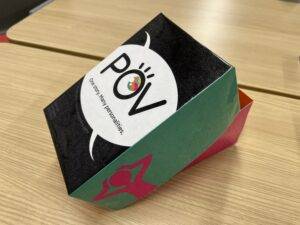
POV is a collaborative storytelling game for 5 to 8 players, ages 14 and up, where players take on character roles to collectively build an unscripted story. Inspired by Fibbage and Mafia, POV carves its own space: while those games focus on deception or deduction, POV rewards creativity and flexibility. What’s more, unlike many other narrative games, players are never bound by their characters: prompts can be written from any perspective, and narrators can steer the story wherever they choose. As long as they act the story out in their voice, their imagination can go as far as they want. This delicate balance of freedom while maintaining structured support through prompts and characters is what makes POV stand out. And the best part – engagement never dips. With only two rounds per game and a fresh starter prompt each time, momentum stays high from start to finish.
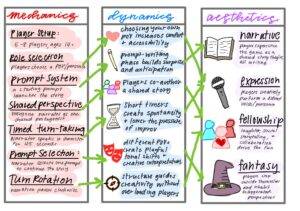
The 45-second narration forces spontaneity, while the hidden prompt-writing phase creates a subgame filled with anticipation – what happens next, and whose idea gets to decide? This mechanic loop consistently delivers the aesthetics we designed toward: narrative, as players co-author a story that belongs to everyone, and expression, as each character voice gives players a creative identity to inhabit and play with.
POV requires no prior game knowledge, only presence and imagination, making it equally welcoming to strangers and close friends alike. Furthermore, components were also designed with color contrast in mind to support players with color vision differences.
Concept Map
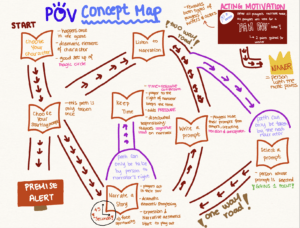
Initial Decisions
When we first started ideation, we wanted to create a game that prioritized fellowship, narrative, and fantasy as the primary types of fun. We wanted to create a party storytelling game where players were actively building a shared story together for performance. We were inspired by games like …and then we died, Wing It, and Wise and Otherwise because they are games that function with similar mechanics as ours, such as improvisation. However, we also noticed that storytelling games can place a lot of creative burden on players, so our design goal was to make improvisation feel more guided and less intimidating, in order to make it accessible to anyone with or without improvisation experience.
Our original twist was to combine the improvisational storytelling mechanics with hidden objectives and role deduction. We wanted the game to feel like players could experience some of the fantasy and character-building of games like Dungeons & Dragons without the complex rules or time commitment. At the same time, we were also interested in deduction and secrecy, drawing some inspirations from games like Mafia. This is where the fantasy element came in, players must temporarily step outside of themselves and into a dramatic persona. Some of our early role ideas included figures like “The Fool” and“The Hero,” So instead of asking players to invent a story completely from scratch, we designed roles, starting prompts, time limits, and a written continuation system to give players structure while still leaving room for fun, chaotic creativity.
To accomplish this, we came up with an idea containing the following elements:
Objective: Be the player with the most points by completing your Plot Point Quests (e.g. “kill the dragon,” “save a stranger”), correctly guessing other players’ Roles, and getting others to choose your suggested story continuations. Players earn points by successfully wearing their Plot Point Quests into the shared story, identifying Roles at the end of the game, or having the next Narrator select their written prompt to continue the story.
Players: Individual free-for-all. Each player draws a hidden Role card and hidden Plot Point Quest cards, then takes turns contributing to the shared story in clockwise order. Players must balance building the group story with completing their own secret objectives.
Resources: Players use hidden Role cards, three Plot Point Quest cards, a starting prompt, a reference sheet of all possible Roles, a notepad for tracking guesses, and a “break the fourth wall” card. The Role card tells each player with kind of persona they have to perform, the Plot Point quests give the players secret story goals to complete, and the “break the fourth wall” card that would allow players to temporarily pause the story and step outside of the roleplay to discuss their observations and guesses.
Procedures: The oldest player shuffles the Role deck and deals one hidden Role card to each player. Each player also receives three Plot Point Quest cards. A starting prompt is randomly selected, and the starting player begins the story. Turn order moves clockwise, with each player contributing for one minute. If a player completes a Plot Point Quest during their narration, they place it face up and announce it to the group.
Outcomes: The game ends after each player has spoken five times or when one player completes all of the Plot Point Quests and the turn order returns to the first players. Players then discuss their final guesses and reveal their Roles. Players earn points for correctly guessing other Roles, and players also receive points if other people correctly guess their Role. Whoever has the most points wins.
Conflict: Players must balance story-building, roleplay, secrecy, and reduction all at the same time. Players need to push the story toward their hidden Plot Point Quests without making their Role too obvious too early. At the same time, they’re watching how others speak and act so they can guess their Roles at the end.
Testing & Iteration History
Playtest 1
This playtest was conducted among our group after submitting Checkpoint 1. We realized after actually playing, there were many competing mechanics that sounded interesting in theory but conflicted with the kind of storytelling and roleplay experience we wanted players to have:
- Hidden Roles conflicted with roleplay. If players performed their Roles well, it became too easy for others to guess who they were. However, the guessing mechanism de-incentivized acting.
- Plot Point Quests were hard to control. Players could force their quests into the story even when they didn’t make sense narratively.
- There was too much to track. Players had to tell the story, act in character, hide their Role, complete Plot Points, and guess everyone else’s Role.
- Deduction distracted from storytelling. The guessing mechanism made players focus more on identifying each other’s Roles than on building the story together. Instead of fully committing to their character or making bold narrative choices, players became careful about revealing too much.

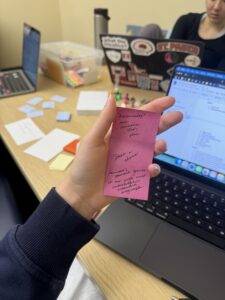
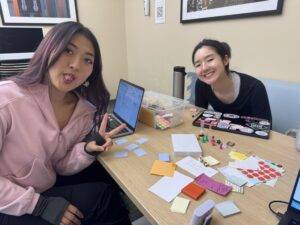
We shifted the game away from hidden deduction and toward clearer roleplay and collaborative storytelling. We focused on reducing cognitive load by making Roles easier to play, giving the story more structure, and designing mechanics that rewarded players for contributing creatively rather than hiding information.
We first removed the hidden-role structure and made Role cards face up. This solved the contradiction where players were supposed to act out their character well while also hiding who they were. We also moved away from Role guessing as the main point system.
We got rid of the Plot Point Quests and made the story-continuation mechanism a more central part of the game and easier to follow. We leaned into the existing structure, where players write possible continuations in one minute and the narrator chooses one to carry forward. We did this because it gave players a clearer, more collaborative way to influence the story without forcing disconnected objectives into the narrative.
Playtests 2 & 3 [Week 3]
These were the playtests conducted during 3A and 3B. These playtests helped us see that the core idea was working, but there were still major problems.
In Playtest 2, some of the things we noticed were:
- Starting the story felt difficult. Players found it harder to be the first narrator because they had to improvise from the starting prompt without much story context yet.
- Roles needed to be more intuitive and flexible. Some Roles were easy for players to understand and perform, while others felt too specific to certain story contexts.
- One person mentioned “I’m not sure how to act this [‘Two Birds with One Stone’ Role card] out. I think I would’ve enjoyed playing something more intuitive, like ‘The Oversharer,’ because it gives me a clearer personality to perform.”
- Players lacked incentive to fully act in character. Even when players had funny Roles, it was not always clear what they gained from fully leaning into their persona.
- The story perspective was unclear. Players were confused about whether everyone was narrating as one shared protagonist or whether each player was playing a different character in the story.
- Timing was inconsistent. One minute felt too long for narration, but some players also needed more time to write prompts, making the ideal pacing unclear.
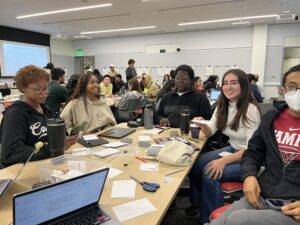
After Playtest 2, we adjusted the game by shortening narration time to 30 seconds, increasing our writing time to 1 minute, and clarifying in the rules that all players were narrating from the perspective of one shared protagonist.
In Playtest 3, some of the things we noticed were:
- Players were writing full sentences and plot ideas rather than short idea phrases and keywords that would allow the next narrator to build their own interpretation of the prompt.
- Some players enjoyed being able to speak, while others didn’t like being put on the spot.
- Some roles, such as the NPC (one of our originals that required the player to speak very minimally and without personality), were less intuitive to act out than others, such as the Romantic. In the NPC’s case, the player felt it would be very hard to earn the vote of the group for being a good actor, since their role was so bland.
- When speaking, players would choose to end their narrations where they felt comfortable – in most cases, this was before the timer would go off.
- One of our playtesters said they enjoyed the combined cooperation and competition, and encouraged us to maintain it.

After Playtest 3, we honestly had a bit of an existential crisis. We weren’t sure if people were having fun doing longer storytelling, or if we should cut down the amount of time they spoke to create a lower barrier to entry by reducing the improv. We considered throwing out the whole thing, and even created a completely new game out of desperation (to be playtested soon, it was still a very good alternative)!
However, we decided to stick to our original plan, refine the Roles (which we began calling POVs) even more, and shorten times to make the game snappier and more engaging… and hope for the best.
Playtests 4 & 5 [Week 4]
Our final playtest in class clarified a great deal for us regarding which roles players would be attracted to and willing to take on, as well as what sort of flow we could build into gameplay.
To prepare, we printed out all of our materials: instructions (as clearly detailed as possible), starting prompt cards, and POV cards (formerly Roles). We also cut the writing time down to 30 seconds to avoid the larger gaps of silence.
In our two rounds of playtesting we conducted for Playtest 4, we shifted our rules subtly to test out different communication methods and atmosphere:
- In our first round (Playtest 4A), we randomly dealt POV cards to each of our 5 players. In our second round (Playtest 4B), we had players survey all the available POV cards and select the ones they were most interested in using. This second method turned out to be far more effective and enjoyable, since players had built a personal connection to their POVs by selecting them.
- For both rounds, we provided players with small orange post-its to write their prompts on and made a note in the instructions to write “up to 3 bullet points” to encourage more phrases and words rather than full sentences. This did help with the flow of the game, and we were able to cut the writing time down to 45 seconds. However, some participants had trouble reading the handwriting on some of the prompt cards – this may have been due to the color of the post-its, which we decided to make white for the final product.
- To incentivize acting more, we added a final Game End mechanism of judging to have players vote on the Best Actor or, as we ended up calling it, the Fan Favorite.
Overall, this was a very convincing and successful two rounds of gameplay:
- We had one player choose to keep their role between the two rounds (“The Mope”), which indicated to us that it was a POV worth preserving. They also indicated their second preference for a POV (in the second round – “The Valley Person”), so we believed this had potential as well that we could assess during our final playtest.
- We had two players choose to swap their roles (“The Romantic” and “The Expert”), and both played their POVs beautifully in the second round. This emphasized to us the importance of having players select their own POVs.
- When asked if they would play the same POVs again if they ever replayed the game in the future, all players said they would not choose the same ones purely out of interest and desire for novelty. This was a concern we had when we allowed players to select their roles, so it was good to hear that our audience would be as open-minded as we hoped.
- Throughout the game, there was a good deal of laughter, both at each other acting out dramatic POVs and at the variety of suggestions noted in the submitted prompts to each narrator. It made us so happy to hear those laughs and see people smile!
With all of these takeaways and changes in mind, we proceeded to our final playtest (Playtest 5) during Board Game Night on Wednesday. Restricting our moderation to the absolute bare minimum (and answering questions only when asked – made notes of these points as well), we observed gameplay with an adjusted timing of 45 seconds for both speaking and writing, and allowed players to select their roles. We also had one person in charge of the timer for the full game Amazingly, our final runthrough produced all the joyful elements of our Playtest 4B, and more, thanks to the terrific acting skills and enthusiasm of some of our playtesters!
As the game progressed, we made notes on:
- How trophy prompts once got mixed up with discarded prompts, for which we added a discard pile card marker for all non-winning prompts.
- How players were slightly confused by the “3 bullet point” rule, regarding whether all 3 points should pertain to the same prompt or they should provide 3 different prompts as one bullet point each.
- How players naturally wanted the context of the next narrator’s POV to:
- make the prompt as relevant for the POV tone as possible
- most likely have their prompt selected as the winner.
We made corrections and adjustments to our materials, POVs, and instructions with the feedback received in our debrief with our playtesters. Ultimately, this playtest was a success as well, a positive closing note to our playtesting journey with POV.
Final Prototype
Our Print & Play game may be accessed for download here or below.
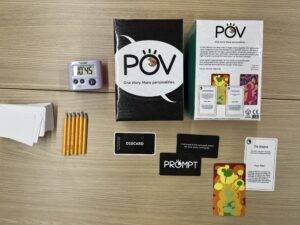
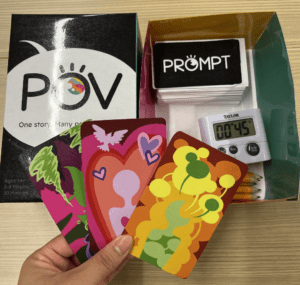
Our final game consists of:
- 12 POV Cards
- 20 Prompt Cards
- 1 Discard Pile Card
- Slips of paper for prompt writing
- Small pencils
- 1 Timer