

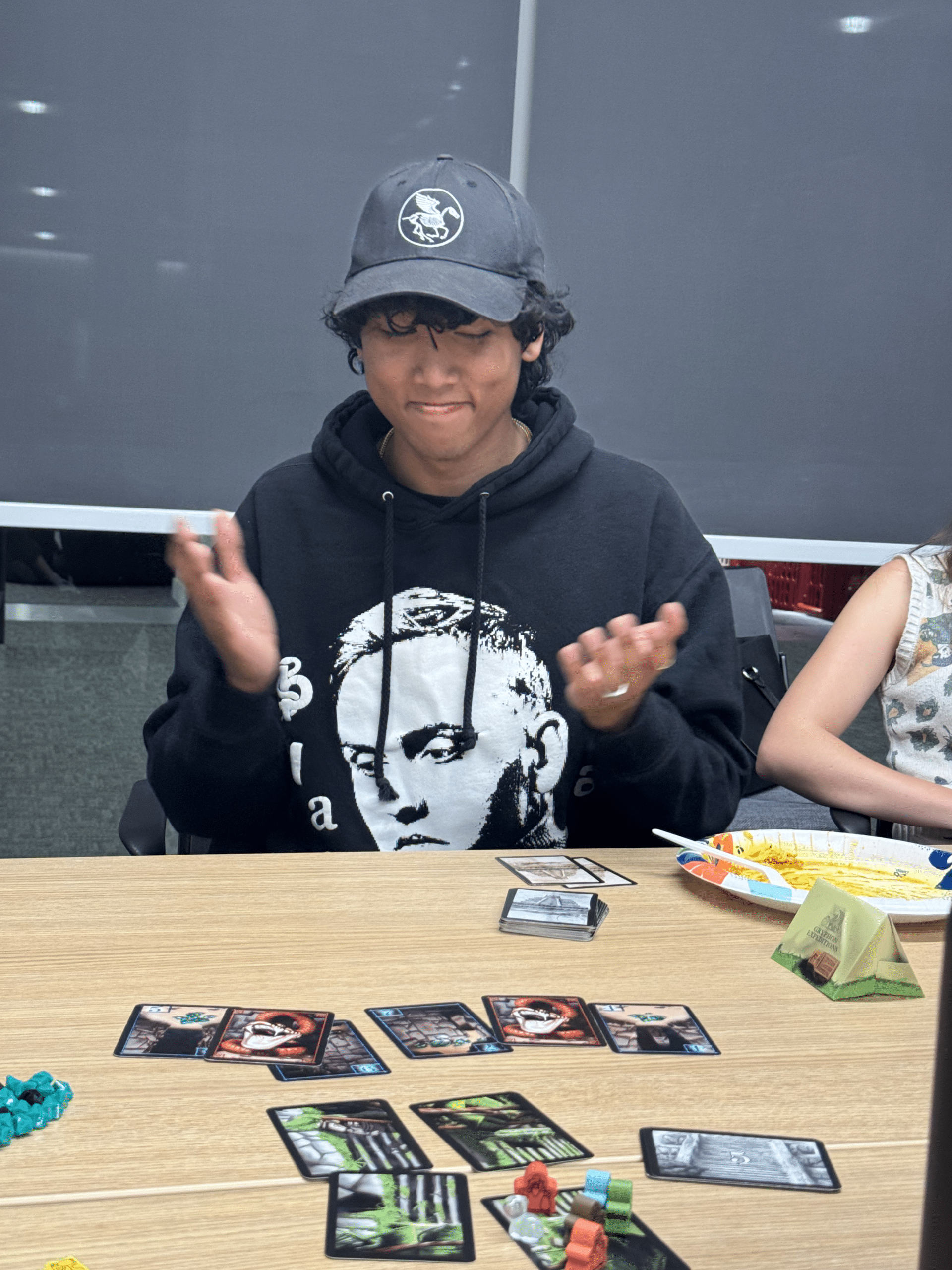
My P1 group is working on a game we call High Rollers, which aims to integrate gambling mechanics into a very light dungeon crawler. Naturally, one of the major questions we want to investigate via our prototypes and playtests is how luck affects player engagement and overall gameplay progression. To better understand this, I chose to play Incan Gold: The Race for Ancient Artifacts, a board game created by Bruno Faidutti and Alan Moon.
Figure 1: A picture of the box art for Incan Gold.
Incan Gold casts players (between 3 and 8 of them, ideally) as intrepid explorers in the ruins of the Incan Empire, competing with one another to collect the most gems and artifacts. The players only really have one core action available to them, and it’s a rather straightforward one. As the party descends deeper and deeper into the ruins, each player can choose either to flee, taking the treasures they collected up to that point with them, or to stay on the expedition in the hopes that even greater riches lie further down. Staying means encountering various hazards, though, and upon encountering the same hazard twice, every player who has not yet fled loses all of their treasure from the expedition. As such, each round presents players with increasingly difficult decisions about risk versus reward. The game’s rules are very easy to pick up, and it moves fast once everyone understands them, appealing to its target audience of families or casual gaming groups.
After playing a few rounds at Board Game Night with between 3 and 5 other players, I noticed a stark difference between Incan Gold and our current iteration of High Rollers. It’s actually a pretty scathing indictment of our work thus far, but one that I hope we can amend in order to bring about an even stronger game. In essence, though both games involve risk and reward, Incan Gold encourages players to “read” one another, which in turn encourages them to take repeated, compounding risks. By contrast, High Rollers has more limited room for players to guess each other’s actions and thus does not incentivize players to gamble as often.
Though the mechanics of Incan Gold are simple, they still give rise to compelling dynamics and aesthetics (besides the Fantasy aesthetic inherent to the game’s plot about spelunking in ancient caves). I noticed a brief but notable “dramatic pause” in each round as each player internally re-evaluates the current game state. During this pause, the players exchange information with their words, facial expressions, and gestures. One may attempt to use this information to guess whether the others will continue through the ruins or make an exit. This is an important thing to consider, as there are certain resources that players must split among themselves if many of them flee on the same turn. There is a notion of the Challenge aesthetic here, where the challenge is trying to outwit the other players into either leaving the round too soon or staying in it too long.
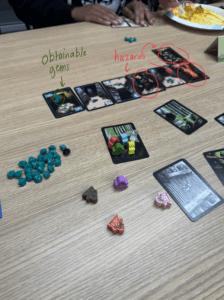
Figure 2: A snapshot of the game state with three hazards at play and not many gems up for grabs. The smart thing to do might be to flee, but what if there are more gems just past this point…?
Consecutive rounds of Incan Gold provided me with insight about the other players’ play styles or “personality types.” Some players were incredibly safe, sometimes fleeing as soon as the first hazard appeared. Some were more shrewd or unpredictable, showing temperance in some rounds but more aggressive in others. Some were named Ryan Loo and continuously lost all of their treasure in every round because they vehemently refused to ever back out. These play styles bring about much drama throughout the game, as players may compete not only to be the richest, but to be the most daring as well. It is this drama that makes Incan Gold‘s uncomplicated premise really shine, keeping things lively even after multiple games in a row.
Figure 3: A video showing the “dramatic pause,” as the players consider their actions as each new treasure or hazard is presented. Ryan coyly shrugs and glances around, as if to egg the other players on or keep them guessing about his intentions.
These emotional events were part of what inspired us to make High Rollers. As demonstrated by Incan Gold, even the most basic chance mechanics can offer players a lot of excitement and competition. The current issue is that the chance mechanics in High Rollers do not really encourage any player to consider what others are doing: at least, not to a satisfactory degree. During our first playtest with other students, we noticed that our players did not interact with one another very often or make much use of our “duel” mechanic, whereby they could steal resources from one another. They seemed to enjoy collecting tokens and gambling with them to progress through the dungeon, which was great, but our “social mediation game” was still disappointingly lacking in opportunities to socialize. As we continue developing High Rollers for our final iteration, it would be wise to take inspiration from Incan Gold, revisiting the game’s rules and premise with greater cognizance as to the Challenge aesthetic and the Narrative aesthetic. This will hopefully let players take better control of the roles they play within their shared gameplay situation and interactions between them more natural and more enticing.
Figure 4: A video of Ryan being met with the consequences of his own untethered greed. This again highlights the fun provided by elements of luck and chance: waiting with bated breath to see what the next encounter would be, erupting into laughter when it turned out to be a game-ruining hazard, et cetera.

I love the tiny videos you made to show emotion!