Team 1: Hunaida Elhassan, Violet Crow, Fiona Han, Mayowa Adesina
Artist’s Statement
Our game is based off one of the most unifying experiences we found for travelers: getting through the TSA line. No matter what one’s background is, how frequent they travel, or what kind of items they carry with them, everyone in our group had a shared experience of being held up by TSA’s subjectivity and arbitrariness. So, we thought, what better than to make a game about it! Gatekeeping is a social party game targeted at teens and college students (ages 15+) that acts as a satire of the TSA line system, meant to be played in ~10-15 minute rounds with 4+ players. It’s meant to poke fun at TSA, bond players together on a shared level of ridiculousness, and inspire some funny moments, facilitating social interaction throughout.
Players can receive 2 roles: the TSA Agent or a Traveler. Each Traveler uses the bag they already have on them as their pool of resources, while the TSA Agent invents Policies on the fly based on what items might be inside. But beware: the Agent’s policies are intentionally tricky, arbitrary, and at times downright absurd- it’s up to Travelers to keep up, follow along, and snitch on fellow passengers who slip up before they get caught themselves.
In this fast-paced game, the rules are never quite on your side- think on your feet, since the Agent might change the policy mid-sentence. Through elements of improvisation and shared absurdity, you’ll learn that at the airport (and in life), the only thing more unpredictable than the line ahead of you is the person running it.
Final Concept Map

Initial Decisions About Formal Elements & Values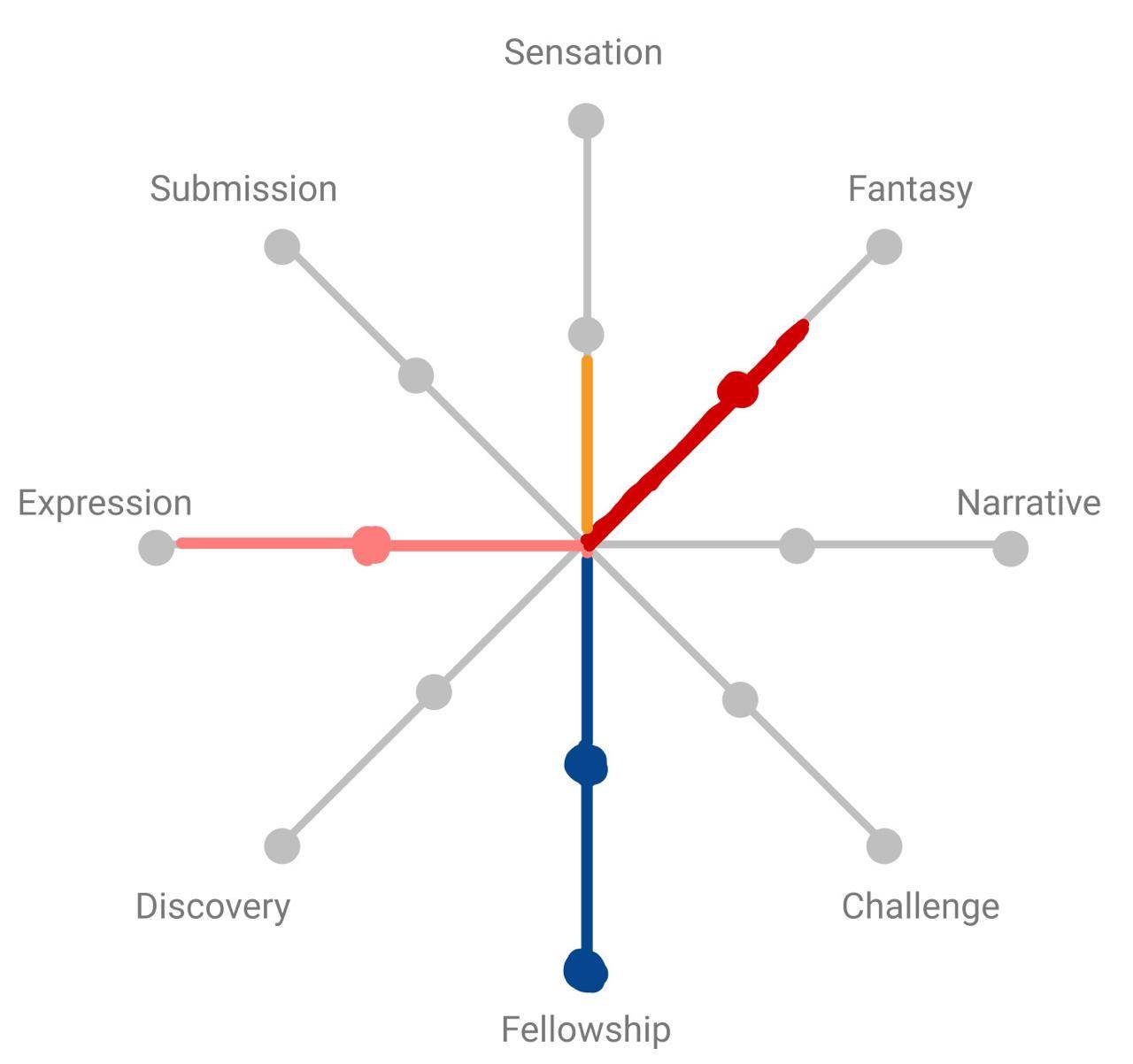
When our team played Mafia for the first time in class, we discussed how we felt something missing with social deduction games was a strong physical aspect: as much as we liked social deduction, we also liked games like Charades or Duck Duck Goose: games where there was an element of the game played outside the game itself. Our first objective was to create a truly accessible game to all, that could be played with items the players simply already had on them. As we discussed, we settled on a game with the theme of satirizing TSA to create sensation, expression, challenge and importantly, fellowship, as types of fun. We felt like having one player act as the TSA agent who facilitated, at times unfair, challenges, would unite everyone on the objective silliness of the scenario and would be the perfect way to usher in a magic circle that united all the players through shared joy. In order to develop this idea, we settled on the following:
Players: 3+. One Player is the TSA Agent, while the rest are Travelers. Travelers are multilaterally competing against each other to be the last standing.
Objective: For Travelers, outlast the TSA Agent’s ridiculous policies based on what you have in your bag. For TSA Agents, get as many Travelers out as possible.
Resources: Players are assigned a bag/use their own bag, with the items they have with them.
Procedures: TSA Agent creates policies based on items that might be in someone’s bag. Think Simon Says – the Agent can create policies that are meant to be tricky to follow. Travelers are expected to follow, and are out if they do not/cannot.
Rules: Travelers can snitch on their fellow passengers to get them out faster. The TSA Agent has jurisdiction over who gets out and who does not.
Outcomes: The last standing Traveler, who has followed all the policies of the TSA Agent, wins.
Boundaries: The TSA Agent is incentivized to give policies that are tricky to follow as well as ones that are intentionally ridiculous, providing challenge to the player. The shared ridiculousness of the game provides fellowship to all players, as they experience the TSA agent’s unfairness together.

Testing and Iteration History
We had three total rounds of playtesting, where our classmates were the players. This was an accurate representation of how our game would be played, as our target audience was 15+ (young adults and college students). We felt like this would be an apt audience, since they would be the ones most likely to share the struggle of TSA, and thus would get the biggest sense of expression from the game. We also wanted our game to function as easily playable for groups of people who don’t know each other well yet. Our playtests were extremely informative, and we made substantial changes to the rules of our game based on players’ feedback. These iterations are detailed below.
PLAYTEST 1:
This first playtest was carried out in class, with three other classmates as our game-players. We made the following notes and observations based on players’ feedback.
- What kind of fun does our game convey?
- Fellowship, Joker – To maximize the fellowship aspect of the game, and to increase social facilitation, we discussed the idea of having players get points from calling each other out when they failed to follow a rule given to them by the TSA agent.
- The win condition could be made clearer for both the TSA agent and the players.
- The TSA agent does not have a win condition currently as the roleplay mechanic of the agent role does not allow it.
- Although players were engaged in each others’ turns, we understood that this was only the case due to a low number of players. We want to ensure our game is enjoyable for multiple players and that everyone remains engaged even if there are many turns before their own.
Based on our feedback received from our players, we decided to implement two additional modes aside from the default competitive mode. Cooperative mode and Chaos mode. We also decided to implement a rule that players can call each other out (and lose/gain points) during competitive mode.
Iteration 1A: The Addition of Game Modes
(Previous implementation): One Player is the TSA Agent, while the rest are Travelers. Travelers are multilaterally competing against each other to be the last standing. The TSA agent is given a win condition, in cooperative-team mode.
Cooperative mode: Travelers lose if all have gotten out before 10 Policies have been assigned. Travelers win (as a team) if at least one Traveler is left after 10 policies have been assigned. The Agent loses if, after 10 Policies have been assigned, any Traveler is still in. The Agent wins if all Travelers are out before the 10th Policy is assigned. The Agent cannot stall indefinitely (for over 10 seconds) to avoid issuing Policies.
Competitive mode: Travelers lose (individually) by running out of points. A Traveler wins by being the last Traveler standing. The Agent cannot lose or win.
Chaos mode: The Agent is the final authority on all things, including all of the rules of the game, which they may remove, change, or add to.

In this iteration, the addition of game modes is intended to give the TSA Agent a clearer win condition and broaden the kinds of fun the game can produce. We found that the Agent was concerned about whether they could win or not, so we had our player interaction pattern shift depending on mode: unilateral competition in Competitive mode (Travelers against each other while the Agent facilitates), one-against-many in Cooperative mode (Travelers as a team against the Agent, with a 10-Policy threshold determining the winner), and unstructured play in Chaos mode (where the Agent has final authority over all rules and can change them at will). During play, Travelers in Competitive mode are incentivized to snitch on each other to outlast their fellow passengers, while Cooperative mode pushes them to coordinate and protect one another against the Agent’s increasingly ridiculous policies. Similar to before, players shared the same resource of the items already in their bags, allowing for player agency and improvisation without requiring any external materials to be brought to the game.
Iteration 1B: Snitching
Through this iteration, we hoped to deepen the social dynamics of Competitive mode by giving Travelers a stake in each other’s turns rather than simply waiting for their own. Thus, we added the Snitching mechanic. Our player interaction pattern leans further into multilateral competition: Travelers are now incentivized to actively monitor their fellow passengers and Snitch on them when they break a Policy, mirroring the paranoid, side-eyeing energy of an actual TSA line.
By empowering players to call each other out and get one another out of the game, we hope to maintain engagement during others’ turns and amplify the fellowship-through-shared-suffering that drew us to this concept in the first place. This could also offload some of the policing work from the Agent, who in our first playtest had to track every Traveler simultaneously, and instead distribute that vigilance across the table. This change could reframe the Agent less as an omniscient enforcer and more as a final arbiter, with Travelers acting as both competitors and unreliable witnesses against one another.
PLAYTEST 2:
Our second playtest was carried out in class, with five other classmates as our players. We observed the following:
- While the TSA agent eventually got the nature of the role, causing chaos and confusion for the group, we had hoped that this would happen within the first 2 minutes of the game, rather than the first 10 minutes.
- Players successfully called one another out for not following policies- the TSA agent had to decide whether or not the accused player was following the rule or not.
- The TSA agent asking players to perform tasks in a random order does not work. It gives an unfair advantage to players (that go last) and have longer to think about their responses. Order must be assigned by the game and questions/tasks given must be equally distributed among all players.
- The TSA agent ran out of tasks to give to the travelers, and would end up stalling to think.
- Some players felt like the certain tasks would be hard to follow for players who were not able-bodied, or could not manage the physically demanding tasks.
Iteration 2: Bag of Items, Policy and Passport Cards
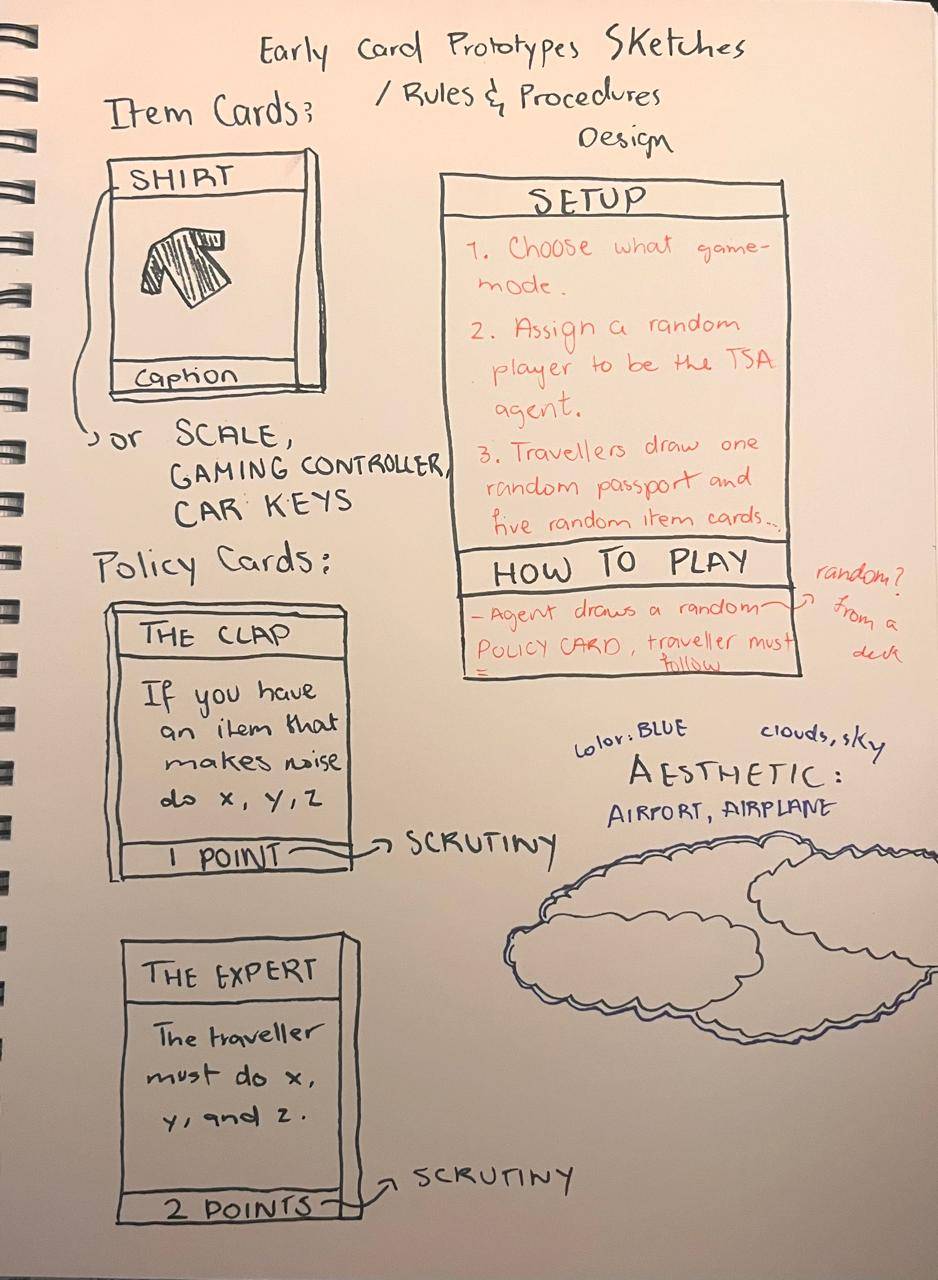
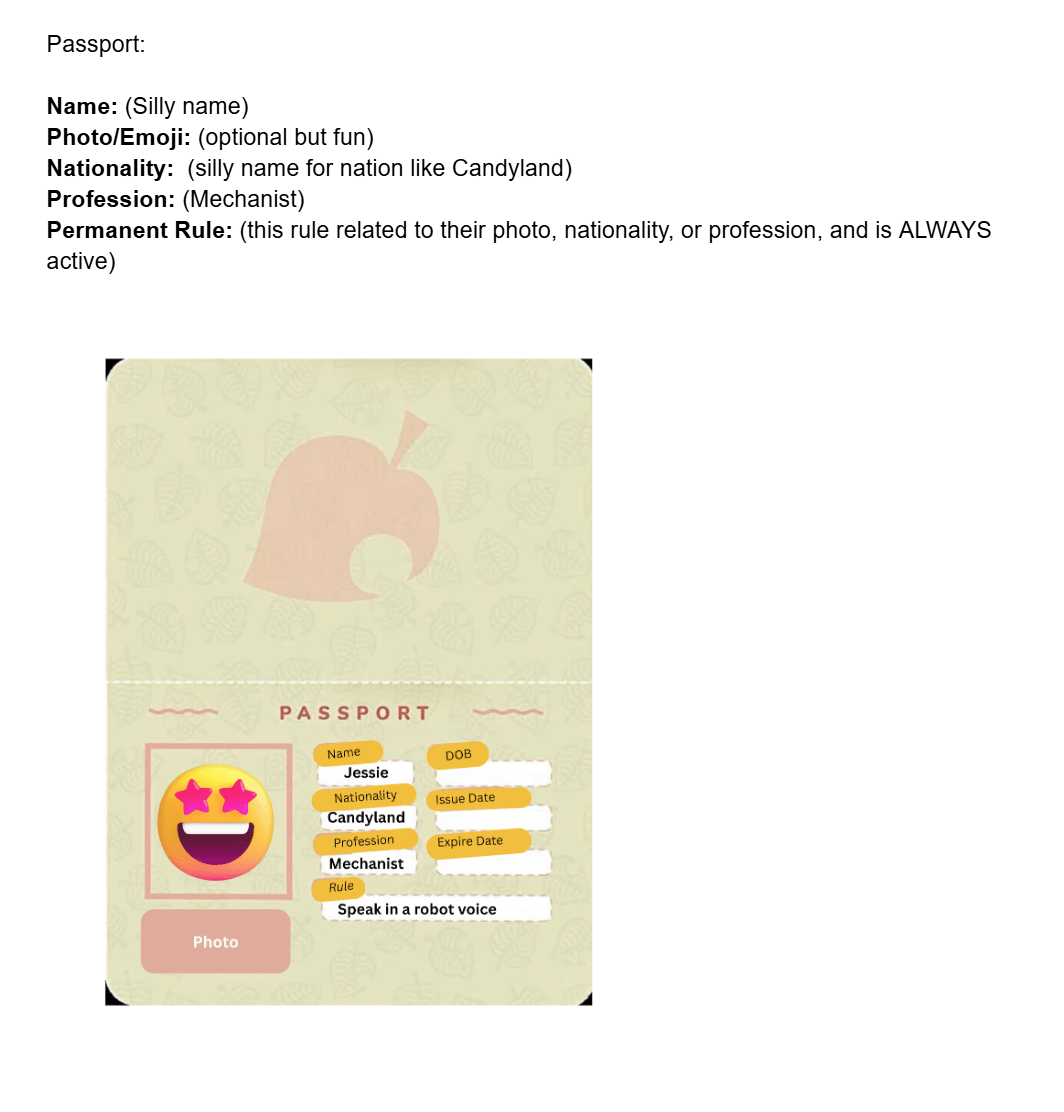
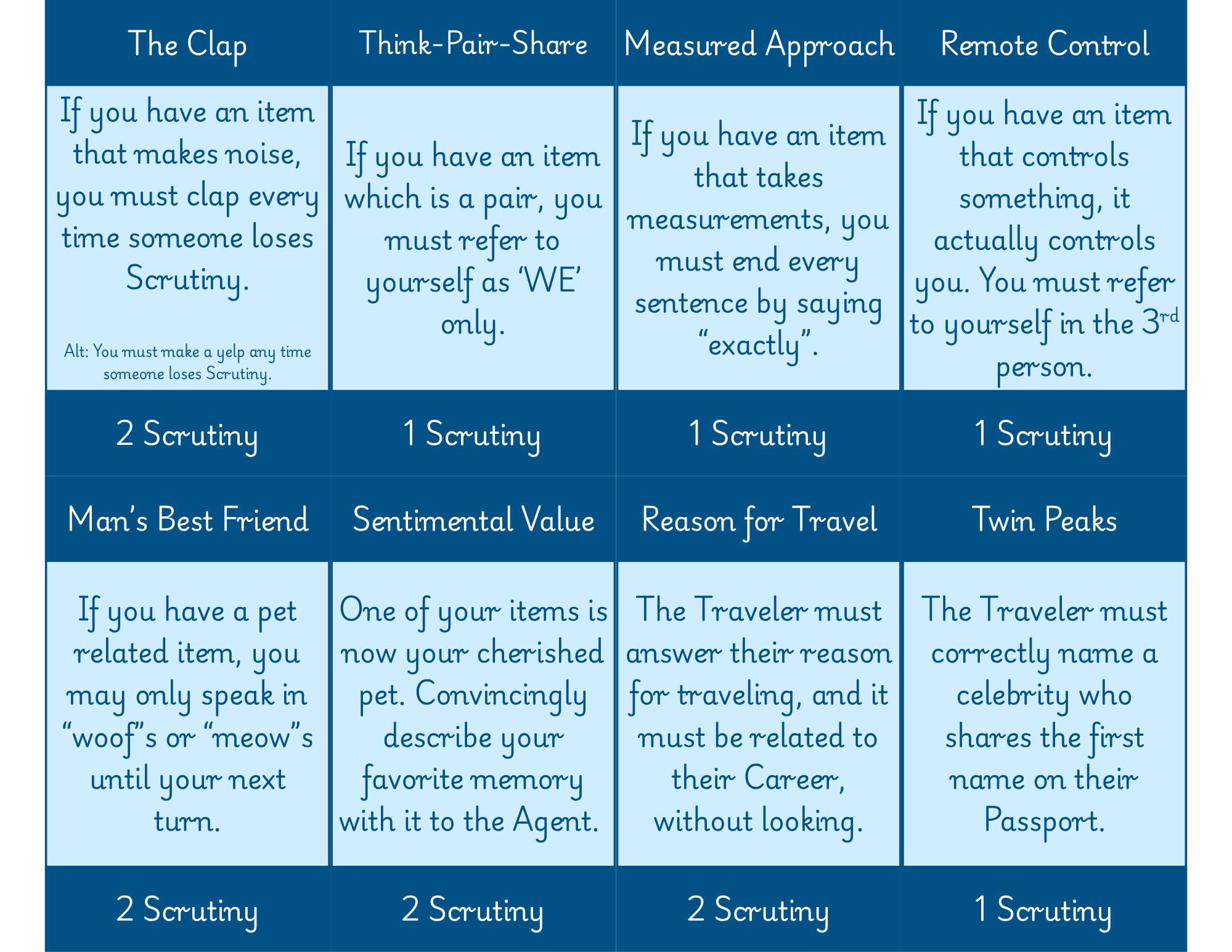
To address our game relying entirely on the Agent’s improvisational creativity, we decided to scaffold the experience with three distinct card types: Policy Cards (drawn by the Agent to dictate what each Traveler must do or avoid) and Passport Cards (which assigned each Traveler a permanent identity and rule they had to follow throughout the round). We made sure that for Policy cards that could potentially prove to be non-accessible, they had an accessible alternative listed with them. We also decided that each bag of Items would be prechosen to ensure each bag had a random and fun assortment of items that would make for interesting interactions with policy.
Our resource structure becomes substantially more deliberate as a result- rather than depending on whatever items players happen to have on them, every Traveler now starts on equal footing with a randomized but bounded set of belongings, while the Agent has a ready supply of prompts to pull from. This addresses the stalling problem we saw in Playtest 2, where the Agent’s creative well ran dry within minutes and the game’s pacing collapsed; by externalizing the Policy generation into a deck, we ensured the Agent could maintain a steady rhythm of absurdity without bearing the full cognitive load of inventing it. Passport Cards, in particular, added a layer of role-play and persistent challenge: a Traveler might be told they could never make eye contact with the Agent or had to refer to themselves in the third person, creating ongoing tension that compounded with each new Policy.
Iteration 2B: Scrutiny
Alongside these cards, we introduced the Scrutiny system- five points given to each Traveler at the start of the game that represent their remaining “patience” with the Agent. Each Policy Card now carries its own Scrutiny cost (typically 1 or 2), so trickier or higher-stakes Policies, like declaring a plausible nation of origin for a food item- pull more Scrutiny when failed than simpler ones. When a Traveler breaks a Policy, they lose the listed amount of Scrutiny rather than being immediately eliminated, giving players a tangible buffer that lets them stay in the game even after a slip-up, and giving the Agent a built-in way to calibrate the severity of each infraction. We believe that Scrutiny will give the game a visible economy of risk: players know exactly how close they are to elimination at any moment.
PLAYTEST 3:
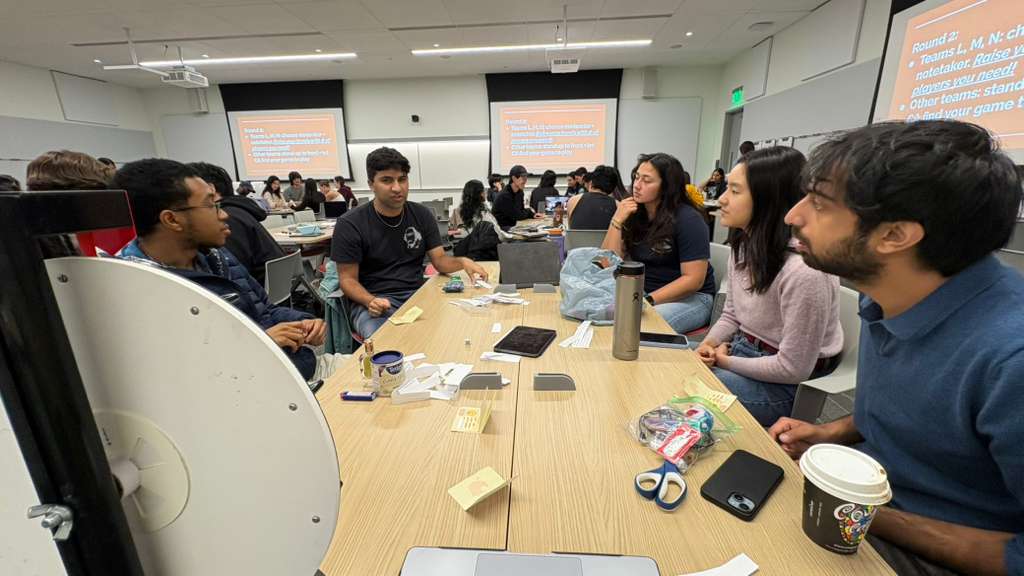
In our final playtest, which was carried out in class, we focused on including all the physical elements of the game. For example, we brought with us a wheel, which was meant to be used for one of the policies. Sequential turn order also became enforceable through dice rolls, which would now make whoever was under scrutiny completely random, preventing bias from the TSA Agent. In our final playtest we found the following:
- Players really enjoyed the absurdity of the policies, the opportunity for roleplay that came out of it, and the satire of the TSA it created.
- It took too long to get into the quick-paced flow of the game as we intended. The players noted that “the dice rolls took too long” and “definitely should be changed to something else.”
- The policies with the best reactions took advantage of the expression element: policies that referenced people’s passports, weird items that happened to be in people’s bags, and ones that allowed the TSA Agent to be as unreasonable as possible.
- Both the Agent and the Travelers had trouble determining which players had Scrutiny and how much, stating “a scoreboard would be nice.”
Iteration 3: Final Changes
The main issue we wanted to fix was having players get into the gameplay loop as fast as possible. We noticed that players were confused by the wording of the rules, so we clarified them to explicitly separate the procedural setup of the game from actionable rules. Furthermore we clarified all edge cases that could come up in the beginning of the game, like clearly clarifying how Travelers were allowed to lie, but the TSA Agent had free reign to call them out, resulting in an extra loss of points. We also addressed the concerns about the dice rolls by having each player be chosen sequentially. However, to retain the element of randomness, we had it so that after every player is chosen, the TSA Agent chooses who gets to be under extra Scrutiny. We removed the random elements such as the wheel and the die as we felt giving the agent even more agency and power over the other players extended their power beyond the gameplay and to the very structure of the game playing experience itself, more strongly pushing the satirical nature of the game.
We also edited the game elements to have even more things that reflected the positive feedback from the players. We added more policies that referenced the specific things noted on people’s passports, referencing their ‘names’, ‘dates of birth’, and ‘career.’ We also added more ‘out there’ items along with the traditional ones that would excite and amuse the players, like a sword right next to a pair of socks, or a millipede next to a MP3 player. Finally, we added policies that helped provide even more fun to the TSA Agent: players enjoyed a card where the Agent got to simply say ‘both of you, give me an item.’ and switched them, having the game continue from there. So, we added more wild card policies that played into the Agent’s power dynamic. All these game elements dynamically served to make the game more energetic, in turn increasing the game’s pace. We felt that this would be the biggest supporter of fun as Fellowship to our game, since we were iterating on the policies that we saw produced joy, laughter, and bonded people together.

Finally, we added physical Scrutiny token cards that could be placed near the player to represent the amount of Scrutiny that players had at all times. We hoped that this would result in Agents being able to balance the flow of gameplay if needed, being able to choose to put players who had more Scrutiny cards under extra Scrutiny. Or, have them pick on players who had less Scrutiny, based on excitement we saw from the players when the dice rolled on one player multiple times. We also thought the act of physically surrendering a token to the Agent creates a satisfying (and slightly dreadful) ritual that mirrors the real-life experience of being singled out at security.
Some other changes we made included the sizes of the bags people received being bigger, which obfuscated the items for added surprise. For our print and play alternative, we created Item Cards, drawn by each Traveler to populate their “bag” with random items, reducing the need for physical objects.
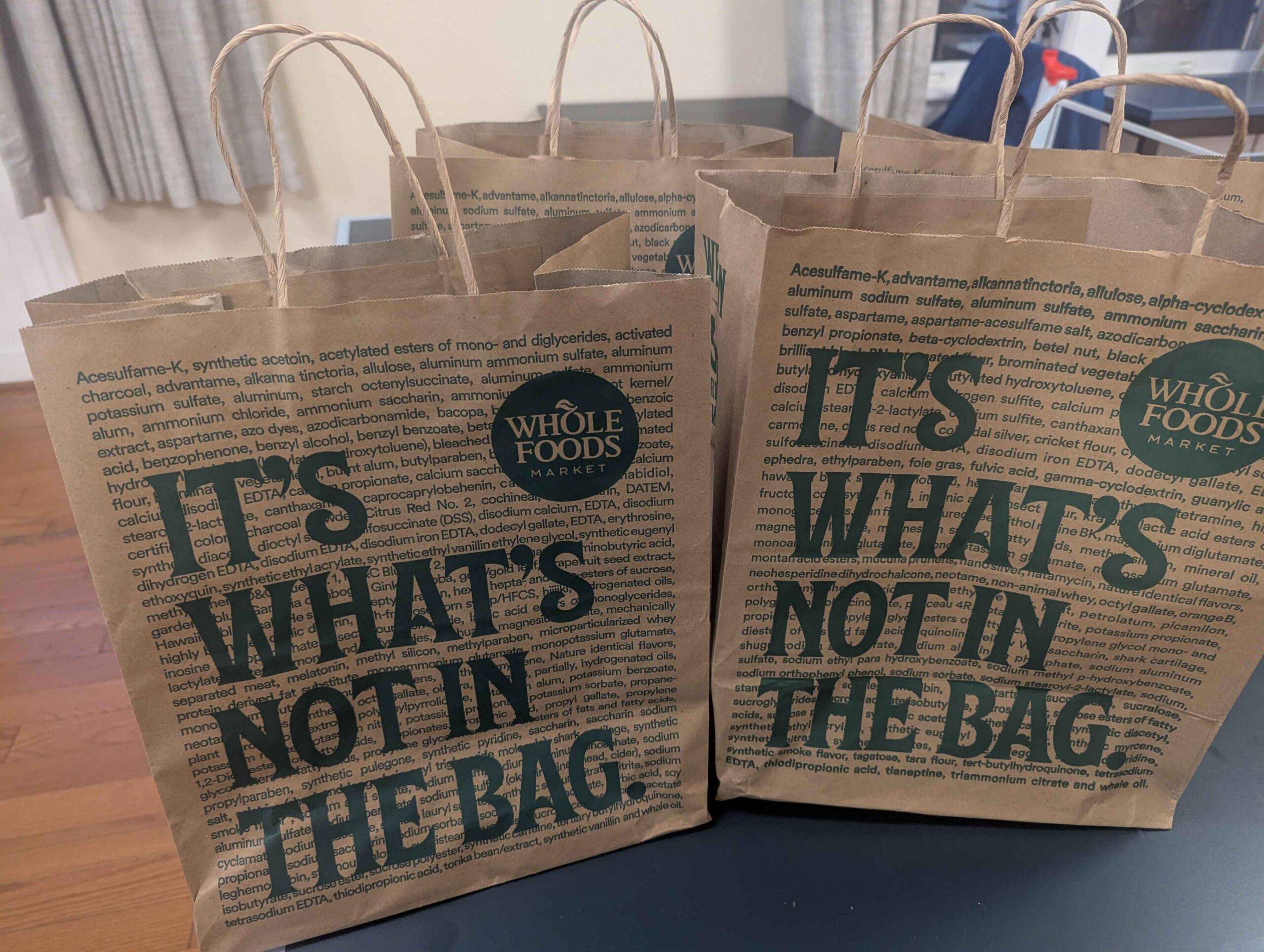
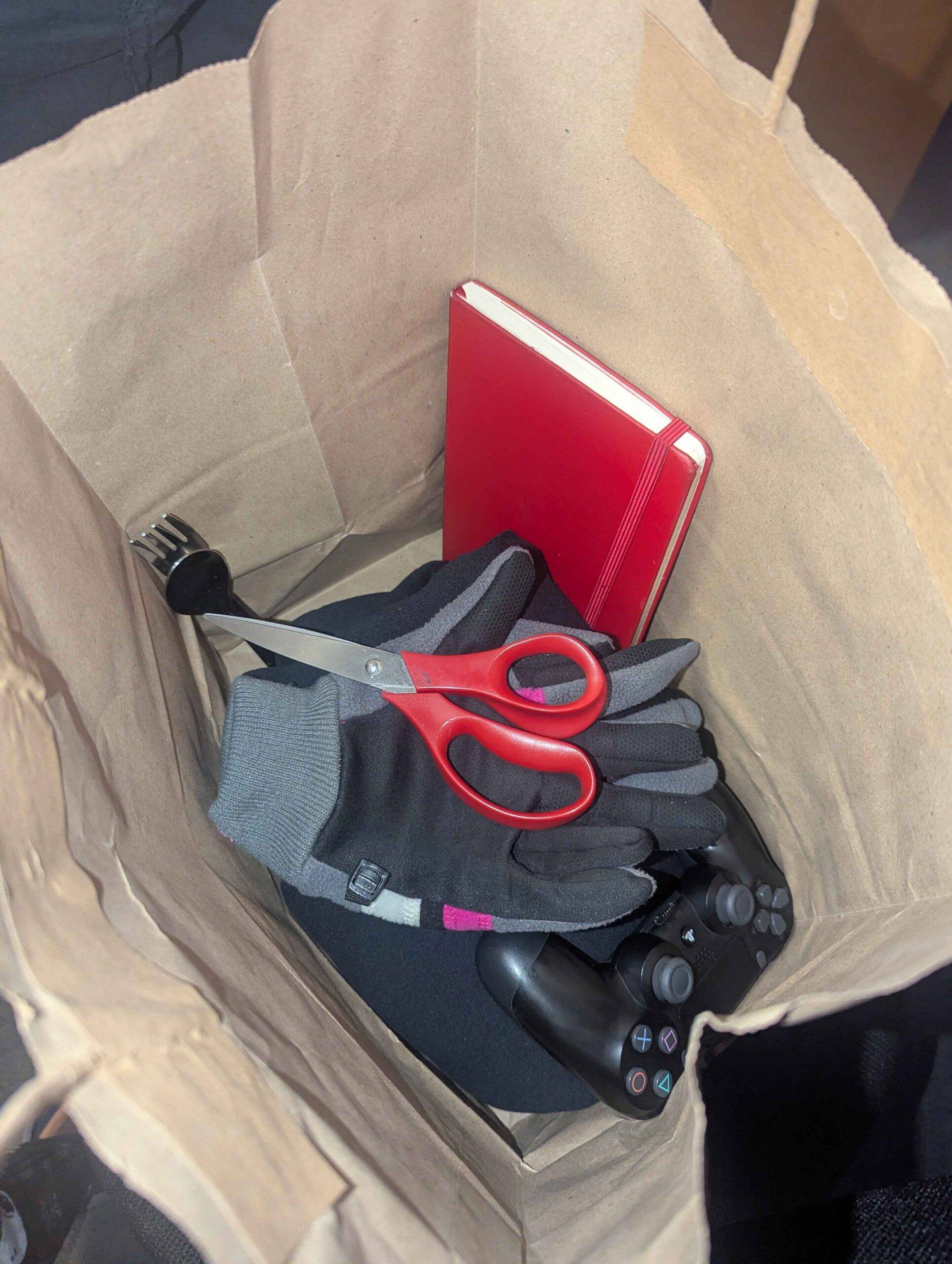
Overall, we made sure Gatekeeping addressed all the concerns of our playtesters and ended up with a final product that we felt manifested social connection for all players!

FINAL PRINT & PLAY PRINTABLE PROTOTYPE (also contains all game materials)