

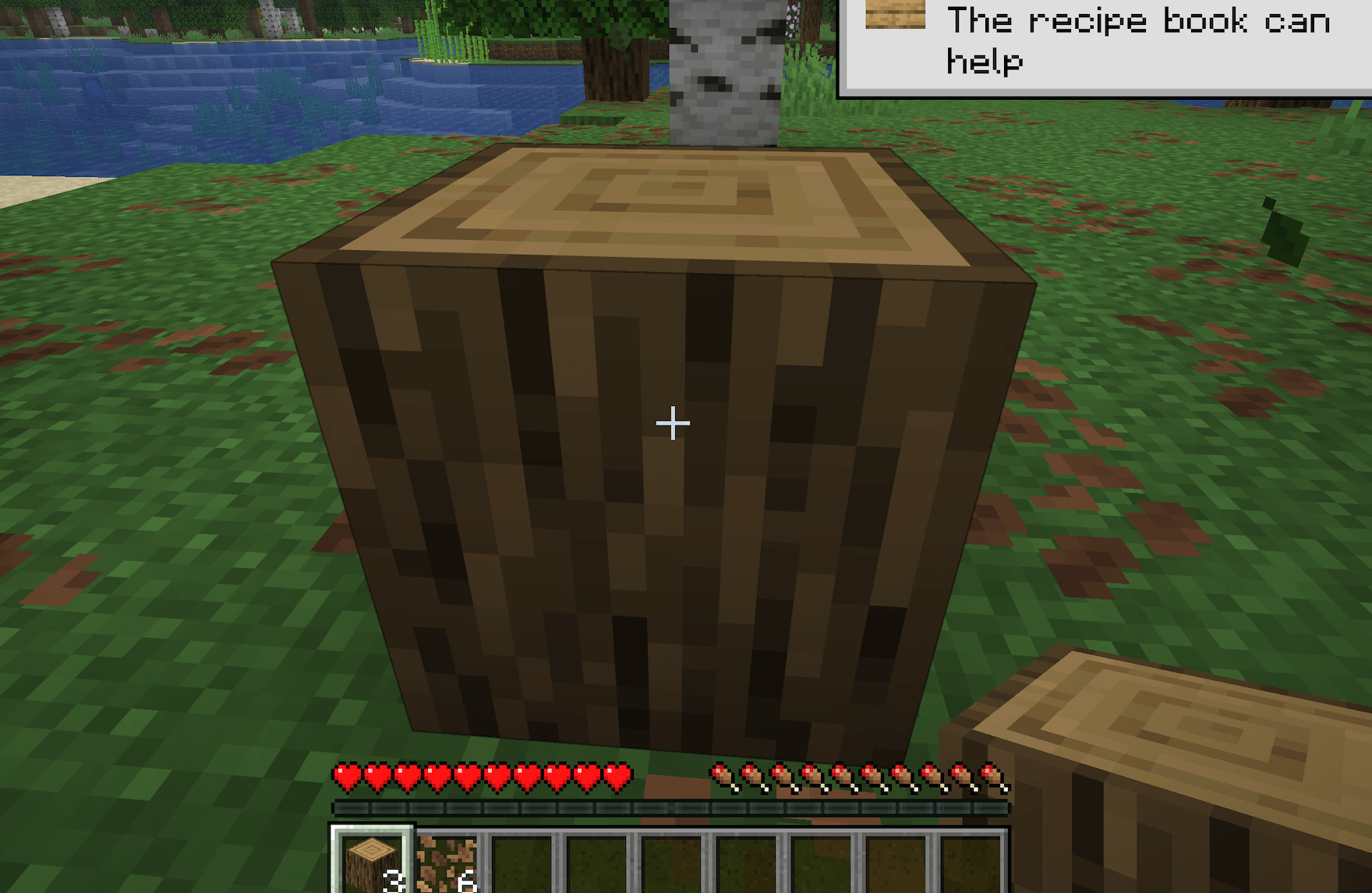
For this week’s assignment, I chose the free demo that gave about ~1.5 hours of play. Minecraft appears to offer unlimited freedom in the way that the game gives very little prefacing information or instructions, and immediately throws the player into the scene. As I was playing, I realized that the game was subtly pushing me into a very specific way of interacting with the world. The McLuhan reading argues that “any medium has the power of imposing its own assumption on the unwary”, and this was demonstrated in the way that I spent much of my first hour extracting resources and trying to reshape the terrain. Even though the game initially felt open-ended and creative, and I was not following a scripted story, the mechanics guided my behaviour and decisions. My experience showed that Minecraft can still be understood as a text, because despite the seemingly unending options of choices, the game structures how players behave and assigns value to the world around them. The meaning of the text doesn’t come through a narrative form like some of the other games that we have played in this class, but rather through the patterns of behaviour that are normalized and rewarded.
The game communicates through interaction rather than dialogue, which helps it still feel meaningful even when lacking a traditional sense of a plot. Almost immediately after joining the game, I was confused about what was expected of me, and started punching through the trees. I saw how my store of wood/leaves increased as I did this action, spurring me to continue destroying and collecting material. The game didn’t explicitly instruct me to do so, but it felt like it was necessary for survival, making the resource gathering feel really urgent and necessary. After a couple of minutes, I noticed how the environment stopped feeling like scenery and started feeling like a way to keep up inventory. I was disappointed when I fell into the water, feeling like it was slowing me down from collecting necessary resources. Trees were wood for crafting, and it seemed that open land was space to build shelter. Even though the game was presented as a space for freedom, it felt like I was being pushed into reshaping the environment in order to progress. I was becoming greedier by the minute!
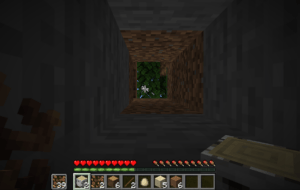
The YouTube video argues that the colonial metaphors are created in, specifically, the relocation of villagers and terraforming. During my play, whenever I encountered uncertainty, my instinctive response was to dig or gather more responses. However, it didn’t feel like Minecraft was a colonization experience (within my short playing experience). The game, by mechanics, lets the players do anything, but the survival systems underneath the sandbox push players toward the “colonizing” behaviours, like extraction and control. At one point, I wanted to see how deep I could go into a hole/where the ground would stop when trying to collect materials, and struggled to climb back out. The moment felt representative of the game’s overarching logic, where even the moments that felt self-directed were still being shaped by the systems that felt like they were rewarding me for altering the environment around me.
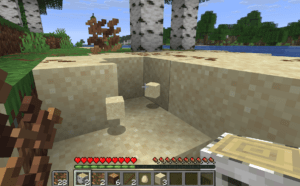
The reward system, in particular, reinforces this one-sided relationship between the player and their environment. Since every action that involves extraction produces some kind of visible progress, in the way that blocks disappear, inventories fill up, we unlock more crafting recipes, and the tools become stronger, there is a clear reward-incentive system. The satisfaction of progression became linked to how efficiently I could move through the environment and unlock more materials. It also changes how the player perceives time within the game. The day and night cycle functions are less of an atmospheric feature and act like a pressure system: I was rushing myself to collect materials, not really out of curiosity but out of a game-manufactured anxiety. Even though this was my emotional response to a situation that maybe didn’t require it, it felt like it was designed into the system (admittedly, this could be because of the short nature of the demo).
Minecraft is thus an interesting “text” because of how our behaviour is subtly pushed and influenced. This is what Minecraft conveys as a medium, that as players, we aren’t being convinced of the game’s logic, but rather influenced to feel like this logic is common sense — the only way to go on.



Hey Anavi! One idea in your argument that I resonated with is that in addition to encouraging extraction, Minecraft’s systems make efficiency feel more neutral than it may truly be. Once progression becomes tied to gathering resources and optimizing production, it becomes difficult to ask whether a particular transformation of the landscape is desirable at all. This makes me think of the video’s discussion of colonialism, but also of a broader critique of technological systems. Many modern technologies frame problems as engineering challenges rather than ethical ones, encouraging us to focus on optimization while obscuring the values embedded in the process. What strikes me about Minecraft is that there are countless ways to play, yet nearly all of them rely on the same underlying assumption that the world exists to be acted upon. Even creative or aesthetically motivated building projects begin with the extraction and reorganization of resources. This makes me wonder whether the game’s most powerful message is not simply that development is progress, but that agency itself is defined through the ability to transform and control one’s environment. If that is true, then Minecraft may be teaching a much deeper cultural value than resource gathering, for it is crafting a vision of what it means to be an effective human actor in the world.
What makes this especially interesting is that Minecraft often feels empowering precisely because it minimizes forms of agency that are not rooted in transformation. The game rewards players for what they build, mine, and alter, but rarely for what they choose to leave untouched. As a result, even players who are not consciously pursuing efficiency can end up measuring success through the visible marks they leave on the world. In this sense, Minecraft may reflect a broader cultural tendency to equate impact with intervention and the idea that doing something is inherently more valuable than preserving something. I think this is where McLuhan’s argument becomes particularly useful: the game’s message is not contained in any explicit narrative about progress, but in the assumptions embedded within its systems. By making transformation the primary expression of agency, Minecraft subtly teaches players not just how to succeed within its world, but how to imagine their relationship to the world itself.