

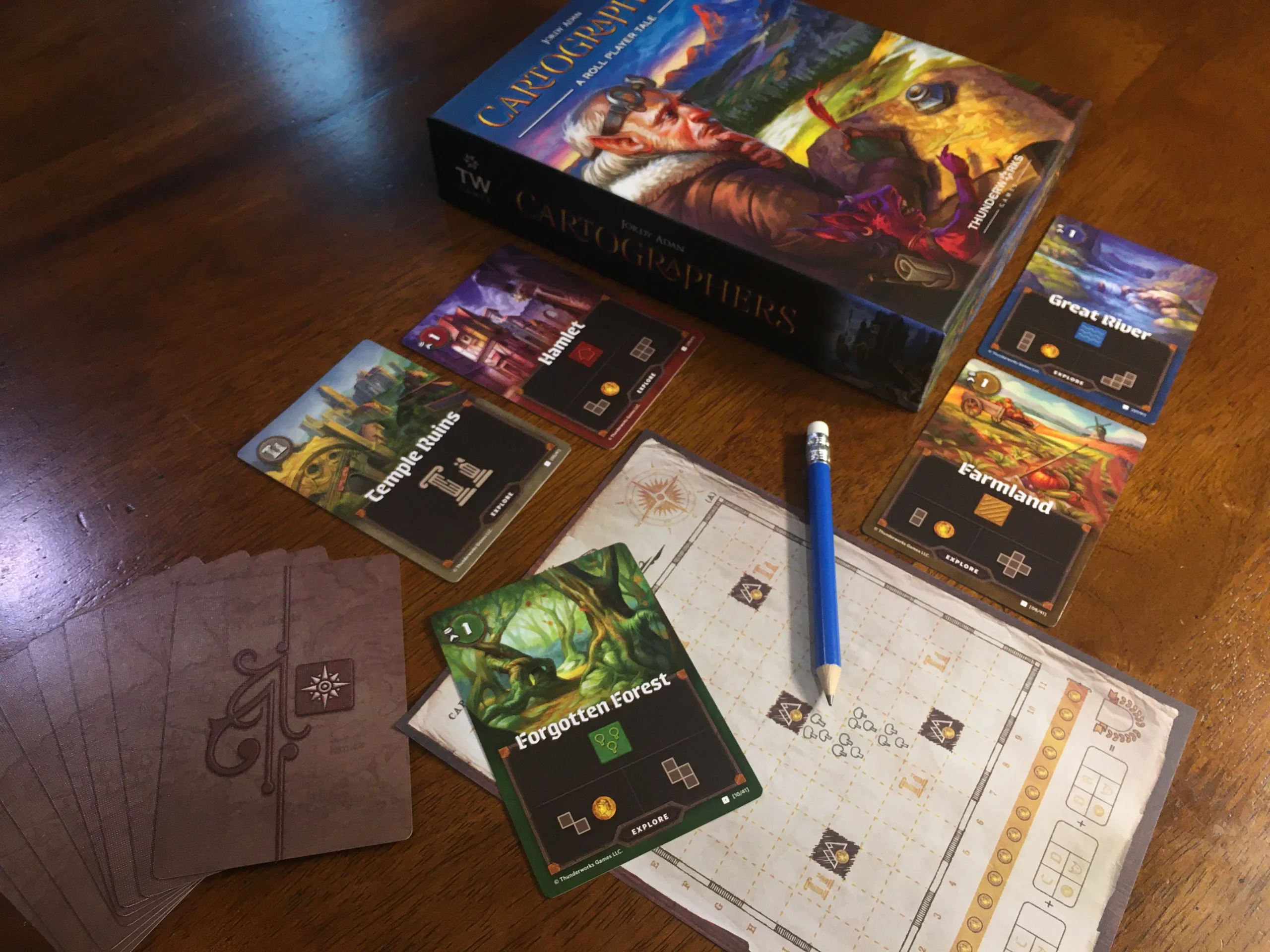
Cartographers: A Roll Player Tale (2019) is a tabletop [roll &] write game (where you “roll” through a card deck) designed by Jordy Adan. With ridiculous names like “Queen Gimnax” and the “Dragul” and a theme that doesn’t add up in its components, I would say this is a game for a very confused audience that is okay with doing math for gameplay and scoring but perhaps doesn’t need to take the game too seriously.
Unfortunately, Cartographers did little to invest the player in the world it attempted to build, from setting the context in the rule book to actual gameplay and progression.
There’s a huge reason for why this game fell through for me, personally. The narrative was a complete mismatch with the gameplay – cartographers are meant to gather geographic data and create maps based on what they observe, whereas the game had each player constructing their individual lands through the writing mechanism.
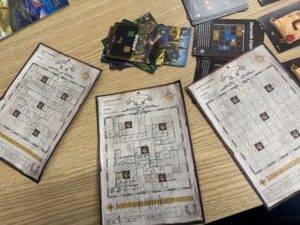
While this does place the game in the world-building category quite firmly, the game premise itself hadn’t been tied closely enough to make sense. For a 10+ age audience, perhaps they wouldn’t care as much, but as someone who enjoys looking at maps and the idea of cartography, this was too inaccurate for me.
The actual gameplay was quite monotonous for all three of us who played. Akary complained that “if you place things badly at the beginning, you’re f***ed” – noticing this “first-turn problem” (what I’m going to start calling it from now on until I find an official term) detaches the player from any sense of investment they might feel in trying equally as hard in later turns. Mai noted that “there aren’t enough [Explore] cards to be interesting. [By the time we get to Fall], we’ve already drawn everything.” These Explore cards were our die rolls, so the expansive nature of the concept of world building wasn’t very tangible, as it is in other games with massive card decks.
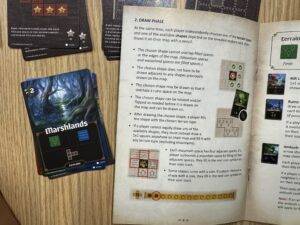
Perhaps the only aspect of the game that truly immersed the players in the aspired atmosphere was the fact that they were writing.
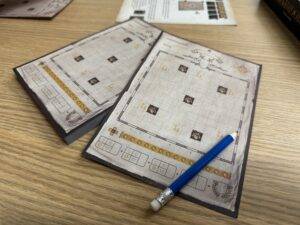
Unfortunately, that was little compensation for the rest of the game. The changing seasons attempted to add to the surrounding and landscape development, but there was really no difference between these “seasons” and other games’ rounds. This is a thematic problem that I feel occurs in multiple games that try to include some sort of natural round progression dynamic. Thinking of a game I do love, Everdell, changing the seasons has a bit more weight behind the action (reactivate your green Production cards vs. draw from the Meadow, take more workers, etc.), but where they faulted is in the dynamic that each player can “change seasons” at different times in the game, yet all players are building cities out of the same constructions and critters within Everdell Valley.
*Sigh* When are game designers going to get these season shifts right… Anyways, back to the game at hand.
The largest qualm I had with Cartographers was tied closely to an ethical issue I could sense that was built into the core of the game. Like I said earlier, gameplay focused on creating a world rather than just mapping it (as it should have done). There’s no problem with that as-is, but the fact that the cartography theme was inaccurately tied to this dynamic of world building reminded me of Louis Lafair’s guest lecture earlier in the quarter, and his game centered around teaching players about gerrymandering.
Let me explain: in Cartographers, the queen (Queen Gimnax – where on earth did they find that name) sends out her mapmakers with certain edicts, such as the one below. The premise of the game (as noted on Board Game Geek) dictates that “Through official edicts, the queen announces which lands she prizes most, and you will increase your reputation by meeting her demands… Reclaim the greatest share of the queen’s desired lands and you will be declared the greatest cartographer in the kingdom.”
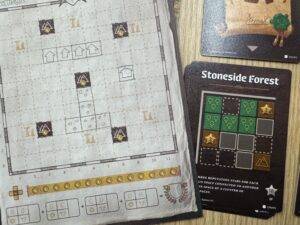
Sounds an awful lot like gerrymandering… doesn’t it… And I suppose that is my problem. This game, like others with different objectives and narratives, subconsciously (or maybe intentionally) encourages the practice of world building without moral obligations. It calls for optimization without reason. When a game like this is made for children (10+ year olds), isn’t it important to consider the messages that the practice of world building is sending? Creating a world in a game is a reflection of a player’s personality, especially in a game like this where practically all the control lies with the player and their perception of their resources. If younger players are encouraged to construct worlds at their whim and fancy, does that set them up to be good people beyond the game’s scope? Games are not just for fun, they are also teaching tools, as Louis and his team demonstrated through their gerrymandering game, Mapmaker. Designers need to be cognizant of the lessons they are teaching players through their games and mechanisms.
Despite the good card quality and the colorful theme, this game felt more like a prototype than a finished product. It has potential, but there are definite areas for improvement throughout.

Loved this write up. I always enjoy a critical critical play.
Thank you! I’ve been finding myself to be far more critical of every game I play than I used to be… 😅