We are Team Moose, and this is High Rollers!!
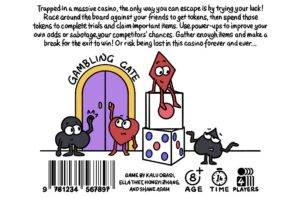
Trapped in a massive casino, the only way you can escape is by trying your luck! Race around the board against your friends to get tokens, then spend those tokens to complete trials and claim important items. Use power-ups to improve your own odds or sabotage your competitors’ chances. Gather enough items and make a break for the exit to win! Or risk being lost in this casino forever…
Artists’ Statement
High Rollers is a game all about placing bets, taking risks, and having fun. When we first met as a team of four, we quickly grew attached to the idea of creating a game that incorporated luck-based mechanics, social interactions between players, and a little bit of strategy. In addition, we wanted our game to be appealing to a wide audience. Even though we eventually settled on a primary target audience of light, casual gamers, we still felt it was important to make room at the table (literally and figuratively) for any player of any background.
This emphasis on accessibility and ease of play became a key feature in many aspects of our game. We iteratively whittled down our initially quite large set of game mechanics into a small handful (moving, collecting items, dueling) that we thought would bring about the simplest, smoothest overall playing experience. We constructed a physical game set with wood, plastic, and paper to give players a sense of enjoyment through tactility (Sensation), and we used contrasting shapes and colors to ensure that our visual design was accessible to a variety of groups. The end result, ideally, is a game that can be learned and played quickly but still makes for an entertaining play session.
Concept Map
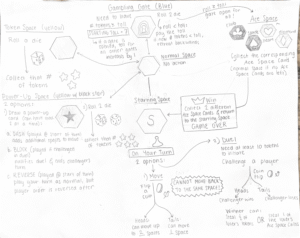
Our concept map for High Rollers, detailing the game’s mechanics and the conditions under which those mechanics take effect.
Initial Decisions about Formal Elements and Values
Initially, our game was meant to take heavy inspiration from Monopoly. We planned to adopt many of that game’s core mechanics and rules, such as purchasing properties, while introducing additional more mechanics related to luck and chance, such as gambling dens and slot machines. Similarly, in terms of formal elements, the game was intended to be a multiplayer competitive game (1 vs 1 vs 1…), where the objective was to collect money and prevent bankruptcy. It was designed as a zero-sum game with very clear winners and losers. Core conflicts in the game would arise from competition between opponents and, in some special cases, gambling mechanics where the luck is against the players, acting as various sorts of obstacles. The boundary of the game would be defined by the game board.
Our game prioritized player interactions (Fellowship/Competition), exploration of novel mechanics and strategies (Discovery), and the excitement or “dopamine rush” of gambling wins. On top of the typical property management and rent collecting mechanics of Monopoly, we had hoped to add more drama and uncertainty by introducing more mechanics tied to RNG and luck, such as incorporating market fluctuation events that drastically change the price of properties or special items that would let players get a cut of other players’ gambling wins.
As we continued brainstorming, though, we ran into two major issues in these early stages. Firstly, we reasoned that no matter how many different gambling mechanics we added, our game would still be too similar to Monopoly (or, frankly, too derivative of it) for our liking. Secondly, our game would simply become too bloated if we kept adding more and more mechanics in an effort to distance ourselves from our original inspiration. As such, we eventually decided to step away from Monopoly’s core rules and mechanics in pursuit of a more novel gaming experience.
Testing and Iteration History
Iteration 0
For our first playtest, we wanted to understand the effects of luck and chance on our game’s overall flow and our players’ enjoyment. To that end, we poured all our efforts into designing as many different luck-based mechanics as possible, so as to understand which ones players really liked and which ones they did not care for. This included dice rolls for movement and token acquisition, games of chance that would grant access to other areas of the board upon completion, and a “Split or Steal”-esque dueling mechanic by which players could take tokens from one another. Since we were focused on the mechanics at this stage, we kept most other parts of our game, such as the visual design, relatively basic.
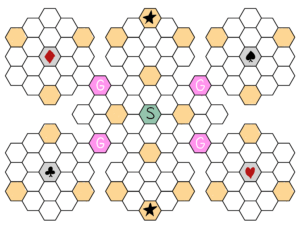
Our first complete design for the game board, meant to be printed out on a sheet of paper.
Our first cohort of (4) playtesters gave us a lot of helpful information about this early edition. Overall, they seemed to enjoy moving around the board and collecting tokens: an encouraging sign. However, they still thought that the moment-to-moment flow of the game was somewhat sluggish. The main source of this sluggishness was the Gambling Gates. Due to their compounding, luck-based mechanics, these objectives were very difficult for players to complete, and they did not offer enough of an incentive to make that difficulty worth overcoming. As a result, most players found that the optimal strategy was just farming tokens and waiting around for someone else to open the Gambling Gates, which did not make for a thrilling gameplay experience.
Iteration 1
Taking our (4) playtesters’ feedback into consideration, we started our next iteration by re-evaluating the role and functionality of the Gambling Gates. We decided that (a) the Gates should be easier to open in general and (b) players should actually win something upon successfully opening a Gate, rather than just being granted access to a new part of the board. This is why we introduced the mechanic through which a player wins tokens by opening a Gambling Gate and why we modified the mechanic concerning the Gates’ toll, such that instead of increasing when a player fails to open one, it only increases when they succeed in doing so.
In addition, we slightly altered the “token economy” of the game. We assumed that since players could get through the Gambling Gates more easily, they could also acquire and hold onto their tokens more easily. We therefore needed to introduce a different, perhaps more productive way for them to “lose/spend” their tokens, which led us to change the way Ace Space Chips worked. Instead of just collecting one by landing on the appropriate Ace Space, players now needed to pay a certain amount of tokens. This amount would steadily increase as the game progressed and players got more and more tokens on average.
We also decided to change the way interactions work between players, most notably in the form of player duels. We saw that our Iteration 0 playtesters found our dueling mechanic very situational and unintuitive, resulting in very few duels over the course of the game. In response to this, we scaled the dueling rules back a bit in terms of complexity (i.e., we did away with the whole “Split or Steal” thing), turning it into a simpler game of chance between two players that could take place more frequently and more spontaneously throughout the game.
Finally, we gave the entire game a significant visual upgrade, building a physical, tangible board out of hand-painted wooden hexagons and crafting other components using hardy construction paper.
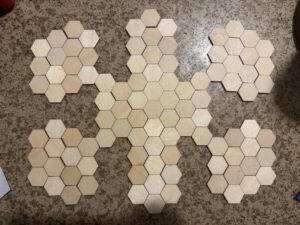
Our second design for the game board, before painting all of the spaces.
Due to all the changes listed above, things went over much better with our second suite of playtesters. They seemed much more engaged in navigating the board and gathering resources, they dueled each other more often, and they moved through the game much faster than before: all great things to see. Even with these adjustments, however, one glaring gameplay issue persisted. Although the players seemed to like the new Gambling Gates as short-term goals, they took issue with the overarching long-term goal of getting to the four corners of the board and back to the starting point again. It still felt like a lengthy, potentially exhausting win condition, especially when each player was only moving one or two spaces per turn.
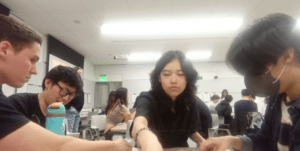
A screenshot from the video of our second in-class playtest.
Iteration 2
With two rounds of playtesting now under our belt, we had a clear idea as to where our final iteration should go. Our first priority was making changes aimed at improving the speed and flow of the game. This led us to modify the win condition; rather than visiting all four Ace Spaces, as had been the case since the game was first conceptualized, players could win by reaching the starting space with only two different Ace Space Chips. Given this, we were also inspired to tweak the dueling mechanic slightly once again, allowing players to steal tokens or Ace Space Chips from one another.
In addition, we introduced power-ups in this iteration. These power-ups were intended to give players a wider variety of actions to take and, in turn, a wider variety of strategies for victory. That said, we only added three of them, and we also made them free for players to acquire upon landing on the right space, rather than attaching a token cost to them. This was done so as not to drastically alter the relationship between the this new power-up mechanic and the other game mechanics.
Finally, our TA Mai gave us some great advice on how to further refine our game from the “cohesion/polish” point of view. Following her recommendations, we gave the game another physical/visual upgrade/ We remade the board using bigger wooden tiles, reusing the smaller tiles from Iteration 1 as other game components. We also adhered the spaces together with superglue and foam to form small sections. These sections could be easily put together to form the full game board and just as easily taken apart to clean it up, remarkably enhancing our game’s playability and readability. (Thanks a million, Mai!)
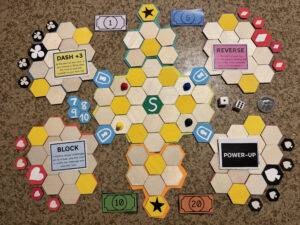
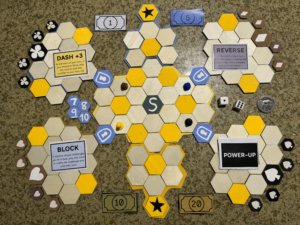
Our final game board design, plus the other game components, in all their beautiful glory!
Our final board game design, displayed how someone with 80% deuteranopia (red-green colorblindness) would see it. We tested this design with the BYU Colorblind Image Tester, which gave us a “Friendly” rating with 100.0% confidence. As we noted in the Artists’ Statement, accessibility is important to us!
We decided to do one final (4-person) playtest with this latest version of the game, just to get a good perspective on the game as both players and designers. We were very happy to discover that this was by far the cleanest, smoothest iteration yet. We were navigating the board at a quick but reasonable pace, making careful considerations about whether or not to initiate a duel, and (if our words and facial expressions were to be believed) just having a great time with the game in general.
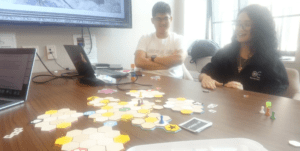
A screenshot from the video of our third playtest, done outside of class.
Iteration 3…?
We brought one guest player along for our final Iteration 2 playtest, and while they seemed very fond of the game overall, we made sure to ask them for feedback and criticism, which they were kind enough to provide. Given what they said, here are some considerations we would make if we were to design another iteration of this game.
- In the current iteration, it is much easier to gain a lot of tokens than it is to lose a lot of tokens. This is perfectly fine for the early game, but as the game goes on and players naturally get more and more tokens, they can begin to lose their gameplay value. It might be good to (re-)introduce other mechanics that can balance out the “token economy” at play here: for instance, needing to spend a certain number of tokens to buy a Power-Up Card or an Ace Space Chip.
- Flipping a coin to move either one space or two spaces is a decent means of traversal, but it can still feel rather stagnant if a player flips tails multiple times in a row. To amend this, our guest suggested an iterative movement mechanic, in which a player keeps flipping a coin until they get tails and then moves one space for each time they flipped the coin. We think this would be a good way to keep movement feeling fresh, and it also aligns well with the game’s overall themes of luck and chance.
Link to Final Prototype + Video of the Final Playtest
A print-and-play version of our final prototype is available to view (and well, to print and play) using the following Google Drive link: https://drive.google.com/drive/folders/1_evCQkcXJOOpPkEUyOdVGSJTmyijJITi?usp=drive_link
This Drive is also home to a printable rule brochure for the game and our two most recent playtest videos (one done in class on April 21st, the other done outside of class on April 25th).
Thanks for reading! We hope you enjoy playing High Rollers!!
– Thet, Hongyi, Shane, & Kalu