Artist Statement
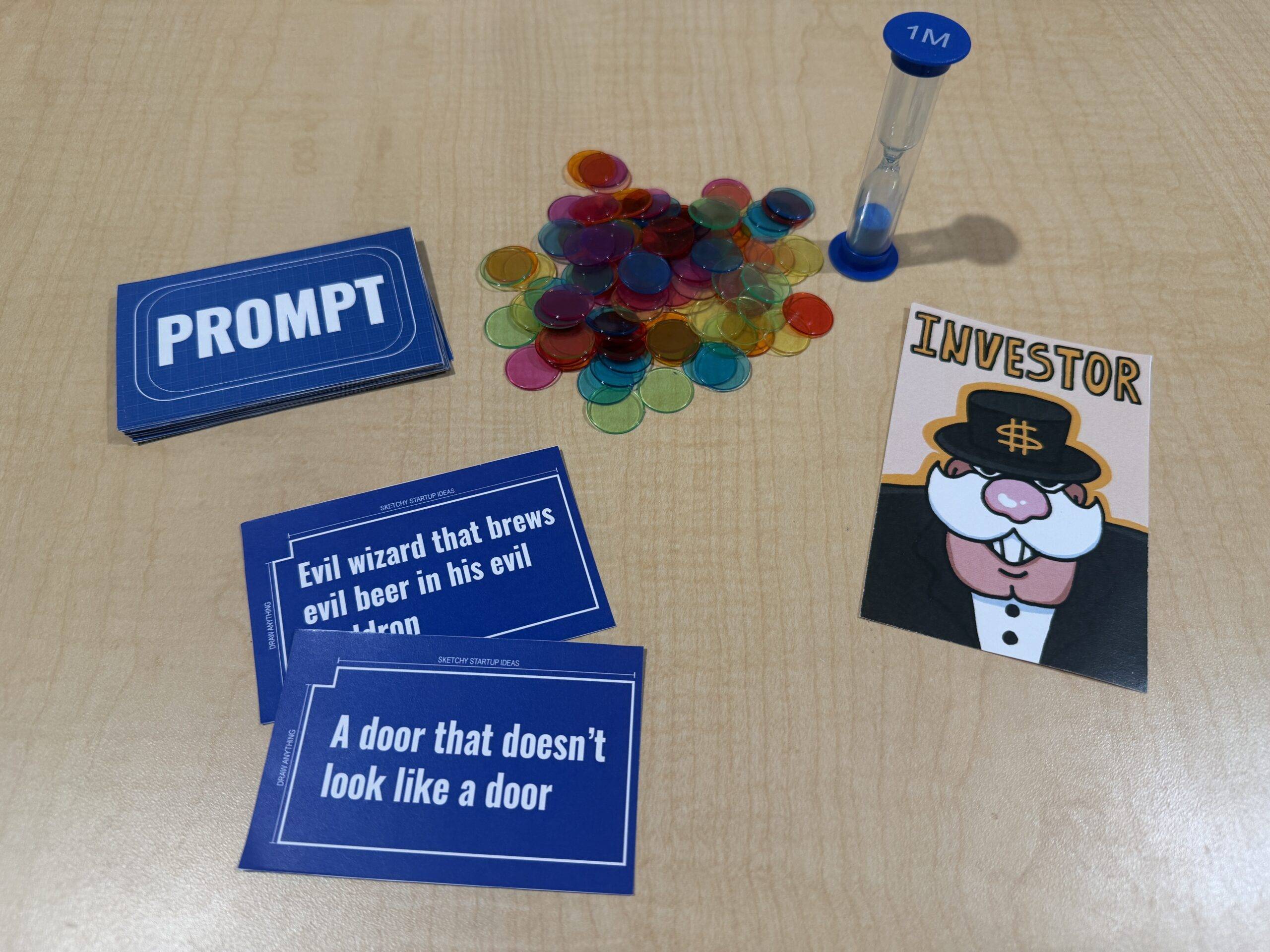
Sketchy Startups (By Leo Sui, Raina Yang, and Leyth Toubassy) is a drawing game where players must pitch another player’s drawing to an investor as an exciting new business venture. With a selection of humorous and absurd drawing prompts, players will have to improvise to interpret each others’ drawing and sway the investor with their argument.
The design of Sketchy Startups aims to reduce the biggest accessibility barrier in most drawing games: the advantage given by drawing skill. Since you don’t pitch your own drawing in this game, your success depends not on your ability to draw, but your ability to interpret it in a creative and humorous way. The poorer the drawing, the more creative freedom the pitcher is given, creating opportunities for laughter and bonding.
The game also has the goal of being a judging game that reduces the negative impact of rejection. Pitching another player’s drawing instead of your own aims to create a sense of detachment from your pitch; a large part of your success depends on the hand you are dealt rather than solely your own pitching and drawing abilities. This makes an underwhelming judge/audience interaction feel less personal and allows players to focus more on having fun and getting crazy with their ideas instead.
Formal Elements
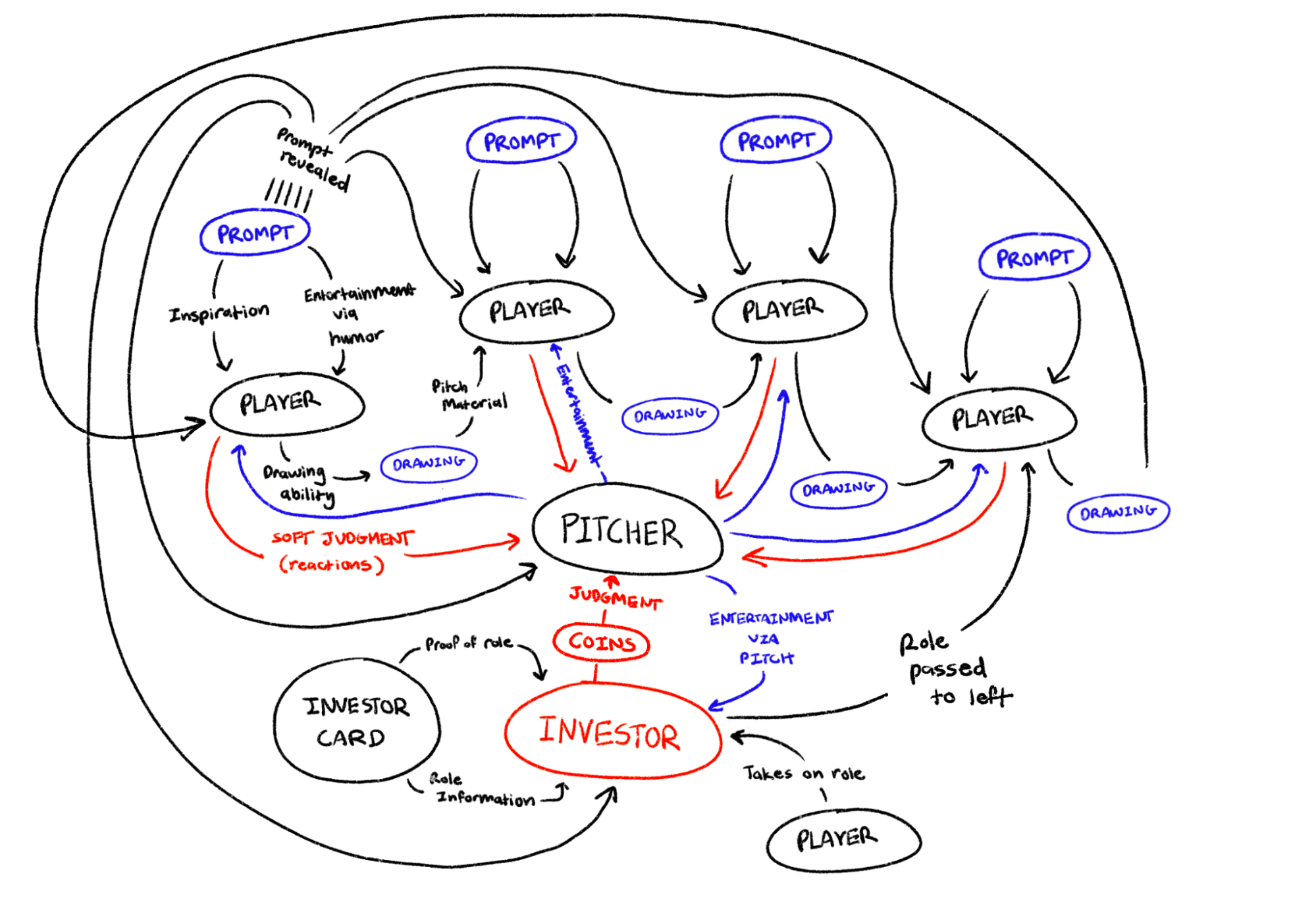
One of the biggest inspirations for Sketchy Startups was the Monsto-Card game we played during CS 247G. We found that our table had a fantastic time playing the game, and really tried to dissect what about this game we found so fun. The key kinds of fun Monsto-Card created for us were expression fun and fellowship fun, so when designing Sketchy Startups, these two kinds of fun were at the top of our minds.
There were a couple of key considerations when designing mechanics to incite these kinds of fun. The first was that expressing oneself, especially in front of people one may not know as well, can be nerve wracking. Drawing is after all a skill, it’s inevitable that some players will make better drawings than others. We felt that if drawing well was a ticket to victory, it would be really difficult to create fellowship fun. If the sole mechanic of a game is drawing ideas, a dynamic is created where the best/funniest artist would win every time. The verbal pitching element also ensures that those with great drawing abilities and those without both get a chance at fun through expression.
Instead, we wanted to target a more general audience, and we wanted the game to work for players who already know each other well and players who may be less familiar with each other. We wanted to create a game where the mechanics fostered easy collaboration and creativity, while also not placing social pressure on players to succeed. To accomplish this ease of play, we created mechanics that are designed to force everyone to fail. The prompts are by design nearly nonsensical, so that even if someone were to draw them perfectly, it would be impossible for the person pitching to accurately identify and pitch the idea on the card. This mechanic creates a dynamic where nobody needs to feel bad that they did a bad job on their drawing or their pitch, because the game makes it impossible for anyone to do well. Instead, players get to laugh together at the ridiculous ideas with nobody being singled out. With the crazy prompts and the swapping of drawings, a successful entrepreneur and a 10 year old child should be put on close to equal footing in Sketchy Startups.
This also follows some of the learnings from the GDC talk on Game Design Patterns for Building Friendships. We focus on creating fellowship through giving the players the shared challenge of interpreting these crazy drawings on the fly. By not requiring active communication during collaboration, we leave the game closer to the talk’s idea of “soft co-op,” which is well suited to those just getting to know one another. Even though communication is not required, the over the table in person format allows for groups of people who know each other better to communicate with one another beyond the boundaries of the game.
Iterations
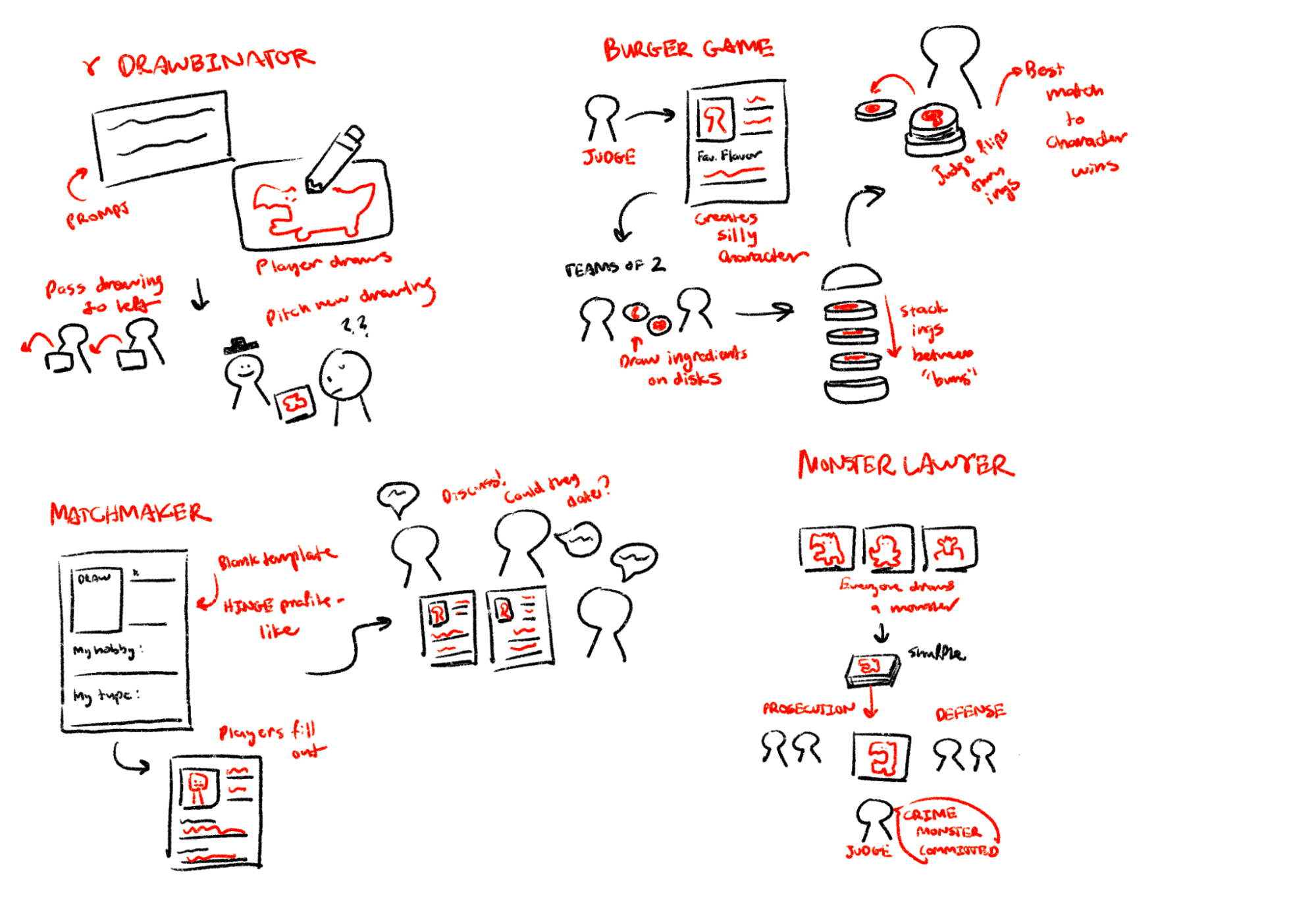
Sketchy Startups began as an idea called Ydrawmbinator, a drawing and pitching game specific to the context of “Y Combinator” pitches. However, during early development, we felt the concept to be too narrow and that the humor of the game would work better when players had more freedom to interpret drawings outside of the scope of YC.
The major mechanics we narrowed down to during initial ideation were the following: needing to pitch one single slide/drawing with each prompt as different as possible, and having the players pitch a slide that is not their own drawing. This would keep the game fast and more focused on improvisation.
Because we missed the first in-class playtest due to time constraints, we conducted playtesting internally amongst the team. This helped us work through basic questions such as what the optimal time length is for drawing and pitching along with specifics of passing– we found 1 minute for pitching and 1 minute for drawing to be the sweet spot and simply passing drawings along the circle worked great. During this stage, we brainstormed other possible mechanics including having coins for the investor, allowing for players to invest in each-others companies, some kind of financial appreciation system for good investments, and a shuffling mechanic so that people didn’t get drawings from the same person. However, we decided to first playtest the core concepts first before adding additional mechanics.
Our first playtest confirmed that the core mechanics were creating the dynamics we wanted to see. In our first in-class playtest linked here, our 5 college-aged players were having fun, laughing at each other’s drawings, and enjoyed the challenge of turning a peer’s sketch into a pitch. We noticed that people seemed to be getting more comfortable sharing ideas as the game went on as well. This playtest reinforced that the core concept was sound, we saw people having fun expressing themselves and cheering on their fellow players as they pitched, expression and fellowship. We were also excited to see people really step into the roles of the Investor and Entrepreneurs, we think the fact that the game did not force this made it a lot more genuine when it occurred.
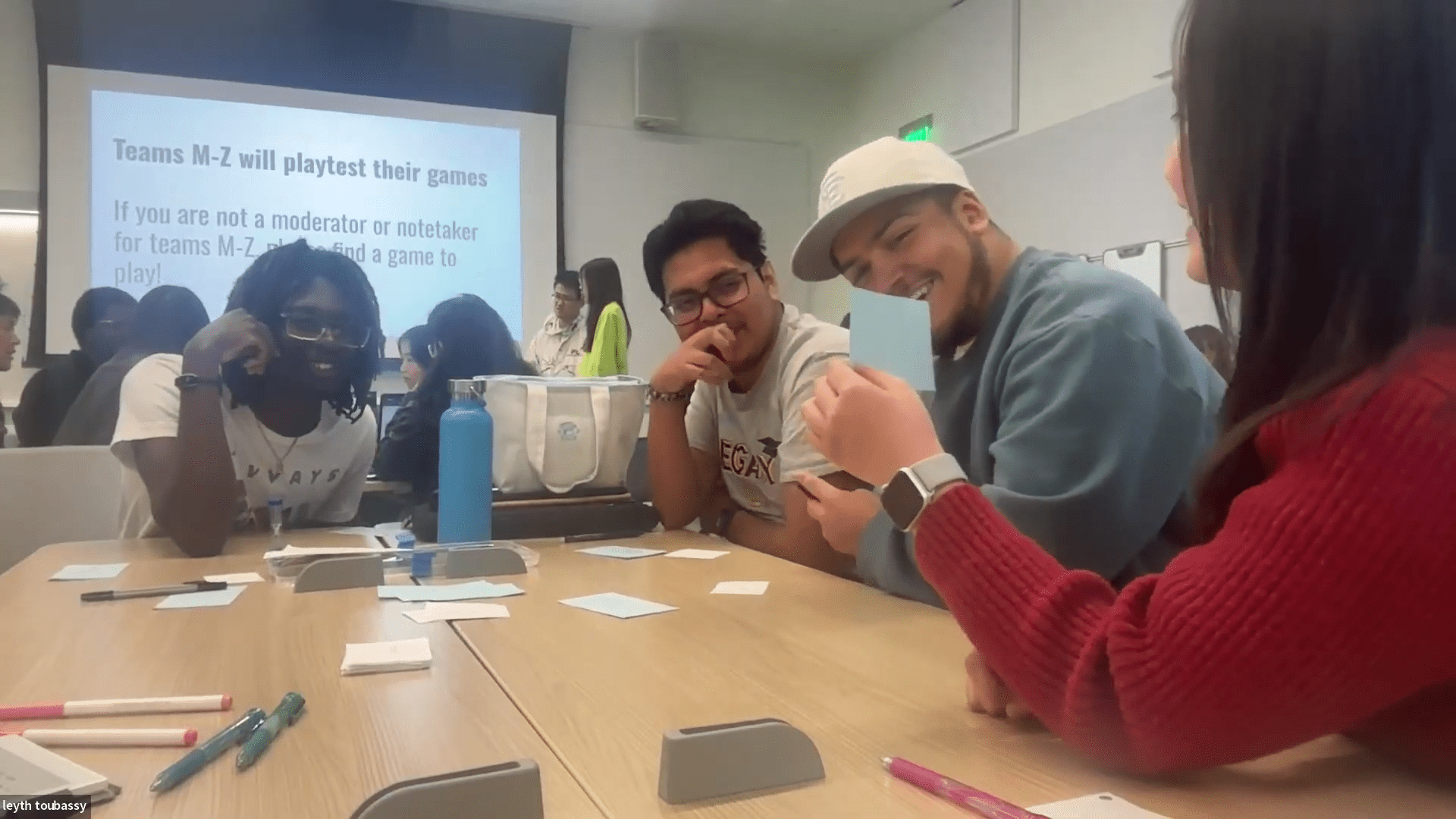
The majority of the feedback we received aligned with features we had already been considering. One of our largest concerns before playtesting was that the investor could become bored while waiting for the drawings to finish. In the playtest we did see this come up to an extent, though it wasn’t as bad as we predicted. As opposed to trying to add more complexity to the game, we decided that giving the investor something like coins to invest with could be sufficient. These coins both help with tracking game progression and give the investor something tactile to fiddle with while waiting for other players to draw their prompts. The coins also allow scoring to be a bit less all or nothing, allowing investors to give points to multiple pitches they liked. Another piece of feedback we got was that since all players passed their drawings to the left, you would always receive the drawing from the exact same person. One of the players in this test speculated that this could lead to one good artist giving the person seated next to them an advantage, though we didn’t see that realized in this first playtest. Nonetheless we decided to change passing drawings to instead shuffle drawings before handing them back to players during the next play test.
Another thing we observed in the playtest was that often, the last few pitches were a lot more polished than the first few. We realized that allowing players to look at their drawings immediately gave players at the end of the pitching order additional time to mentally prepare for their presentation. This not only weakened the improvisatory nature of the game, but also caused players to engage less with the presentations coming before them. Keeping drawings hidden addresses these problems, and this mechanic further highlights the pitcher’s real-time reaction to the drawing they received.
We also got a bit of feedback on this playtest regarding various ways our game could be potentially “gamed” by someone who was playing the game in a more competitive way. One of these concerns was that people could just hand in a blank drawing to screw over those next to them. Another was that some of the scoring system felt shallow, and that investing was really more of just picking. This feedback mirrored some of the ideas we had earlier in development, but we ultimately decided that we were happy with how the core mechanics functioned. We didn’t want to add more depth than was necessary and run the risk of scaring players away with complicated rules and math.
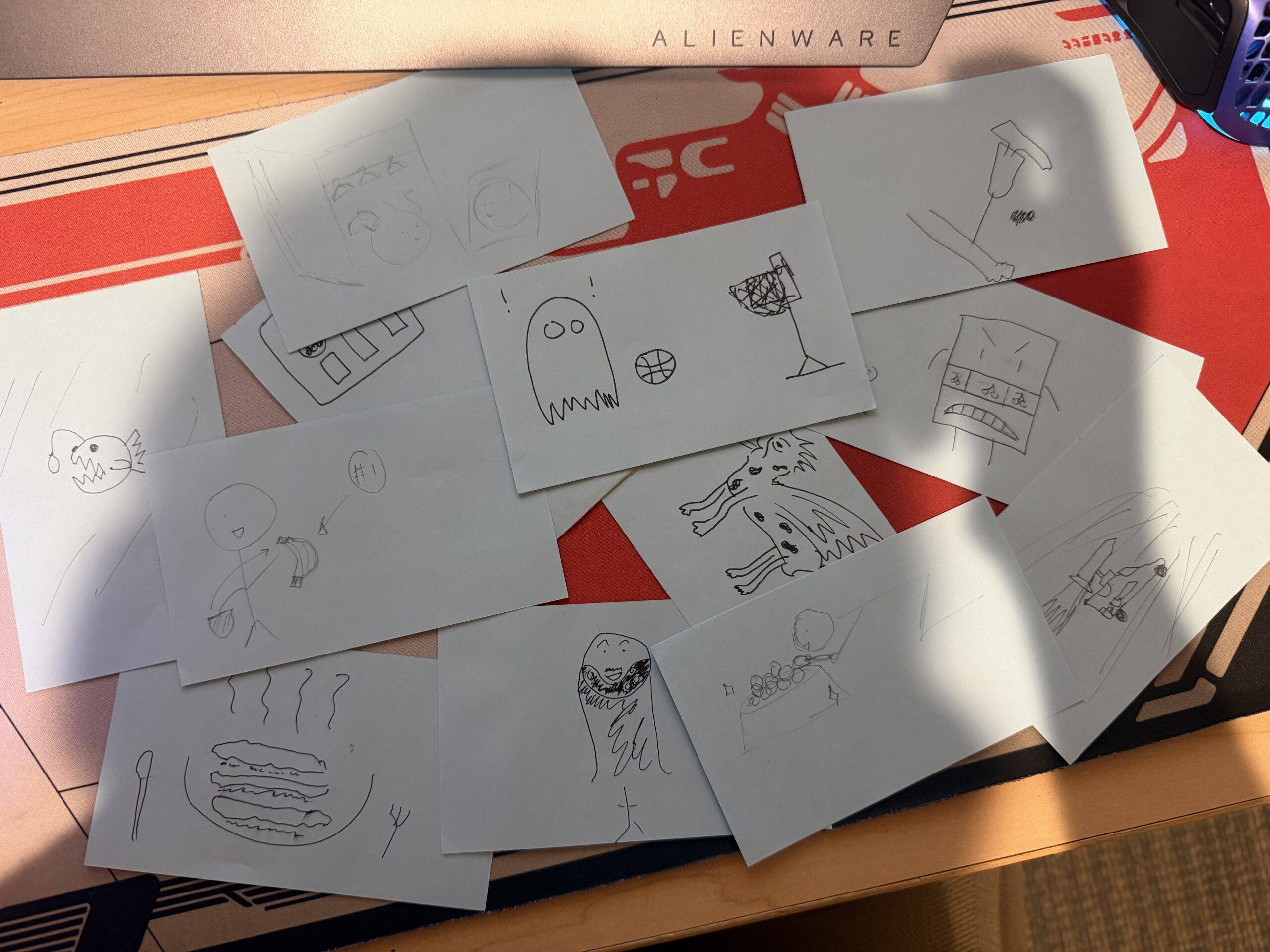
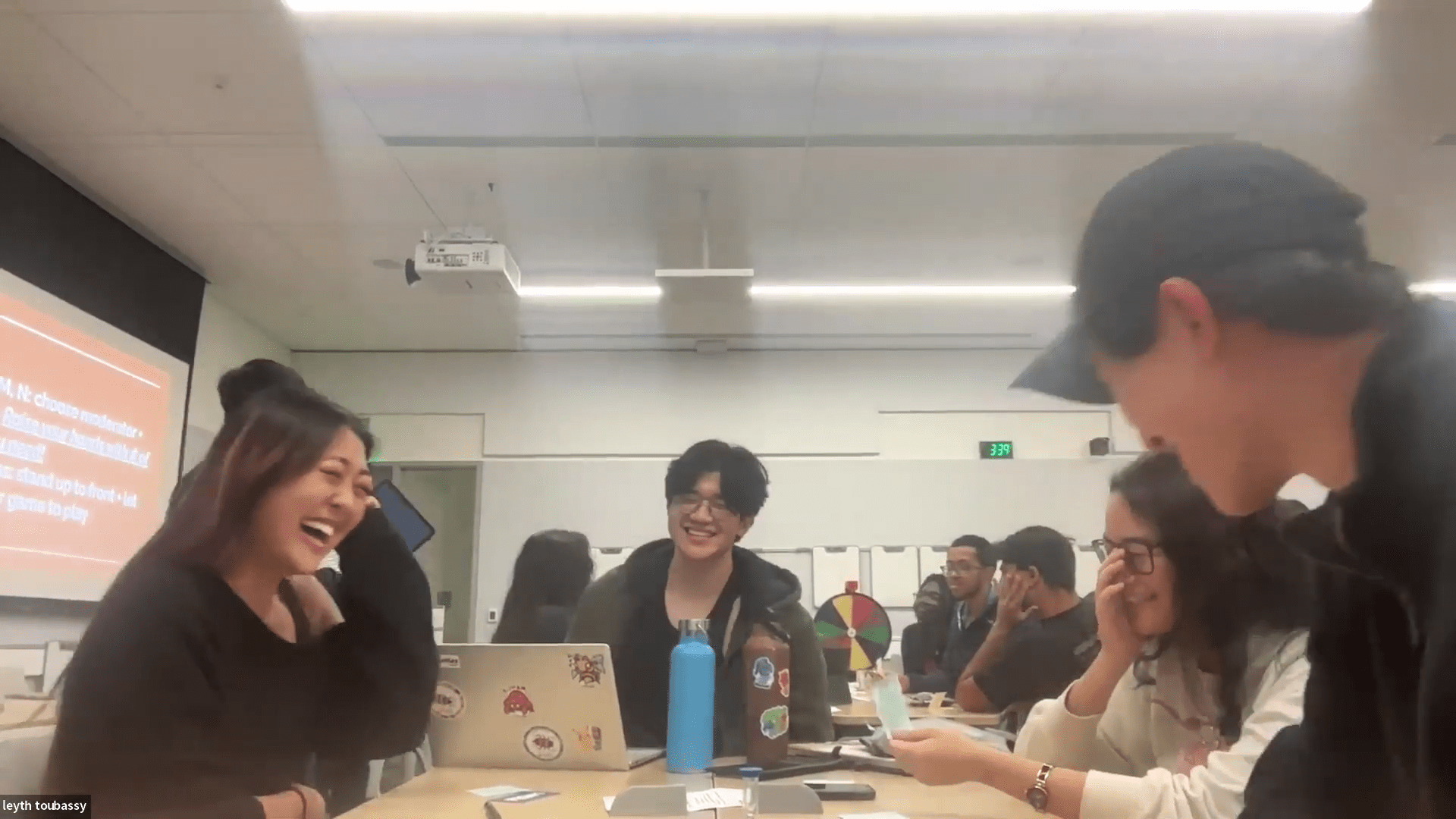
For the second playtest (also in class with 4 college aged students this time), one big concern was the overall game length. While players enjoyed the individual rounds, playing for almost an hour felt too long due to the mental fatigue of drawing, pitching, and judging multiple times in rapid succession. To address this we added some explicit instructions on ending the game to the rules. For now these are a bit vague, but are at least present. If we were to continue this project, we would likely add some winning threshold, like the first player to 5 coins wins, but would want to playtest this amount before making any sort of final decision.
We also noticed logistical issues with card shuffling. Because the drawings were distributed randomly, players had a chance of receiving their own card. When this happened, players felt inclined to pitch their drawing as whatever the prompt read, since they knew the prompt behind the drawing. This meant every round, a player would have a chance to be completely excluded from the core mechanic of the game. Random distribution also removed the fun moment of watching another player react to seeing their assigned drawing for the first time. In response, halfway through the playtest we swapped to an alternative mechanic we had designed ahead of time to address the same issue as the shuffling. By alternating the direction that drawings are passed each round, switching between left and right, we guarantee that players do not receive their own drawings while still allowing them to receive drawings from different people over the course of the game. Since the investor does not draw during their round, players can receive drawings from up to three or four different people, which is enough variety for a game designed for three to five players. This also helps to alleviate some of the anti-competitive behavior one of our testers from the first playtests had. Since anyone you give your drawing to will later be handing you one of their drawings, players are incentivized not to intentionally screw over their fellow players. This collaboration going both ways also adds additional opportunity for fellowship to the game.
If we were to continue this game, we would probably consider making some kind of digital experience to complement it. A digital experience could perform a lot of the state handling that we avoided for the sake of ease of play. Things like more dynamic investment, player voting, and the like, could all be practically simplified through a digital experience. In terms of the physical version of this game, with more time we probably would have gone further in terms of balancing things like the number of coins the Investor gets, and figuring out a more formalized way of ending the game.