Artist’s statement: This game transforms Stanford’s campus into a social map and a stage for playful deduction. Players locate one another through a series of relational questions, some geographic (are you farther north or near water) and some relational (have you been there before). While a game of physical hide and seek (including running) would do us some good, this lets Stanford students pretend they are outside without seeing the sun. Using the Stanford map as the board highlights the dichotomy of this place as our home but also as a campus large enough that you can always find a new corner to hide in. The goal aims to create a shared social experience where campus life is strategic, humorous, personal, and social. The players have shared experiences as they all dread the Cal card when they fail to guess correctly and a little friendly competition as the seekers battle solo or in pairs to see who will find the hider first.

The front of the box clearly conveys the theme of the game and the flexible and short style of the game.

The back of the box provides a simple overview of the rules and what is provided by the box.
Design Journey: We began by imaging a Ninja Warrior style Scavenger Hunt that required students to complete physical challenges and share proof with their friends. As we considered other possible games we started our comparative analysis and considered games with embodied components like geocaching or Jet Lag. While this sounded fun, we had concerns about our ability to play test it in class given the logistics. Clue gave us inspiration for how we could ‘explore’ a space without leaving the classroom and Hues and Clues gave us an idea for how to identify specific square. We then integrated the question asking mechanism of Jet Lag to add strategy to the game. Find the Farm was born as a Stanford specific Hide and Seek game.
Concept map:
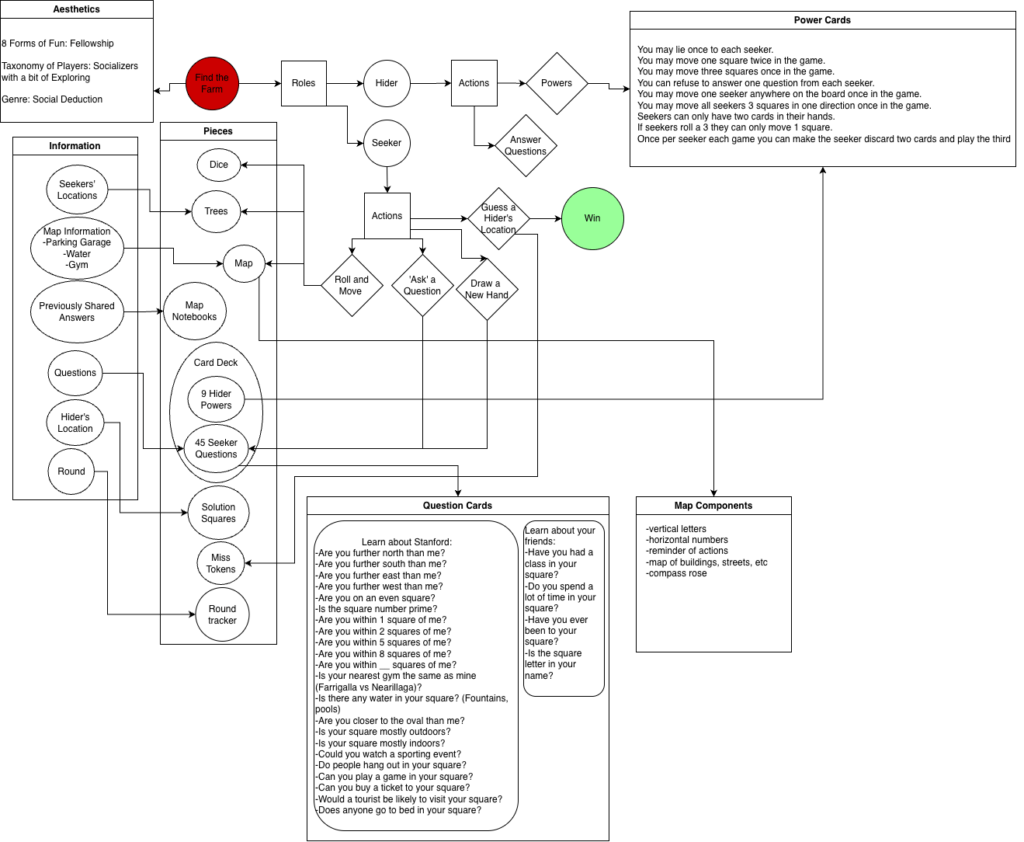
Given the general assignment, we aimed to create a game that would provide fun from fellowship and appeal to Socializers. We believe that the map exploration of the game will add a little more fun from discovery and appeal to explorers. The light competition will also provide some fun from challenge as you battle again limited time to find the hider.
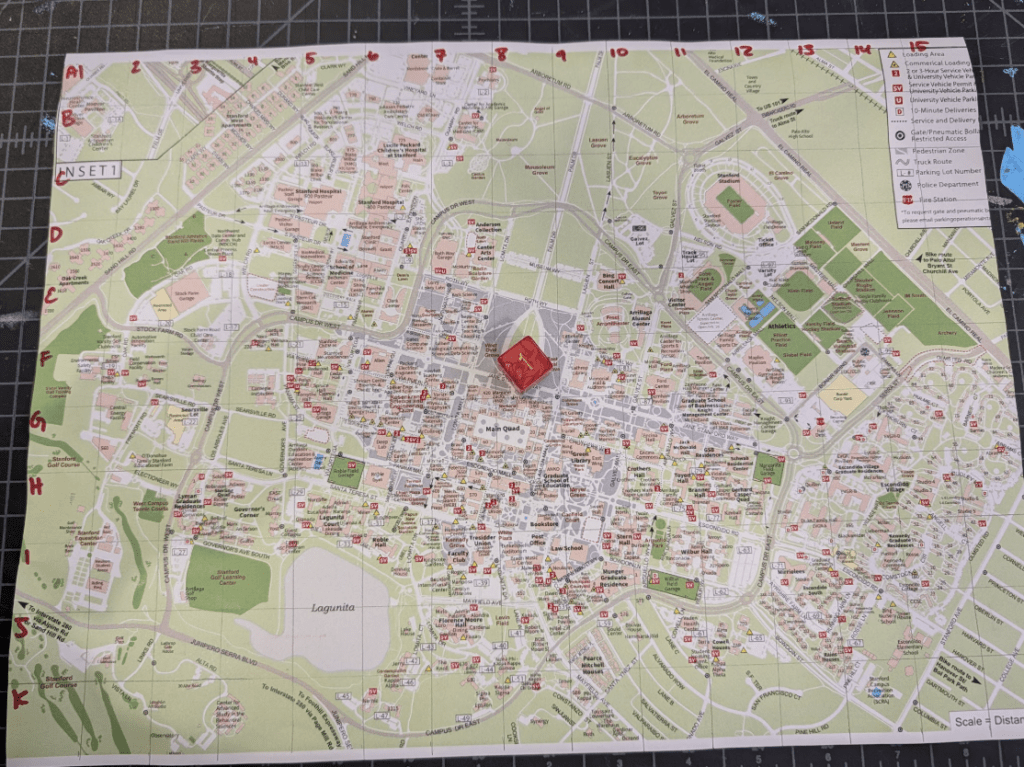
The first prototype we produced included a printed map of Stanford divided into a grid. The hider selected a square and the seekers took turns asking a question and then rolling a dice to move around the world. While we were pleasantly surprised with relatively smooth gameplay we discovered the need for player to take notes of information that they had gained. We also discovered that markers to track where players had incorrectly guessed were necessary to track information.
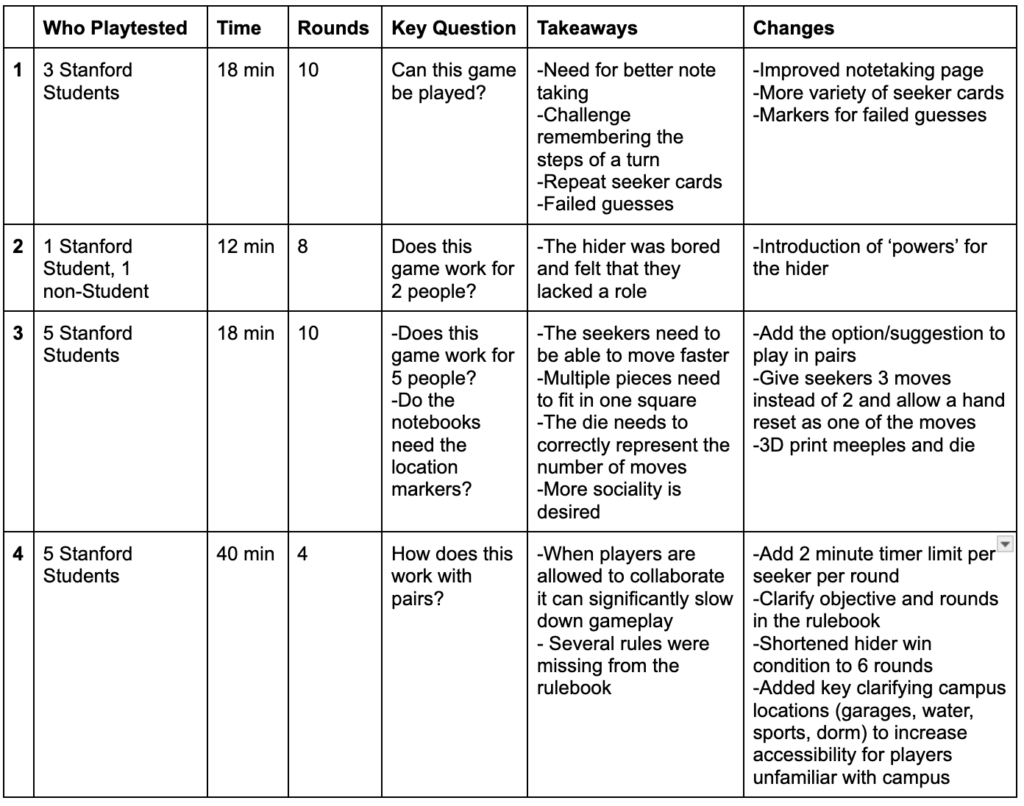
We then opted to play a smaller two player version of the game. This time was the first time the hider role was played by someone outside our team. They had strong negative feedback that they felt the role lacked sufficient agency and they were bored. We introduced ‘powers’ for the hider so that they are making strategic choices as they play.


We recognized the need for information management in the game. Most obviously players need a space to track what information they have gained from the hider. This miniature map allows them to mark this information down. Given this notebook structure we also decided to add an assistive tool that reminds players about the choices they can make about how to act in each round.
Information management was also improved by adding a custom key to the game board to assist in responding to the specific question cards in the deck.
Despite the mechanics functioning to create a balanced game that allowed players to play with a range of strategies, we still felt in our third play test that the game failed to meet the goal of promoting social interaction. We altered the game to suggest that instead of playing independently, players play in pairs.
If you would like to watch the full play through it can be seen here: https://stanford.zoom.us/rec/share/gNCI02i6W2tmW8XEE4pKxQeygd550nF9wqntrPKki1DugXZg8agwoaQywXaBYyxk.dvOcR15zRccPQrQx
Passcode: Diq$Ygk3
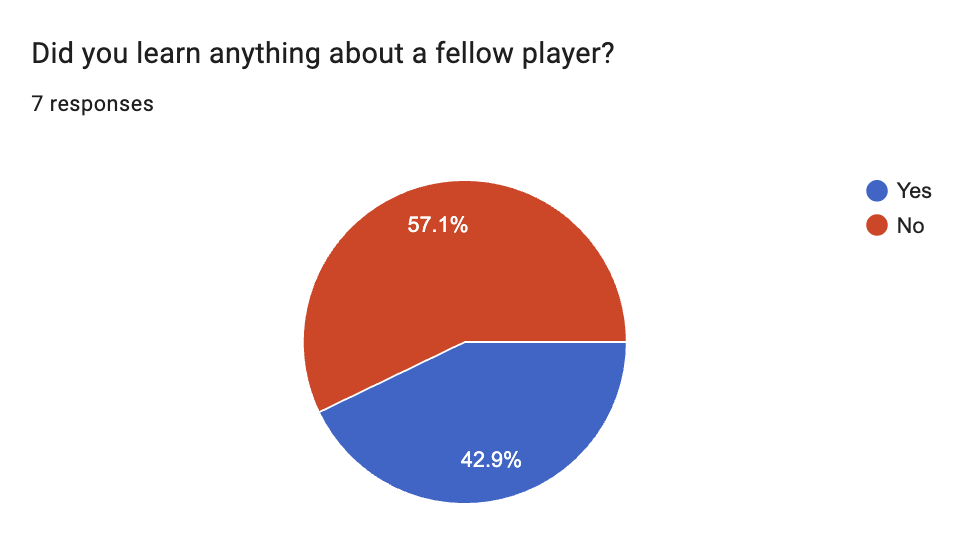
Our final play test showed that the mechanics we had established continued to work well in teams and that partners interacted more with each other when they are in pairs. Players discussed their plan and reacted to progress with each other even yelling “Bang!” when they gained significant information. The only drawback was that this greater social interaction dramatically slowed game play. However, we were able to implement a two minute timer per turn in the later portion of the game which added to the fun from challenge and ensured that the game still ended within 40 minutes. The survey that we created to collect information about important elements of the playtesting showed that even though prior play testers had not learned anything about their peers when playing, 3 of the 4 players in our final playtest reported learning something about a peer.
Here are some interesting time stamps you can watch if you’d like
- 0:22 The rules for who is the hider were tested for their specificity and they worked
- 2:00 Players actively discussed what color piece to be
- 2:36 Players questioned the rules regarding the number of cards but interpreted it correctly
- 4:40 Players clarify the objective
- 5:45 Players are excited by their notebook but want larger dividers
- 7:16 “This is Fun”
- 9:00 The hider uses a power but one team does not notice
- 9:15 Players request larger maps
- 10:12 The hider makes a mistake and reads the question out loud- laughter ensues
- 10:44 “Oh Bang! That might be game over”
- 13:11 “This is Fun”
- 14:34 “As far as I know, yes”
- 14:40 Players didn’t realize that the dice was custom
- 15:10 Players suggest a time limit on discourse
- 20:34 “Where do you live?”
- 25:35 “Bang! Wait he is?”
- 26:00 “There’s a compass here”
- 28:25 “That’s F***** That’s extremely evil”
- 31:52 Disagreement about one answer
Overall, we met our goal of creating something fun and specific to Stanford. All playtesters reported that they appreciated the Stanford specific theme.

We were especially proud that in a game with simple rules could create “Strategy and complex problem solving for sure”.

Print-n-Play: This pdf includes the board, round tracker, player tokens, location markers, and personal maps.
3D Print-n-Play: If you have access to a 3D printer here are the designs for the dice and player pieces:


Citations
- The Cal Logo https://commons.wikimedia.org/wiki/File:Cal_logo.png is made available under the Creative Commons CC0 1.0 Universal Public Domain Dedication.
- Tiny and quick to print Christmas tree was created by Printed-Toys and is licensed under the Creative Commons – Attribution – Non-Commercial – No Derivatives license.
- Dice 1 2 3 was created by Aspect50 is licensed under the Creative Commons – Attribution license.
- The Stanford Tree image was generated using ChatGPT
- The board was created by editing an official delivery map from Stanford in Canva using icons from the Canva library.
- The cards were created in Figma using the design elements in Figma.
- The game box images were created using a combination of ChatGPT and Adobe Photoshop