Skip to content
The Mechanics of Magic

The Mechanics of Magic

Game Design Writings by Students at Stanford taking 247G and 377G

  • Library
    • CS247G Community Game Design Resources
    • Game Design Resources
    • Graphic Design for Game Designers
    • Graphic Design Resources
    • Chapter 11 from Game Balance
  • Read Write Play
    • Hollow Knight: RWP 4 2023
    • Mystic Messenger: RWP 6 2023
    • Undertale: RWP 3 2023
    • What Remains of Edith Finch: RWP 5 2023
    • Catan: RWP1 2023
    • 80 Days: RWP 2 2023
  • 247G Syllabus
    • The Formal Elements of Game Design
    • Design for Play | Week One | Lecture A
    • Design for Play | Week One | Lecture B
    • Design for Play | Week Two | Lecture A
    • Design for Play | Week Two | Lecture B
    • Design for Play | Week Three | Lecture A
    • Design for Play | Week Three | Lecture B
    • Design For Play | Week Four | Section A
    • Design For Play | Week Four | Section B
    • Design for Play | Week Five | Class A
    • Design for Play | Week 5 | Class B
    • Design for Play | Week 6 | Class A (no class)
    • Design for Play | Week 6 | Class B
    • Design for Play | Week 7 | Class A
    • Design for Play | Week 7 | Class B
    • Design for Play | Week 8 | Class A
    • Design for Play | Week 8 | Lecture B
  • Serious Play Study Group Overview
    • Study Group Week by Week Breakdown
      • Formal Elements of Games
      • Final Reflection Essay
    • [Optional Material] What is fun?
    • Project 1: Those Who Play, Teach
      • READING Visual Design of Board Games
      • Pitch Your Teaching Game
      • Sketchnote: Playtesting Boardgames
      • Sketchnote: Erin Hoffman // Wind, Not Sand: Mapping Dynamic Emotion Across a Product Landscape
      • SketchNote: MDAO
      • Critical Play: Write up your game of FLUXX
      • [Optional Material] Playtesting
      • OPTIONAL Board Game Usability
    • P2: The Future We Deserve
      • Critical Play: A Mechanic and a Story to Tell
      • Interactive Fiction: Tiny Playable Prototype
      • Introducing Interactive Fiction
      • Map and Premise
      • Critical Play: Story AND Storytelling games
      • Essay or Sketchnote: Rise of the Video Game Zinesters
      • Sketchnote: Art of game design- Story
      • [Optional Material] Emergence and Progression
      • Essay or Sketchnote: Rise of the Video Game Zinesters
      • Project 2 Reflection Essay
      • Share what you Learned: Writing Excuses Podcast
      • Values at Play & P2 Peer Grading
    • P3: The Game of Unexpected Consequences
      • P3 Concept Doc
      • Playable prototype
      • Working With System Dynamics (mindmap the reading, apply it to your game)
      • Mapping Systems
      • Sketchnote/Response for Rules & Tutorials
      • Project 3 Check-in
      • Project 3 Reflection Essay
    • P4: Refine a game
      • Sketchnote/Response for Playtesting with Strangers
      • Read: Mechanic is the Magic
  • On Sketchnotes
  • Printing at Stanford

Author: Jessica Yauney

Critical Play: Hues and Cues- Jessica

April 11, 2026

Hues and Cues is a color-guessing party game created by The Op Games that allows three to ten players who are at least eight…

Sketchnote: Game Design Patterns for Building Friendship- Jessica

April 9, 2026
Potential game box cover art for a photo scavenger hunt called Snapshot

What do Prototypes Prototype- Jessica

April 8, 2026

Image generated by ChatGPT While prototypes can be made to test many elements, the most important elements in my mind at this time are…

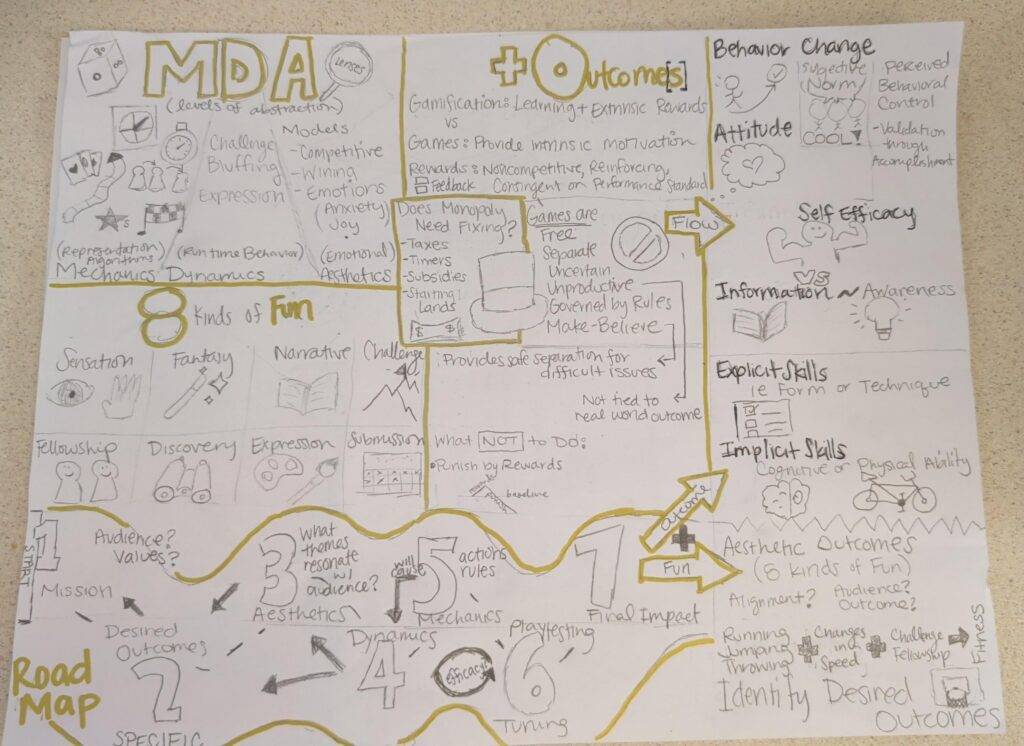
Sketchnotes of what games are and are not

Sketchnotes: What Games Are/Aren’t- Jessica

April 5, 2026

AutoDraw AI program used to improve quality of doodles.

Critical Play: Wavelength- Jessica

April 4, 2026

One-Sided Cooperation At 8pm on Friday night after my husband and sister-in-law got back from the Aquarium since she is visiting us on her…

An image of the crew box and examples of the cards inside. It describes the game as strategic thinking, cooperative trick taking, and expertly designed

8 Kinds of Fun- The Crew- Jessica

April 3, 2026

Whenever I’m with my parents or my brother, we have to play The Crew. It combines fellowship with a level of challenge that feels…

Mindmap image with the 5 formal elements of game design

Jessica’s Mindmap: Formal Elements

March 31, 2026

It was especially interesting to note the elements or versions of elements that I was unfamiliar with. I still have questions about who defines…

Photo of Jessica with her husband Zac and her son Leo who is wearing a gingerbread man costume

Jessica Y Introduction

March 31, 2026

Hi! My name is Jessica (I added the Y since there are often multiple Jessica’s) (she/her) I have a million photos of Leo but…

Welcome to the Stanford HCI Game Design Blog.

Currently this blog holds two formal classes being taught by Christina Wodtke as well as Independent Study Work. In winter of 2022, cs377g was cancelled because of covid-19 uncertainty, and became a study group. You can follow along by looking at the SGSG syllabus and weekly break down.

CS 247G: Design for Play(SYMSYS 195G)

A project-based course that builds on the introduction to design in CS147 by focusing on advanced methods and tools for research, prototyping, and user interface design. Studio based format with intensive coaching and iteration to prepare students for tackling real world design problems. This course takes place entirely in studios; please plan on attending every studio to take this class. The focus of CS247g is an introduction to theory and practice of the design of games. We will make digital and paper games, do rapid iteration and run user research studies appropriate to game design. This class has multiple short projects, allowing us to cover a variety of genres, from narrative to pure strategy. Prerequisites: 147 or equivalent background.

CS 377G: Designing Serious Games

Over the last few years we have seen the rise of "serious games" to promote understanding of complex social and ecological challenges, and to create passion for solving them. This project-based course provides an introduction to game design principals while applying them to games that teach. Run as a hands-on studio class, students will design and prototype games for social change and civic engagement. We will learn the fundamentals of games design via lecture and extensive reading in order to make effective games to explore issues facing society today. The course culminates in an end-of- quarter open house to showcase our games. Prerequisite: CS147 or equivalent. 247G recommended, but not required.
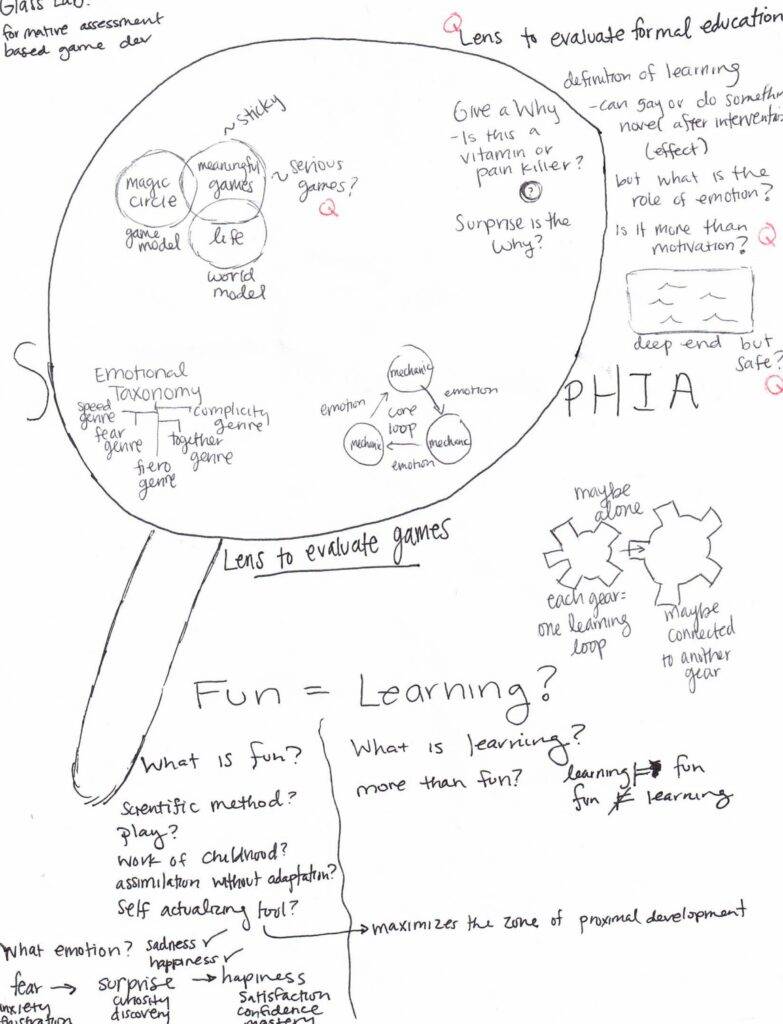
SGSG: Serious Games Study Group

  • Library
    • CS247G Community Game Design Resources
    • Game Design Resources
    • Graphic Design for Game Designers
    • Graphic Design Resources
    • Chapter 11 from Game Balance
  • Read Write Play
    • Hollow Knight: RWP 4 2023
    • Mystic Messenger: RWP 6 2023
    • Undertale: RWP 3 2023
    • What Remains of Edith Finch: RWP 5 2023
    • Catan: RWP1 2023
    • 80 Days: RWP 2 2023
  • 247G Syllabus
    • The Formal Elements of Game Design
    • Design for Play | Week One | Lecture A
    • Design for Play | Week One | Lecture B
    • Design for Play | Week Two | Lecture A
    • Design for Play | Week Two | Lecture B
    • Design for Play | Week Three | Lecture A
    • Design for Play | Week Three | Lecture B
    • Design For Play | Week Four | Section A
    • Design For Play | Week Four | Section B
    • Design for Play | Week Five | Class A
    • Design for Play | Week 5 | Class B
    • Design for Play | Week 6 | Class A (no class)
    • Design for Play | Week 6 | Class B
    • Design for Play | Week 7 | Class A
    • Design for Play | Week 7 | Class B
    • Design for Play | Week 8 | Class A
    • Design for Play | Week 8 | Lecture B
  • Serious Play Study Group Overview
    • Study Group Week by Week Breakdown
      • Formal Elements of Games
      • Final Reflection Essay
    • [Optional Material] What is fun?
    • Project 1: Those Who Play, Teach
      • READING Visual Design of Board Games
      • Pitch Your Teaching Game
      • Sketchnote: Playtesting Boardgames
      • Sketchnote: Erin Hoffman // Wind, Not Sand: Mapping Dynamic Emotion Across a Product Landscape
      • SketchNote: MDAO
      • Critical Play: Write up your game of FLUXX
      • [Optional Material] Playtesting
      • OPTIONAL Board Game Usability
    • P2: The Future We Deserve
      • Critical Play: A Mechanic and a Story to Tell
      • Interactive Fiction: Tiny Playable Prototype
      • Introducing Interactive Fiction
      • Map and Premise
      • Critical Play: Story AND Storytelling games
      • Essay or Sketchnote: Rise of the Video Game Zinesters
      • Sketchnote: Art of game design- Story
      • [Optional Material] Emergence and Progression
      • Essay or Sketchnote: Rise of the Video Game Zinesters
      • Project 2 Reflection Essay
      • Share what you Learned: Writing Excuses Podcast
      • Values at Play & P2 Peer Grading
    • P3: The Game of Unexpected Consequences
      • P3 Concept Doc
      • Playable prototype
      • Working With System Dynamics (mindmap the reading, apply it to your game)
      • Mapping Systems
      • Sketchnote/Response for Rules & Tutorials
      • Project 3 Check-in
      • Project 3 Reflection Essay
    • P4: Refine a game
      • Sketchnote/Response for Playtesting with Strangers
      • Read: Mechanic is the Magic
  • On Sketchnotes
  • Printing at Stanford

Archives

  • April 2026
  • March 2026
  • December 2025
  • November 2025
  • October 2025
  • September 2025
  • June 2025
  • May 2025
  • April 2025
  • February 2025
  • December 2024
  • November 2024
  • October 2024
  • September 2024
  • June 2024
  • May 2024
  • April 2024
  • December 2023
  • November 2023
  • October 2023
  • September 2023
  • August 2023
  • June 2023
  • May 2023
  • April 2023
  • March 2023
  • February 2023
  • January 2023
  • December 2022
  • September 2022
  • August 2022
  • July 2022
  • June 2022
  • May 2022
  • April 2022
  • March 2022
  • February 2022
  • January 2022
  • June 2021
  • May 2021
  • April 2021
  • September 2020
  • February 2017

Recent Posts

  • Sketchnote: Game Design Patterns for Building Friendship
  • Sketchnote: Game Design Patterns for Building Friendships
  • Reyna’s Sketch Notes – Patterns for Building Friendship
  • Sketchnote: Game Design Patterns for Building Friendships—Akary Buenrostro
  • Sketchnote: Game Design Patterns for Building Friendships

Recent Comments

  • Cristofer Acosta on Sketchnote: Game Design Patterns for Building Friendship
  • ban on You Will Always Be at the Mercy of the Author’s Ghost (RWP)
  • Jeffery Cai on Critical Play: Bluffing, Judging and Getting Vulnerable…
  • Trini Rogando on Honkai: Star Rail – MDA & 8 Kinds of Fun
  • EvvrryyDDY2 on Critical Play: BABBDI

Categories

  • P2: The Empathy Machine
  • Featured
  • Project One
  • milestone
  • P2: The Future We Deserve
  • mindmap
  • P1: Social Games
  • CS247G
  • Assignments
  • P1: those who play, teach
  • Lectures
  • P2: Games In Space
  • Critical Play
  • P3: The Game of Unexpected Consequences
  • Project Two
  • Project Four REFINE
  • P4: Refine a Game
  • Sketchnotes
  • Project Two: The Future We Deserve
  • From the Instructor
  • Project Three: The Game of Unexpected Consequences
  • ReadWritePlay
  • 377G: Serious Games
  • SGSG

Meta

  • Register
  • Log in
  • Entries feed
  • Comments feed
  • WordPress.org

Meta

  • Register
  • Log in
  • Entries feed
  • Comments feed
  • WordPress.org
Copyright The Mechanics of Magic. All rights reserved. | Theme by SuperbThemes