One-Sided Cooperation
At 8pm on Friday night after my husband and sister-in-law got back from the Aquarium since she is visiting us on her spring break and I got my son to sleep, pumped and worked on my sketch notes we decided to play wavelength. In many critical plays that sentence would be out of place but when playing a game like Wavelength where group dynamics have such an impact all of those things shifted play slightly and in a game where the ending score was 10-9, they could have changed the outcome.

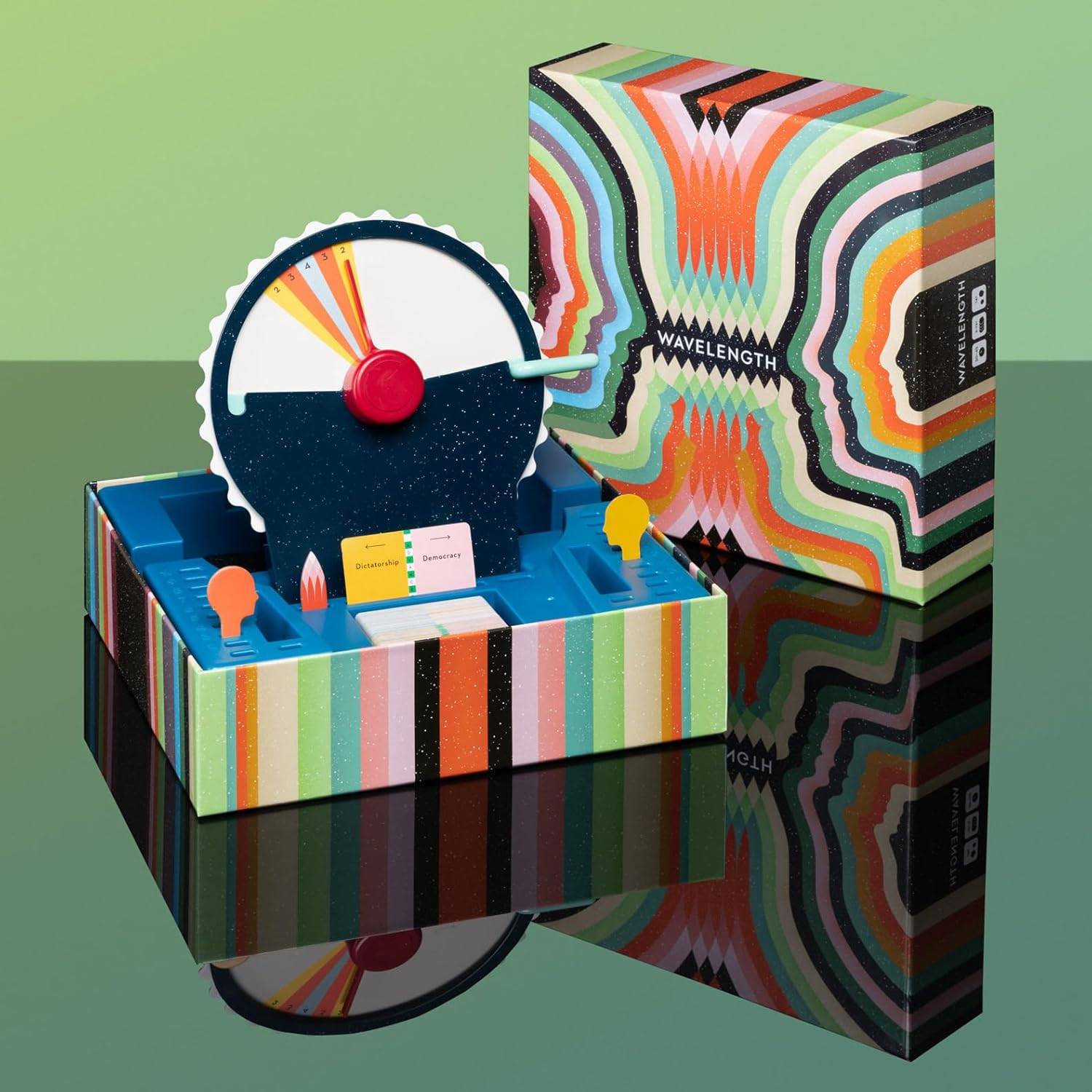
Wavelength is a game created by CMYK intended for two to twelve or more players who are each at least 10 years old. It is offered as either a cell phone app or a board game. We chose the board game. While most board game synopses end there, this one added one more stat. The mood is thoughtful and talky. Our experience confirmed the talky aspects but for several reasons it was slightly less thoughtful.
The rule book states that if you have 2-5 players they suggest cooperative mode but this is when the group dynamics shifted our experience. I love cooperative games but given my role as older sister and my husband’s as big brother, we had to ask my sister-in-law if she wanted to play cooperatively. Spoiler alert: she did not. So we devised a scheme where my husband created all the clues and she and I were head to head competing. This structure for player interaction shifted the dynamics from a non-zero sum game to a zero-sum game and led to us mostly getting-to-know my husband as we did not rotate the clue giving role.
My role as big sister also pushed us towards mild cheating. After the guesser identifies their guess, their opponent has the opportunity to guess if the correct wavelength is higher or lower than their guess to score a point. While the rules do not permit the original guesser to change their guess, when my sister-in-law heard my explanation, she would inevitably move her guess in the direction I suggested. Since my guesses were accurate, this led to her earning more points and stating “I love breaking board game rules.” Because of our positionality as helpers or protectors, we allowed this one-sided rule breaking.
Universal Norms
Our established knowledge of each other and our vast shared experience also deeply shifted our play. While we could have used our bank account balance as a clue in this game, we acknowledge that many people wouldn’t. They wouldn’t, not just because it would be breaking social norms but, because it wouldn’t be a good move. The mechanics are designed so that clue givers are explicitly trying to select a clue where they and the guesser have a shared understanding or can be on the same ‘wavelength’. No one except for maybe a spouse has enough shared understanding about my bank account balance for it to be a useful clue.
Given this mechanic, where a good player is incentivized to find shared understanding, we hypothesized that wavelength has the potential to include everyone. This is one of the unique strengths in a genre where people are sometimes left feeling like their differences are exposed. If the clue giver knows enough about the other person to select clues in the overlap between their respective contexts, everyone can play. In a small group or in a homogeneous group this is a great aspect of the aesthetic of wavelength. The context where the mechanics may unintentionally cause exclusion is in a larger group where a minority of players have a different lived experience. In this case, a clue giver is incentivized to give clues that fall within the contexts of the majority to improve their outcomes. While proposing segregation of teams is an unpopular and ethically fraught choice, in wavelength this might actually be the best way to ensure inclusion.
Getting to Know an Acquantance
Which brings us to our central conflict in this play through, ironically our lack of good conflict or challenge. We knew each other too well for these mechanics to be fun. We had mastered the patterns of the game and exhausted the fun. While it would have been more obvious if there was a final level to ‘beat’, we ‘beat’ the game by knowing each other too well.
My biggest conclusion from this game play was that Getting-to-know games have a very particular range of relationship depth in which they are fun. In the words of the Theory of Fun, because the patterns of game are the shared experiences of the players, if they players are strangers then “The player might fail to see any patterns whatsoever, and nothing is more boring than noise [so the game ] is too hard” but if the players are best friends “The player might master everything in the pattern. He has exhausted the fun, consumed it all [so they] beat [the game]” before even playing it.

There was only one clue in the game where people did not score points and this was arguably the most fun of the night. When my husband drew the range of Star Trek to Star Wars he got excited until he remembered “[I] don’t know the difference.”
Only when we didn’t have sufficient shared understanding to get on the same wavelength did we have a challenge. While I would like to claim I didn’t do too badly (see the photo for evidence), I did not earn points and we all got a good laugh.

When we played another getting-to-know game called Spectrum, we had to remove cards that were too easy. For example, when you all attend the same church, ‘guessing’ if someone believes in God is not fun. As the mechanics are different here, my suggestion would be that cards be grouped for ‘strangers’, ‘acquaintances’ and ‘close friends’. We would have benefitted from more cards that relied on rarer experiences and strangers would benefit from more cards with objective universal phenomena. I’m now tempted to create these decks but since I’m writing this blog at 4 in the morning while my baby sleeps, I’ll leave with some examples.
| Strangers | Acquaintances | Close Friends |
| Hot – Cold Loud – Quiet Fast – Slow Big – Small Safe – Dangerous | Expensive – Cheap Healthy – Unhealthy Popular – Obscure Relaxing — Stressful Serious — Silly | Star Wars — Star Trek Yummy — Yucky Overrated — Underrated Workaholic — Lazy Drama — Chill |