BABBDI: Explorative Architecture at the Expense of Narrative Architecture
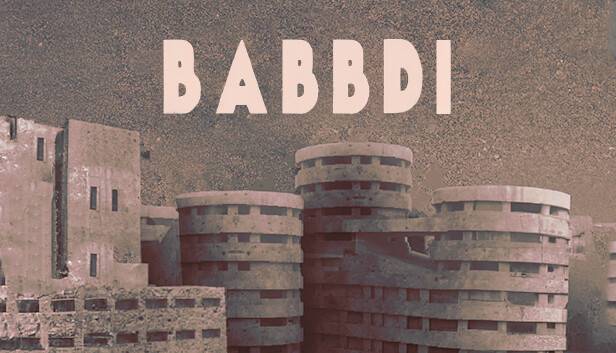
BABBDI, the 2022 indie exploration video game developed by Sirius and Léonard Lemaitre, leaves you with questions right from the start. The simple description of needing to “find your way out of BABBDI” and the city’s striking architecture (Fig. 1) draws in an initial target audience of players who might be looking to uncover the secrets of the city through first-person exploration. However, the design of the game drives most players to quickly shift to other mechanics instead.
At its core, BABBDI is not a story-driven game; it is a game about the idea of exploration. When BABBDI says it is an “exploration experience,” this goes past just being a walking simulator. Walking is only the beginning of what “exploration” means in BABBDI, and thus it is not what tells the story. Instead, BABBDI is a game about the feeling of exploration itself, but in doing this lacks sufficient narrative architecture to support the desire for story.
Originally, I started BABBDI with excitement for uncovering the narrative of the game. Seeing a man and woman who wanted to get out of BABBDI with train tickets, I wanted to know: Who were these people and why does everyone want to leave BABBDI? However, as I continued playing and learning more about the game, I became less engaged with the narrative tidbits. Instead, I ended up zooming around the world through one of the many movement mechanics, seeing if there was anything I could interact with. The game became less about the narrative, and thus less motivating for me. Instead, it began to be about pushing the boundaries of exploration.
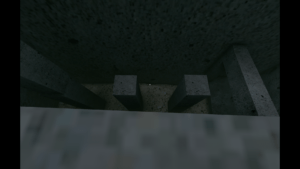
For example, I began BABBDI with a worry of being able to take damage. Then, I slowly explored more outlandish actions and pushed my own expectations of game mechanics. From falling into a small pit and not taking fall damage, to eventually jumping down from the tops of buildings and knowing it wouldn’t hurt me, BABBDI’s thoughtful design of the world encourages you to gradually experiment with how you can move in it (Fig. 2). As you explore the mechanics, it also increases your ability to explore BABBDI’s creative design of brutalist architecture, finding out more about the corners of the city itself.
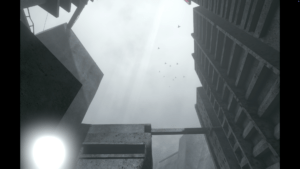
My greatest intrigue also came from moments of exploration of mental barriers in BABBDI. In contrast to aesthetically-similar games I’ve played (such as Control), there is no violence in BABBDI. However, this doesn’t stop the game from suggesting violence. In its very first moments, the game gives you a baseball bat while a man encourages you to use it. There is an achievement for jumping in front of the train. That suggestion—of what would happen if you did—is almost scarier than a standard FPS or horror game where you know you can hurt and get hurt, and I appreciate placing the ethical dilemma of violence into the player’s conscious choice. The opacity and suggestion of violence encourages the player to create an emergent narrative of personal violence, as opposed to a forced relation to violence. Do you hit the man with the bat? Do you jump onto the tracks? I could never get myself to try hitting the man with the bat. I could get myself to try jumping (Fig. 3).
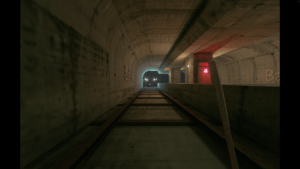
However, the avenue of exploration that felt least developed is that of the urge to explore for narrative coherency. Ultimately, BABBDI is not a story game. This is reflected in the fact that most BABBDI player forums and analysis are about the act of speed-running. As opposed to many slower walking simulators, BABBDI lets you move around by using a motorbike, pickaxe, leafblower, and even a propeller to let you fly. These mechanics are quite fun to speed around with, but disrupt the narrative stability of BABBDI. In a town of all these physics-defying methods of transportation, the authenticity of the characters’ desires to escape and their confinement to fixed locations on the map becomes less meaningful. You as the player, with your explorative abilities, can begin to operate without much care for the story at all.
Especially compared to many other walking simulators, such as What Remains of Edith Finch, Firewatch, or even similar small indie horror releases such as Kitty Horrorshow’s Anatomy, BABBDI leaves much to be desired narratively. Dialogue and story are disvalued with other mechanics of the game taking precedence. In one of the top discussions on theorizing about BABBDI’s story, the first reply is this: “youre reading wayyy to much into this.”

Ultimately, I think BABBDI would have been even stronger if it had designed more thoughtful narrative architecture. In a game about exploring, the architecture itself and mechanics are certainly fun. However, they overlook another fundamental aspect of exploration that is underdeveloped in comparison—that of story. Perhaps if there had been more embedded narrative through dialogue responses that referenced other characters, more insights into the rooms people occupied, or even just more dialogue that didn’t only encourage the player to get a train ticket, then there would be more motivation to explore the story itself in BABBDI (Fig. 4). These would not be to detract from the ways that some players can have fun out of speed-running and mechanics; instead, it would make BABBDI an even more enjoyable experience for all kinds of explorers.
Just as players might go to games for different reasons, there are many different ways to explore as well. Story is just one such method of exploration that BABBDI has underdeveloped, and one that they could incorporate more by utilizing more narrative architecture. Ultimately, BABBDI does a great job of creating an architectural world that catches the eye, but a narrative architecture that loses it.