Artist’s Statement
Blind Spot is a social improv game about talking, reacting, and trying not to mess up under pressure!
At its core, the game is built around a simple idea: people don’t really notice how they speak and behave, but everyone else does. We wanted to turn that into something playful and fun.
In the game, you get to inhabit many different roles and scenarios. You could be at a red carpet interview, a coffee shop, or a summer camp cabin, but the twist is that you’re trying to complete hidden goals and avoid hidden restrictions simultaneously. Because everyone is doing this at the same time, every conversation becomes a mix of improvisation and strategy.
Feel free to look at our Print-n-Play here!

Figure 1: Final Print-n-Play of our game
Concept Map
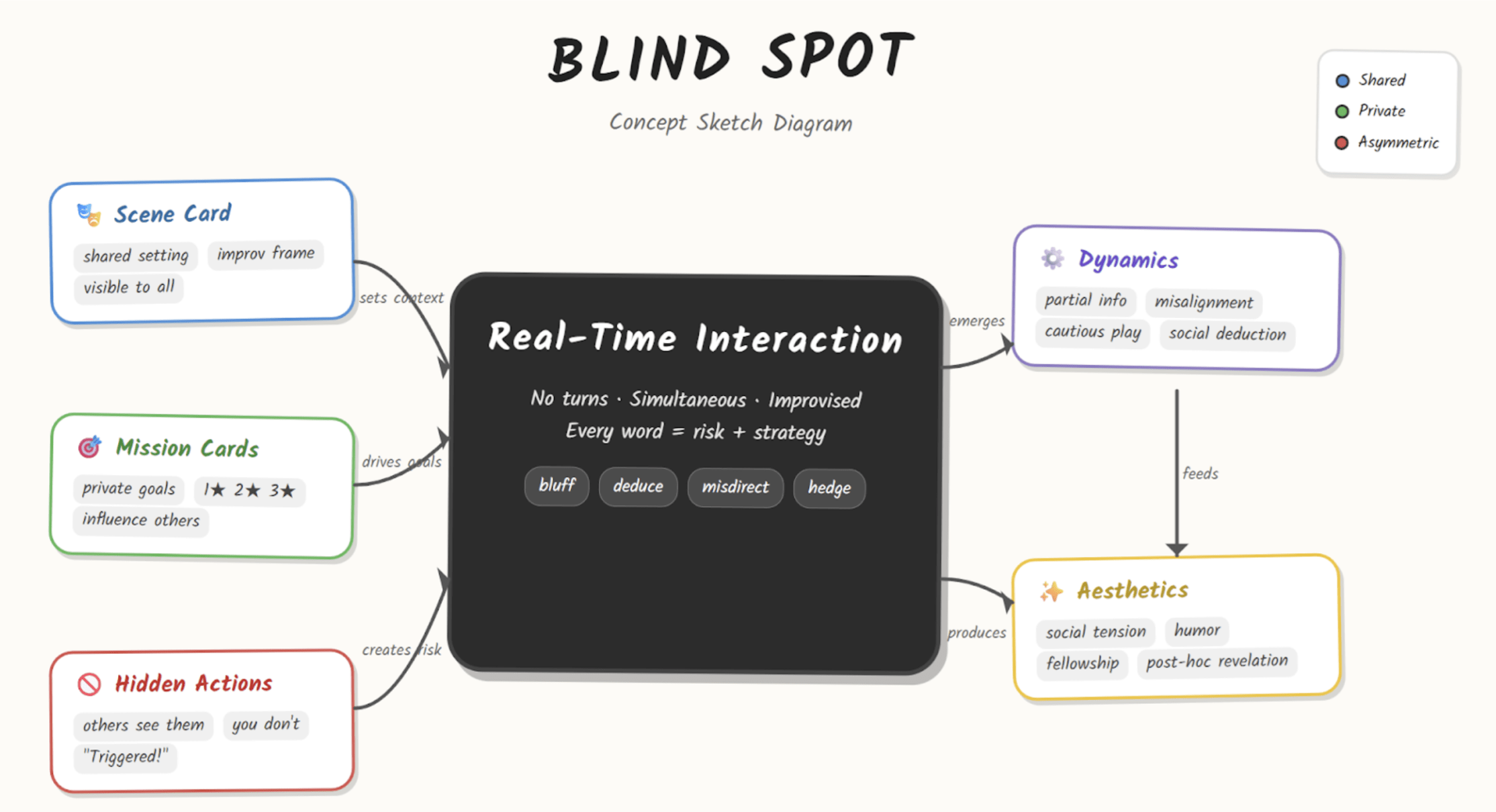
Figure 2: Concept map of our game.
The mechanics are simple. Players interact through shared scene cards (a formal framing mechanic), private mission cards (a goal system), and hidden constraints (asymmetric information). These mechanics combine to produce a dynamic of continuous interaction under uncertainty, where every statement or action has potential risk or strategic value. We intended for the dynamics to include real-time social interaction with turn-taking. Instead of waiting for structured phases, players are always active in the same conversational space.
The aesthetic experience that emerges from this is social tension mixed with humor. Players are not trying to “perform well” in an acting sense, but rather navigate unpredictable social situations while juggling hidden information. The game is most successful when players are laughing, second-guessing each other, and reinterpreting what just happened.
A key design realization through iteration is that the strongest aesthetic is not competition or performance, but social uncertainty with deduction pressure. The fun comes from misreads, near-misses, and realizing what players were trying to do after the round ends.
Initial Decisions
From the beginning, we designed around a core idea. We wanted players to always feel like they are both participating in and subtly manipulating the same conversation space. This led us to remove turn-taking entirely and build a real-time interaction system instead of a structured round-based loop. The result is a continuous gameplay flow where players are always engaged.
The system is built from three interconnected components. We have
(1) Scene cards, to provide a shared improv framing that sets the context of interaction, whether that is a red carpet interview, a coffee shop, or a summer camp cabin.
(2) Mission cards that introduce private objectives that often require influencing other players’ speech or behavior. This creates overlapping incentives within the same conversation, where players are simultaneously participating socially and pursuing hidden goals.
(3) Hidden constraints. These are forbidden actions that other players can see but the affected player could not. This asymmetry of information became an important driver of the experience. It creates tension not through direct competition, but through partial knowledge and misalignment between what players think is happening and what is actually true.
One of our early design intentions was to make improv accessible rather than intimidating. We did not want the game to rely on performance skill or comfort with acting. The scene structure was meant to support easy entry into roleplay, letting players participate immediately without needing to perform well.
At the same time, we implicitly supported multiple play styles: some players naturally leaned into social conversation, others treated the game like a deduction puzzle, and others focused on optimizing mission completion. Over time, we realized that the system was unintentionally rewarding cautious play, since saying less often reduced risk. This created tension with our goal of a highly interactive social experience.
Looking back, the most important shift in our thinking was realizing that the game is not primarily about winning or deduction. It is about sustained social tension created by partial information and overlapping goals, where meaning only makes sense after the interaction ends.
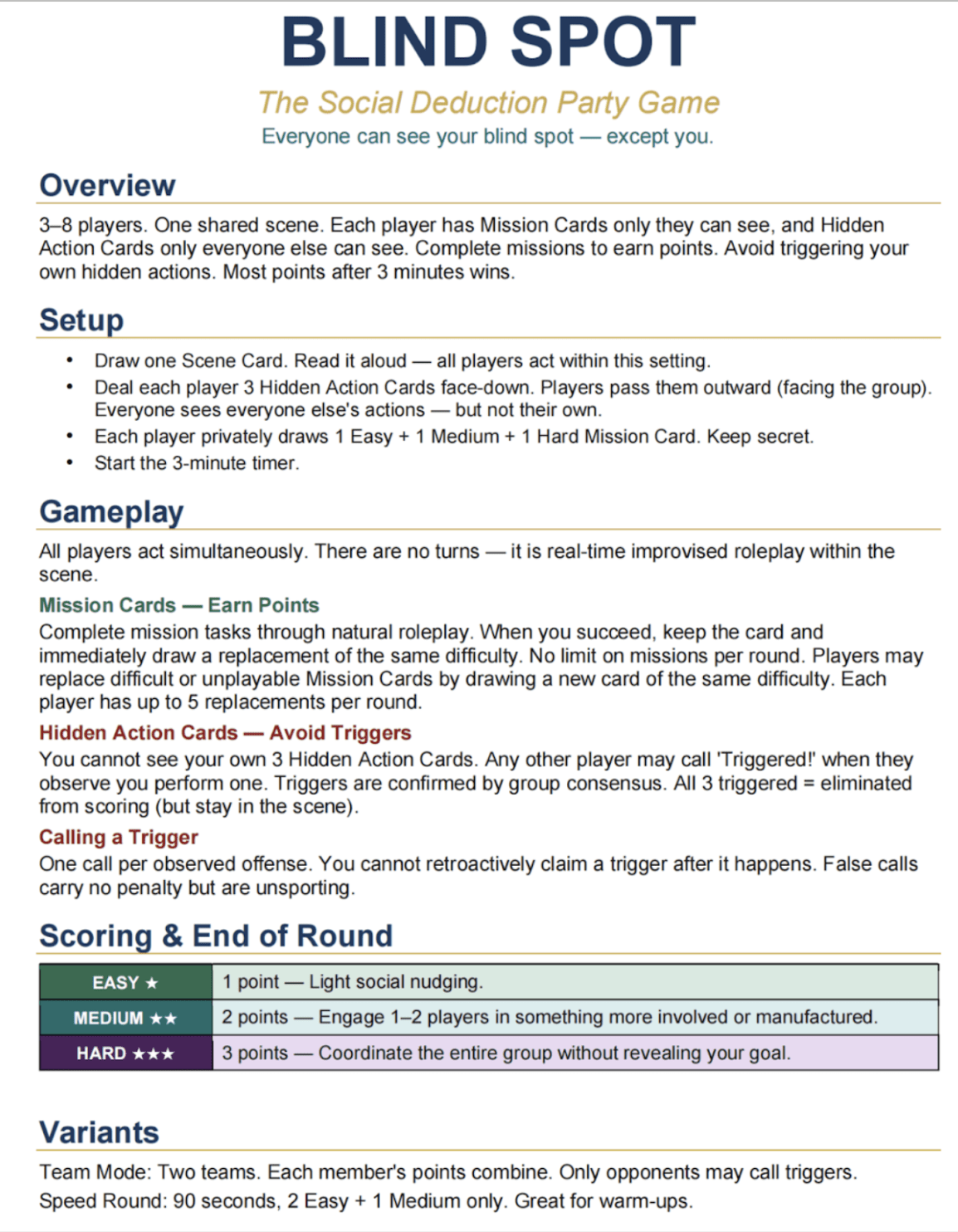
Figure 3: Rule sheet for our game
Testing and Iteration History
Across playtests, we consistently noticed that the system worked best when it maintained real-time interaction, clear framing, and meaningful hidden asymmetry. Each playtest iteration revealed different breakdowns in how those elements interacted.
Playtest 1:
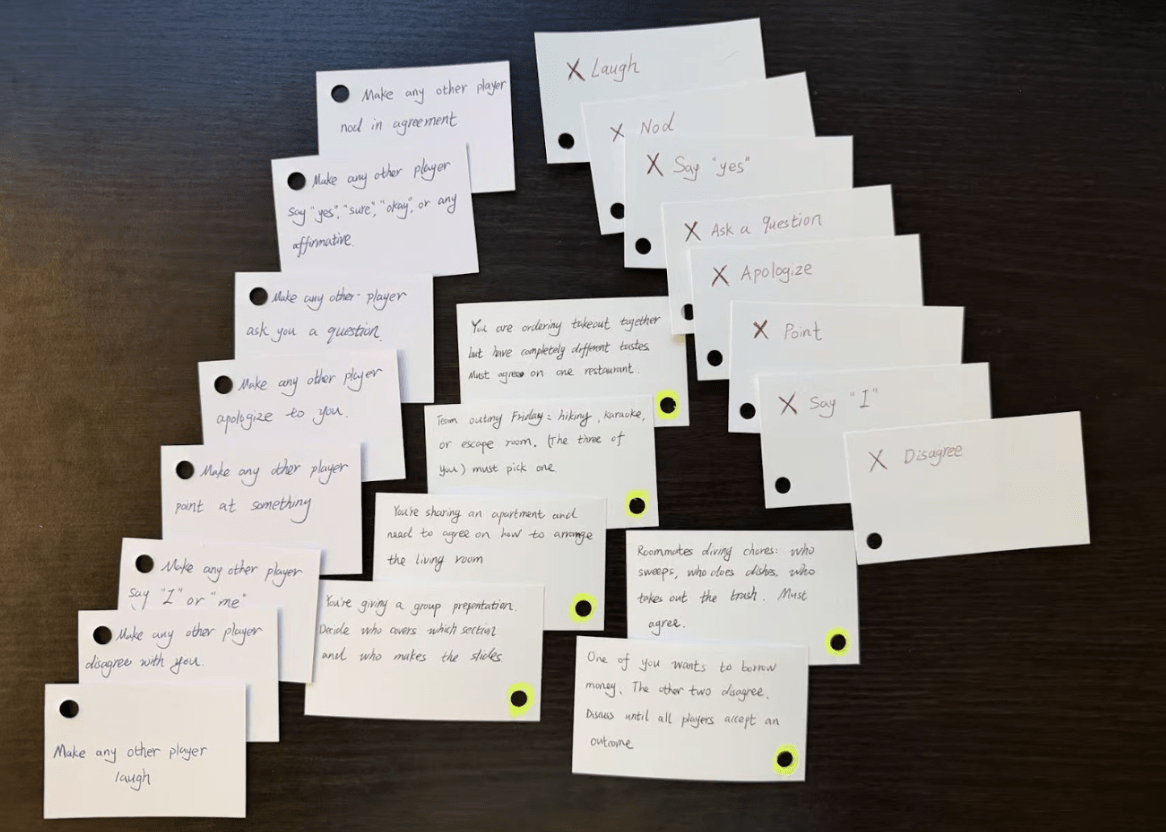
Figure 4: Card used in the first play testing
In the first playtest, the system used Scenario cards as the primary structure for improv. In this playtest, conversations often stalled depending on the prompt. Some scenes naturally supported interaction, while others failed to generate sustained dialogue. The issue here was not engagement, but consistency. The mechanics did not reliably produce the dynamic of continuous interaction we were aiming for.
Playtest 2:
In response, the second iteration shifted toward structured Question and Debate prompts. This change significantly improved conversational flow. Players were consistently engaged, and the system created a strong interaction loop where players could reliably steer the conversations to meet their missions. However, the experience began to feel less like social deception/improv, and more like a get-to-know you conversational game with hidden objectives. The manipulation aspect became less central, even though interaction improved overall.
Playtest 3:
To recover the original intent, we reverted in the third playtest back to Scenario-based design. This successfully reintroduced moments of deception and social misdirection. When the system worked, players actively tried to mislead each other and interpret behavior strategically, which aligned strongly with our intended aesthetic. However, this version suffered from clarity issues. Players were often unsure about card roles, scoring, and win conditions. The cognitive load of understanding the system reduced participation unless facilitators intervened, which broke the real-time flow.
Playtest 4 (Watch the full playtest here: https://youtu.be/WyIfCGOQIEg):
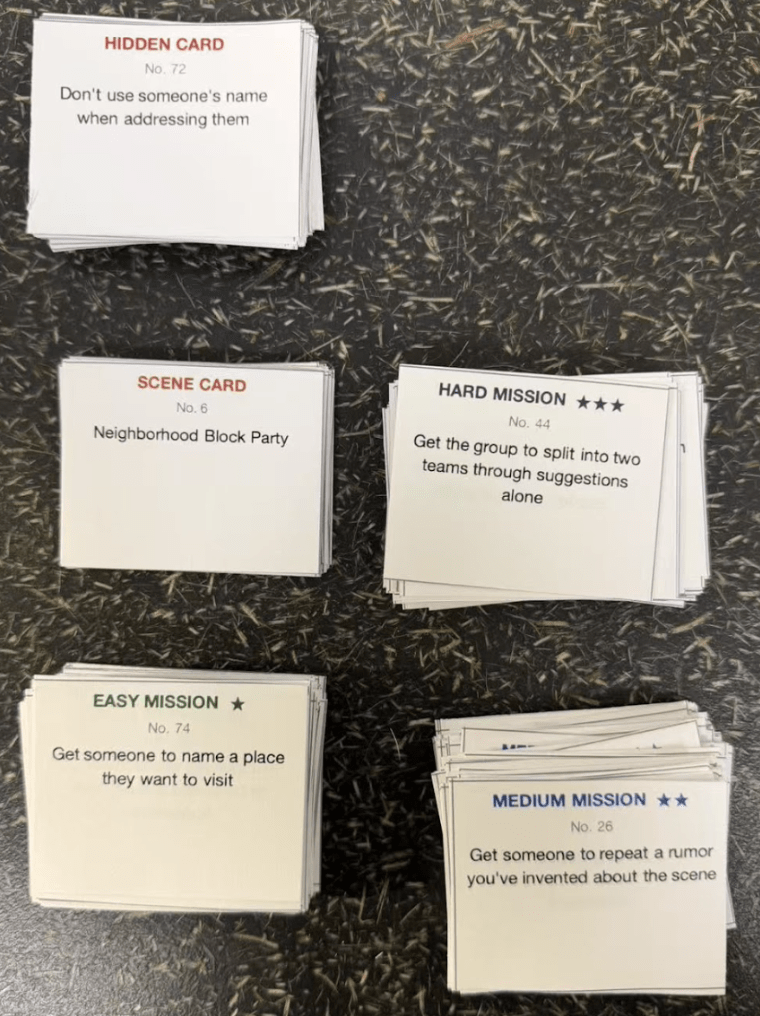
Figure 5: Card used in the last play testing
The fourth playtest was the most stable version of the system. We have five players in total. We had clearer rules and repeated scene cycling, players began naturally adapting their behavior to the hidden constraints. We observed more subtle strategic behaviors emerge, such as hedging language and cautious responses, and players became more sensitive to how their words might be interpreted by others. This version successfully produced the strongest version of the intended dynamic: continuous social interaction under uncertainty.
However, a major issue also became clear. Because speaking could either help other players complete missions or trigger personal constraints, silence sometimes became the optimal strategy. This created an unintended dynamic where the system discouraged the very interaction it was designed to produce. We also saw persistent issues with mission balance and flexibility, as well as ambiguity in how certain objectives should be interpreted.


Figures 5 and 6: Scenes from our final playtest at game night.
Conclusion
Across all iterations, three mechanics consistently proved essential to the intended experience: shared scene framing, asymmetric hidden constraints, and continuous real-time interaction without turns. When these three elements aligned, the game successfully produced its intended aesthetic of social tension and humorous miscommunication.
However, breakdowns consistently occurred when the system either became too structured or too unclear. Too much structure shifted the experience toward conversation or debate, reducing deception. Too little structure increased confusion and reduced participation. Similarly, hidden constraints were highly effective at generating interesting behavior, but only when players were actively speaking.
The most important insight from iteration is that the game’s core aesthetic is not competition or performance, but sustained social tension created through partial information. The system works best when players are continuously engaged in conversation, even if that conversation is messy or imperfect.
Going forward, the key design challenge is aligning incentives so that participation is always the optimal strategy. The mechanics already generate strong emergent behavior; the next step is ensuring that the system consistently rewards engagement rather than caution.
Citations
AI tools (including ChatGPT and Claude) were used to brainstorm and prototype visual design concepts and to assist in editing and refining parts of this document