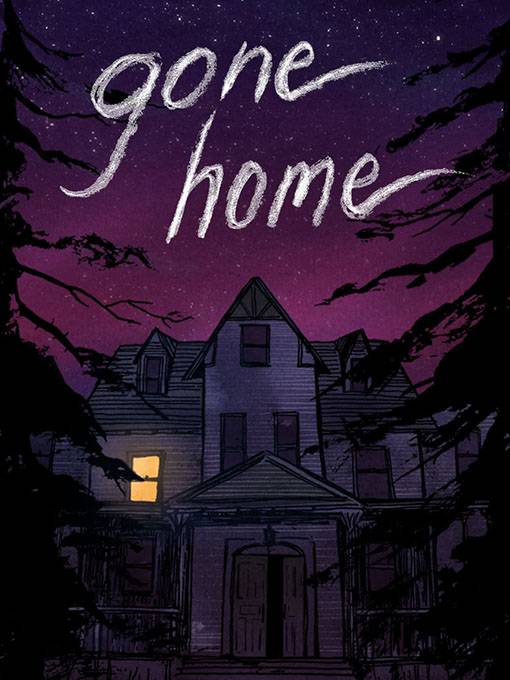
For this critical play, I played Gone Home, a short mystery walking simulator by The Fullbright Company. It is a singleplayer game that is designed as an interactive novel: players move through the world slowly uncovering more of the story. Though Gone Home has only a few major mechanics, they cleverly play off one another which, combined with the clever level design, leads the player in uncovering bits and pieces of its narrative.
Gone Home’s narrative is primarily delivered through voice acted ‘Journals,’ detailing Sam’s life in the home. However, additional Journals are only unlocked by utilizing Gone Home’s major mechanic: interacting with objects. The major mechanics at play are walking and picking up items. While the designers made it so that most small objects in the home can be picked up, inspected, and read, only a few will unlock additional Journals that further inform the player on the mystery. Thus, the game was designed so that players are incentivized to search every corner of the home, open every cabinet, and grab every object in hopes of receiving another Journal for more information. The addition of the narrative sequence at the beginning of the game cements the player’s ultimate end goal to solve the mystery of the protagonists’ missing family. Such actions are essential in progressing through solving the posed mystery, but also provide insight to the protagonists’ family and their daily life. For example, players can easily find a large family portrait hanging on the wall, her sister’s high school hoodies in the closet, her track and field awards on a shelf, books detailing her father’s failed publications, or letters describing her mother’s park ranger job. As players interact with objects, attempting to unlock more journal entries from Sam, they inadvertently learn more about the protagonist and family itself. Objects are also intentionally laid out to build upon pre-discovered Journals: players can find teenager parenting and making friend books early in the game which give insight into Sam’s character. Thus, Gone Home’s developers intertwine their narrative into the mystery through the use of Embedded Narrative, sneaking in information about the family themselves while the player attempts to find clues to solve the mystery.
The voice-acted narration from the Journals greatly contribute solely to the narrative. Unlike other games in which players may receive recordings that hint at an upcoming danger or a key part of the mystery, Gone Home’s journals are more closely compared to literal journals: snippets of Sam’s personal life in the town. This design allows the designer to easily embed their narrative into the user experience: in searching for clues, players will instead find tons of information regarding Sam’s life, and it is only until later in the game where players will receive hints as to Sam’s whereabouts. This design felt a little different to what I expected from a mystery game, but it is successful nonetheless: players will receive the narrative as they search for clues, and may even find themselves focusing more on completing the narrative.
In addition, the game’s architecture supports the story by quickly teaching players all they need to know to progress the narrative. Initially, players are spawned right outside the front doors, which are locked. Thus, players are directed to search the surroundings for a key to open the door, learning how to pick up and inspect items in the process.

By placing the key in a dark corner under a christmas duck in a cabinet, players are taught that key items may be hidden under objects inside drawers/cabinets, and dark places can be lit up using lamps and room lights. Future areas of the game have easy-to-spot light switches to illuminate rooms to search for more clues. In addition, cabinets are often left slightly ajar to remind players to search them.


The home’s architecture also functions to conceal and constrain. The entire right side of the house is initially locked, and players are funneled to the left side of the home to explore, where they can find much of the early context surrounding the home and Sam.
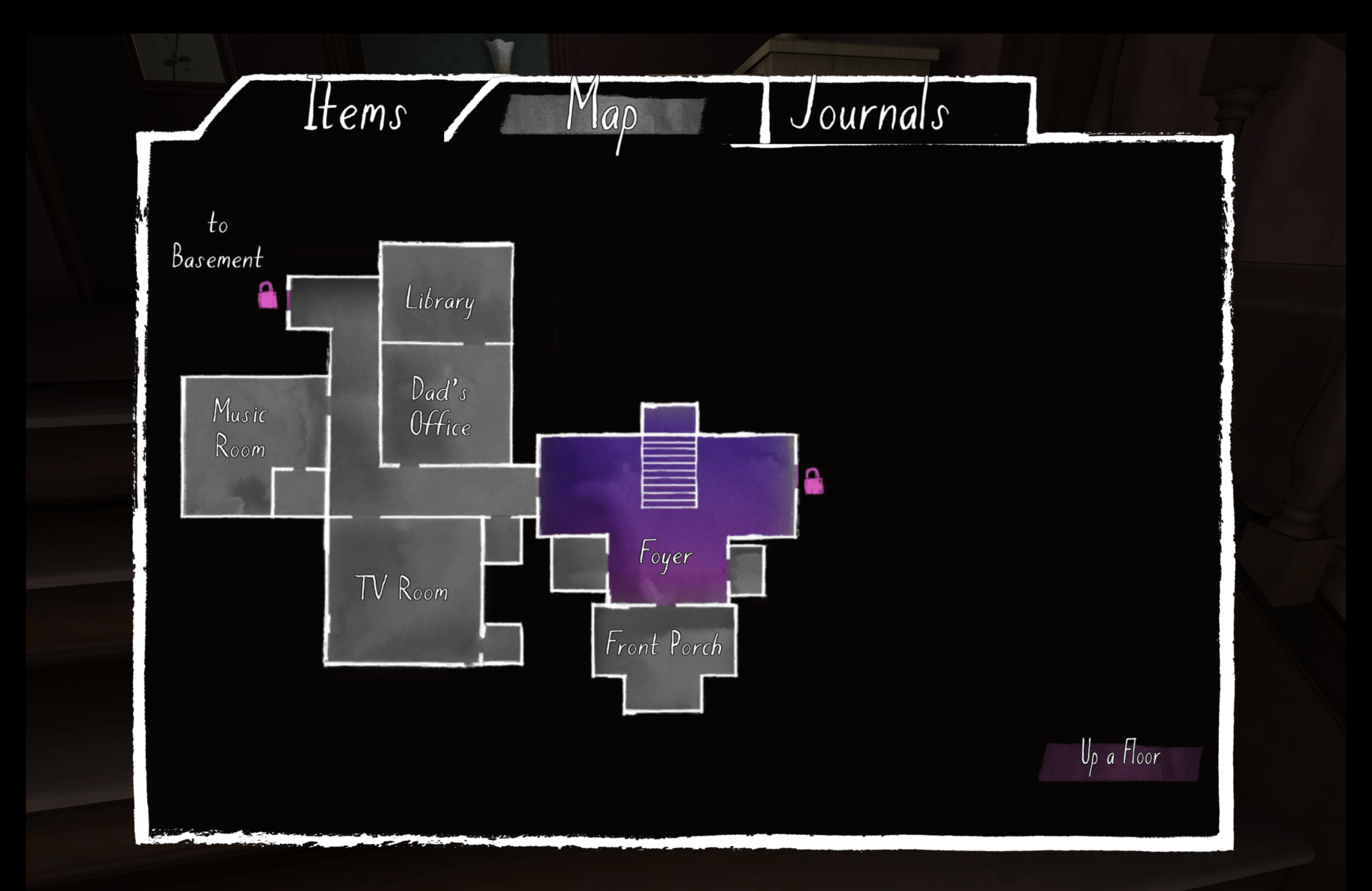
In addition, the home also contains hidden corridors and compartments that are only accessible after the player learns about them through Sam’s journals. These areas contain more hidden information about the house itself and key items to progress through the story while also providing players easy ways to backtrack to access these compartments, as walking is pretty slow. As example below, the secret corridor in the parent’s bedroom grants quick access to the first floor library, which is near many of the newly revealed compartments.

All together, the architecture in Gone Home encourages exploration by teaching players the game’s base mechanics as well as constrains players with locked sections, forcing them to explore different parts of the home and receive the narrative in chronological order.
Gone Home contains many accessibility features to mitigate possible accessibility barriers. One of which I used lots is the subtitles option, allowing players with hearing difficulties to still be able to catch content from voiced narration. The subtitles work well to this end, but also fall short in mitigating these barriers in conjunction with the game’s interaction mechanics. Specifically, when reading a document or letter, the document will block the subtitles from appearing, making it so that you cannot both read and listen to the narration at the same time. While the game also freely allows you to replay any discovered Journals, it does seem like a bit of an oversight to hide subtitles while reading documents. I understand that the text could have confused players had it been overlapped with the document text, but it could have also been moved to another part of the screen and/or made a stark contrasting color to allow for multitasking in game.