
Brooke Ballhaus, Lily (Xinrui) Li, Jeffery Cai, Jinhyo Huh, Sabrina Yen-Ko
Artist’s Statement
Have you ever found your entire day has been wasted doomscrolling on reels? Does social media make you insecure? Does your algorithm know you better than your parents? Us too!
In ReelLife, the player gets to experience the other side of social media. You’ll start your onboarding journey at Quoz (the newest social media platform that EVERYONE is using) by getting a glimpse into a character’s life. Don’t ask us how we got that security cam footage… Send your users reels and see how they react! But don’t let their engagement get too low. You might get put on a PIP.
This game is intended for players who love a strong narrative, player agency, and maybe a few ethical dilemmas along the way. Across seven days, you’ll become intimately familiar with your users and find that your actions may have consequences. What’s worse, an Alpha male or a modern medicine denier? That’s up to you! You’ll learn plenty about Skylar and Orion, but you might learn more about yourself.
Get ready to laugh, cry, and experience a little brainrot.
Concept and Mechanism Maps
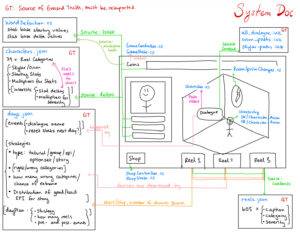
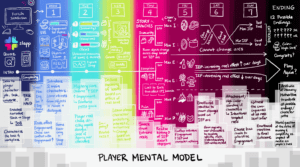
Scope
ReelLife is currently an MVP. We prioritized the design of our entire system from start to finish, including the reel, engagement, and metric mechanics and the full narrative branching structures and content.
Initial Decisions
In our initial meetings about ReelLife, each of us was inspired by the effect that recent social media design – particularly short-form content platforms such as Instagram Reels, TikTok, and YouTube Shorts – has had on our lives. What is it about this form of content communication that is so addicting? How has the use of social media changed our lives and our psyches? What are the ethical implications of creating an algorithm that actively harms its characters?
Most people in our generation are users of these apps, data entries for the algorithm, but how would it feel to be on the other side? That is why we created ReelLife. No longer characters, our players get to explore the impact of social media in an active way, watching their actions have consequences in real time.
Target Audience
We intended ReelLife to be a mature, singleplayer game targeted towards players that enjoy a rich narrative experience and uncovering embedded narratives. We were specifically designing for Explorers, through our embedded narrative and multitude of entertaining reels, and Socializers, through the in-depth confrontation with the characters’ problems. However, we believed that by ingraining multiple objectives in the gameplay experience, ReelLife would also satisfy the Achievers with the puzzle of optimizing engagement and coin count. We intended to add multiple accessibility features to make our game playable by a diverse set of players.
Narrative
The idea that we entered ideation with was that our game would be subversive. We wanted players to interact with an embedded narrative structure to understand the characters, whose deepest interests may not align with their first impression. Furthermore, the player would learn that the company they work for may have malicious intentions. In ReelLife, a player acts as the algorithm for a social media company Quoz. By sending reels to their characters and watching them interact in their rooms and relationships, the player learns about that character’s life. As the game progresses, the player also learns that the most engaging reels they send to their characters impact their lives in negative ways while also benefitting Quoz. We initially wanted to have many characters that all had very impactful roles in their world, whose actions would thus impact the other characters. We started with “an average joe” and “a mafia boss,” planning to integrate other characters such as “a politician.”
We aimed to aid our embedded narrative with environmental storytelling. A character’s room would evolve with their emotional state, giving hints at the impact the player’s reels are having. Through dialogue sequences, the changing rooms, and the reactions of the character, the player would uncover more of the characters’ full stories. For this reason, the primary role of architecture in our game is exploration. There is one room per character. This room gives the player their initial information about the character so that they can begin sending reels they think align with the character’s interests.
Puzzles
We began by building a toy — we wanted the mechanism of sending reels to be fun and challenging. We decided that the implementation of puzzles in our game would be about information gathering and understanding, fulfilling the psychogenic needs of cognizance and understanding. The act of sending reels amplifies the theme of social media in our game and the solution is restricted to information revealed in our embedded narrative.
Level Design
Our initial decision for level design in our game was a day structure where mechanics would slightly evolve over time. New information would be revealed each day and the system we use to calculate player engagement would become slightly more extreme or difficult over time. At the start of our game, we weren’t entirely sure how we would achieve this.
Mechanics, Dynamics, and Aesthetics
When first thinking about our game, our initial idea was to create a game where the player experiences a changing mental model of the narrative and understands that their original objective is unethical. Furthermore, we wanted our players to feel that their actions had consequences, many of them unintended. From this point, we began to think about the aesthetics and dynamics we most cared about so that we could create mechanics that promote them.
Fun as Discovery: Based on our original idea, we wanted the players to experience the dynamic of realizing that they had been led astray based on the game’s initial information. As well, we wanted the player to slowly unroll the narrative of each character and to learn about the characters through many different channels. We thus implemented the following mechanics:
- The character’s rooms change as the game progresses.
- The characters experience multiple interactions with their loved ones throughout the day.
- The player begins with an obscured objective.
- The player views many new reels that are entertaining in their own right and provide more information about the characters.
Fun as Challenge: We wanted the puzzles to be difficult but solvable. We wanted players to experience a dynamic of having to work hard to both keep the player engaged and influence them positively. To create these dynamics, we implemented the following mechanics.
- Many reel “solutions” depend on close inspection of the characters’ narratives.
- A particular reel’s effect on engagement changes over time (and we eventually added that engagement lowers every three reels).
- It becomes harder to get a good ending as the days progress.
Fun as Narrative: Replayability was something we really cared about. We wanted the narrative to be complicated enough and have enough paths based on player actions that a player would have the motivation to replay it over and over again. Thus, we had the following mechanics.
- There are many endings based on player actions.
- Different narrative paths reveal different information about the characters’ lives.
Fun as Fantasy: The player takes on the role of the algorithm. We wanted that experience to be immersive and engaging, such that the player experienced the dynamic of playing as the character we staged. Thus, we added the following mechanics:
- The player sees pieces of the algorithm operator’s life.
- Some reels have immediate consequences, showing the impact of player actions.
Fun as Fellowship: We wanted the player to be invested in our characters and have opinions about how their lives evolve. To create this dynamic, we made the following dynamics:
- Characters have narratives with insecurities and pain points that are human and relatable.
- Characters have motivations, are animated, and evolve throughout the game.
Fun as Expression: An important part of our initial idea was the player experiencing an ethical dilemma and learning something about themself while playing the game. We did not want to create an interactive novel. We wanted player actions to have a cumulative effect and for the players to understand that cumulative effect. Players can express who they are and their core values by deciding what objectives they aim to achieve. To do this, we have the following mechanics:
- The core gameplay loop compounds to affect the end results.
- Players can change their behavior halfway through the game and still have agency over the ending.
Fun as Sensation: We wanted the experience of actually playing our game to be enjoyable. We knew that the artistic feel of the game would impact the player, so we did the following things:
- We created new and thematic artwork for the entire game.
- Our friends made music specific to each character based on their descriptions (credit to Jake Lee and Kam McCondichie).
The mechanics listed here are explained more explicitly in the iteration history.
Initial Formal Elements
Possible Objectives:
Maximize their coin count by increasing a character’s engagement.
Influence characters positively and save them from a sad ending.
Players:
The game is for 1 player, playing against the game.
Procedures:
The core game loop is a single interaction loop (repeated many times across 7 days):
Mental Model: The player has an understanding of their character’s interests and personality.
Decision: The player uses what they know about their character to choose one of three reels best suited for the character.
Action: The player sends the character a reel.
Rules: The reel is identified as within a character’s interests or not.
Feedback: The game increases a character’s engagement based on the rules, which the player can see.
Update: The player understands from the feedback whether or not a character has that interest.
Resources:
Each character has engagement, which is only increased or decreased by the player’s actions (no drain). Based on engagement, players gain coins (tap). Coins can be used in the shop (converter) to buy decorative trinkets for their desk.
Conflict:
Obstacles: The player starts knowing nothing about a character and must learn how to raise their engagement.
Dilemma: The player must decide which objective to complete.
Outcome:
No lose condition. A character experiences one of many ending scenes.
Iteration History
Playtests 1 & 2: Tuesday In Class 5/12

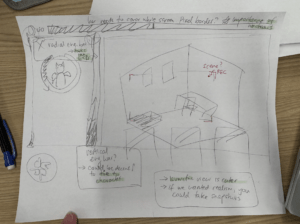
We had our two playtests during studio 7A with Justin and Ryan. For this playtest, we implemented a proof of concept for our main gameplay loop: selecting one out of three reels to impact three metric bars for a character. The camera’s view point would zoom out over the course of the game to reveal more about the character.
The positive feedback that we got was that the core mechanic of selecting reels was easy to follow and the premise was interesting. Players also reportedly enjoyed the content of the reels, laughing at the odd specificity of the captions.
However, players expressed that they felt aimless about what to do. It was difficult both to understand what the impact of one’s choices were on the character and what the player’s key objective was. At the start of the game, there were too many unknown variables to keep track of. Having three bars at the start made it confusing to understand which reels were “good” or “bad”. On top of that, the 2D view of the character did not noticeably stand out from the rest of their room, so players were confused about what details they should pay attention to.
Players also commented on how it was not clear what the zoom mechanic was for. The zoom was simply a zoom-out centered at the character’s face, it didn’t reveal any specific items that would give the player more information about the character.
Additionally, Ryan mentioned how if we were to stick to largely environmental changes, it would be difficult to build emotional investment in the character. Environmental changes are important when playing a supportive role in worldbuilding, but it is difficult to understand a character by only seeing the things around them. Instead, characters taking explicit actions would more directly reveal facets about their personality.
Iteration 1 – Implementing the Game’s Core
Between this playtest and the next, we had a week to transform our proof of concept into a playable core of our game.
We started ideating on how to better design our UI to communicate details in our environment more intentionally. The key points that we agreed on were that:
- The room should have minimal clutter, and all objects in the room should communicate something about the character’s interests.
- We should have a single large engagement bar that the reel clearly affects as an aggregate metric for how well you are doing.
- Information about the UI would be spread out over multiple levels so there is less of an initial information overload. We would introduce simpler mechanics like the single engagement bar first, then introduce the more mysterious 3 bars later.
To add another modality of communicating whether the user succeeded in engaging the character, we also added a laughing animation to show when the reel sent to the character was engaging. Additionally, we added an idle animation for the character to show they are distinct from the rest of the room.
We also created a tutorial to onboard users on how to play. It allowed us to clarify the player’s initial objectives and explain mechanics such as the engagement bar and selecting reels.
Finally, we chose to use in-game dialogue as our main modality of communicating the narrative, rather than only environmental changes. We wanted to show the characters interacting with the other people in their lives through online and in-person conversations to show our players their personalities and build investment. We built out 3 days of dialogue that shifted based on the user’s engagement at the end of each day and 4 endings that were triggered based on the user’s metric bars.

Playtests 3 & 4: Thursday In Class 5/21
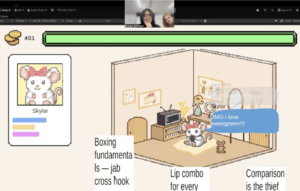
Our next playtests were in class during 8B with Kevin and Nicole. This playtest featured two opposite types of players. Kevin identified that he mainly plays shooter games and occasionally cerebral puzzle games, which meant that he was mostly out of the target audience for our game. Nicole identified as someone who played a lot of narrative-focused games, which made her a better fit in our target audience.
The generally positive feedback that we got was that the art direction of the game was endearing. Both players commented on the sprite and how it was cute that Skylar reacted positively to the engaging reels that they sent to her. Players also commented that they liked the tone of the dialogue, particularly how casual and fitting it is for a social media focused game.
During this playtest, players glossed over the dialogue. But even though they only skimmed the dialogue, they were able to pick up details about the characters such as the fact that Skylar wrestles with an eating disorder, and Orion has a little brother. Thus, our goal of injecting the narrative through reel content and objects in characters’ rooms was successful. However, the fact that players didn’t feel engaged with the dialogue means that both its content and presentation were lacking.
Players also commented on how the three metric bars on the left seemed a bit arbitrary because there was nothing in the game to tell the player what those represented.
Iteration 2 – Dialogue Pacing, Animations
For this iteration, we focused on tackling the issue where players didn’t feel connected with the game because the dialogue assets were lacking in visual polish, hard to read, and were able to be dismissed quickly.
We first made all-new assets for all of our dialogue bubbles. We added the proper text insets so that the text would not overlay onto logo sprites. We also aligned the font choice with the pixel art aesthetic for the rest of the game, including in both the reels and dialogue. We ensured that all text assets had a solid-color background, with text color that has a clear contrast from the box’s background color.

We also added an animation to the text along with a debounce timer so that the user would have to slow down and read the text as it appears. Dialogue bubbles were only made dismissible 0.35 seconds after all of the text had been animated.
Finally, we finished the animation loops for Orion. We added an idle animation loop to make him visually stand out of the static room, and added an excited swiping animation for when he gets sent an engaging reel.
Playtests 5 & 6 – Tuesday In Class 5/26
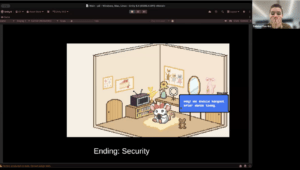
These playtests happened in class Tuesday during 9A, with Elline and Jay. Both players reported that they were familiar with narrative games, so both were part of our target audience.
Similar to the last playtest, players enjoyed seeing the sprites react to the reels that were being sent. Elline reacted to a lot of the reel contents and wondered whether her choices in messaging would impact the characters. Once she realized that they did have an effect, she exclaimed “that’s so sad, what the hell, this is evil”. Elline focused more on consuming the dialogue, so her reel choices were often based on the one that she knows the characters are more interested in. In the post-game interview she admitted that she felt more empathetic towards Skylar and more concerned towards Orion.
Jay played more to explore the effects of the different reel categories on the characters. By doing so, they realized that Skylar’s interests were more aligned with a stereotypical teenage girl, while Orion had a wider pool of interests. They remarked that they enjoyed the multifaceted nature of Orion’s character more than Skylar’s. During their playtest, they also said that their goal was to NOT engage Skylar. This led to her engagement dropping to 0, which ended her day early before all of the dialogue could play.
There were mixed opinions about the pace of the game. Elline cited that the game ended really abruptly, while Jay thought the game was a reasonable length. This may be tied to their comments about the controls of the game. Elline said that it was easy to drag reels up and release them, but Jay said that it hurt their hand to use the trackpad to drag for an extended period of time.
Iteration 3 – Days 4 to 7, Story Branching
We were always going to implement more days to our game, but this round of playtests greatly shaped how those days would manifest. Originally, we were going to have players continue a similar gameplay loop for days 4-7, perhaps only changing the contents of the reels and shifting how interested each character is in each category. This playtest told us that our original intended change would be far too subtle. Players like Elline want more agency in affecting the character’s outcomes, and players like Jay want to be able to build up their mental model of the character’s interests through exploration. Adding more days to the game gives players more time to realize both of these goals, so long as the new days are not merely a rehash of the previous 3.
Previously, the endings felt abrupt because endings that were supposed to go at the end of day 7 were slapped onto the end of day 3. Now that we had more time to work with, we thought that we should expand on the storylines that players found more fascinating and cut out the facets of the characters that felt out of place. Particularly, we reworked Orion’s mafia background to be him working in a toxic restaurant instead because it made the character less cartoonish and more real. The new background emphasized his more relatable traits, like false bravado and commitment to family.
One problem we noticed was that, with three metrics and two directions (good or bad), there were 6 possible directions for the player to influence the character. With three reel choices, there was no way for the player to do exactly what they wanted no matter how you assigned the reels. To fix this, we implemented story branching. On day 4, each character would enter a branch of the story based on what metric was most interacted-with. Once in that branch, the reel choices would guarantee at least one reel that would raise that metric, and one reel that would decrease that metric. This directly helps the player maintain complete agency in the latter half of the game. Our goal was to break the game into an exploration phase before day 4, and an influencing phase during and after day 4.
Playtest 7 – Monday Game Night 6/1 – Butch

On Monday game night, we had Butch playtest the game. He self-identified as a player of all types of games, and he likes narrative games “if they are not boring”. Optimistically, he is in our target audience.
During this playtest, he played with a clear goal in mind for each character. Because of that, he noticed the tracking feature as soon as he hit Day 4, since all of his reels thereafter kept primarily affecting the stat that he interacted with most during Days 1-3.
He commented heavily on the balance of the game’s numbers. We observed that the metric deltas were too small to reasonably minimize or maximize any specific metric of choice, which took away from his perceived player agency. He also noted that engagement bar deltas were too large, and that he would reach the maximum and stay there without much conscious effort.
Butch also noted that there was no pressure to win because the engagement bar fills too quickly, and there was no incentive to accumulate money since there was nothing to spend it on.
Iteration 4 – Engagement Tax, Getting Fired, Shop, Object Changes
To address the numerical problems with the game, we added a tweakable base value and multiplier for both the metrics and engagement and continued iterating it with every subsequent playtest.
We added an engagement tax, which drops the users engagement by a certain amount every 3 reels sent. To make it meaningful, we made it so that you can get fired if your engagement hits zero twice in one day. This adds a mounting pressure for the player, and pits the player’s best interests against the characters’. Our hope was to bring a similar discomfort when making these tradeoffs, like in complicity games.
To add some value to the money that the player accumulates, we also added a shop where they can buy powerups and cosmetics for the rest of the game. The powerups serve to make it easier to raise engagement and therefore make more money through the multiplier. We hoped to influence the players to send more engaging and metric-raising reels via sunk-cost fallacy. Cosmetics also exist purely for the player’s own satisfaction. Using money as a means to improve the player’s own experience comes at the cost of the characters’ wellbeing, which is another feature of a complicity game we wanted to emulate.
Finally, we deepened our embedded narrative and environmental storytelling by changing the condition of objects in the room when a metric hit a minimum or maximum. For instance, hitting maximum pain on Skylar would cause her to discard her shoes more haphazardly in the room.
Playtests 8, 9, & 10 – Tuesday In Class 6/2
During Studio 10A, we had Ryan, Raina, and Christina test our game.
The most salient part of Ryan’s playtest was how he interacted with the new shop and UI elements. The overall reaction was positive – he explored the shop and later saved up enough money to purchase one of the background colors. But there was some confusion with UI – he naturally clicked into the shop during the downtime between when Skylar’s day ends and when Orion’s day begins, and, during that time, the game transitioned to Orion’s room. Another, he said he would have liked it if it was more clear that the reels you send have a direct impact on the events that happen.
During Raina’s playtest, she recognized that sending negative, engaging reels to the characters would reinforce negative thoughts for them. She recognized at the point in the game when we expected, saying that “this is problematic” on day 4. The main gameplay problem from this playtest was how resetting the metrics back to the starting values made it too easy to achieve the good endings even if her previous choices put her down a bad path.
Our last in-class playtest was with Christina. Her gameplay was focused on maintaining high engagement and collecting coins despite “feeling horrible” about the negative impacts she was causing the characters. Due to her background and life experiences, she felt an internal motivation to prioritize earning coins, but it directly conflicted with her concern for the characters’ wellbeing. Her style of play demonstrated complicity to the game’s structural and verbal pressure that explicitly rewards high-engagement, metric-raising reels that are incompatible with the desire to make the characters happy. This playtest showed us how ReelLife inherently poses ethical dilemmas through intentional economy, narrative, and dialogue design, and how it can induce complicit gameplay depending on the player’s pre-existing intrinsic motivators.
In addition, Christina expressed difficulty in repetitive click and drag motions, especially when she felt like she was “in a race to do as much as possible”. Her playing experience was pressured and stressful despite there being no time pressure, which is something we wanted to avoid going forward.
Iteration 5 – Shop Tutorial, Reel Tuning, Endings, Accessibility Shortcuts
The behavior Ryan observed when he opened the shop at the end of Skylar’s day was normal, since that was when the game would automatically transition. But to fix potential confusions, we moved the tutorial for the shop to in the middle of the day (not for the next playtest but will be in the version we submit).
To address the feeling of a lack of agency, we completely re-tuned the reels and redesigned the types of reels you received on each day to directly correspond to the story. We embodied the philosophy of “let the player do it once” onboarding by interspersing reels with content that directly affects the next line of dialogue for the character. The goal is to show that your choices have an impact on the story, but also preserve our vision that it’s the cumulative effect of all of your influences that affects the characters.
To make the reels feel intentional and aligned with our story branching, we removed generic reel categories that broadly targeted multiple metrics (e.g. “OldHomeVideos” would reduce all of Skylar’s metrics). Instead, we split them into specific categories directly related to the storyline (e.g. “ProviderFailureShame” for Orion’s pain arc). For each metric, we assigned 2-3 categories that would increase the metric and 1-2 categories that would decrease the metric.
Within each category, we split the reels into “subtle” and “extreme” reels to ease the players into more problematic reel content. In the beginning, before they enter a story branch, the reels are subtle and the content in the bad reels appears harmless. But once they enter a story branch, more extreme and taboo reels regarding the same topic start appearing.
Furthermore, we more carefully tuned the reels so that the player would have a more guided exploration experience. On day 2, reels of varying degrees of severity are offered to the player. On day 3, reels from each of the metrics are offered to the player. This addresses Butch’s concern about seeing duplicate reel categories, while also allowing the player to have both agency over the direction of the storyline (Day 2) and the storyline they want to follow (Day 3). For days 4-7, we added a shifting probability to get more extreme reels. Choosing extreme reels would mean more extreme reels in the future.
We added higher fidelity endings to complete the game. Players were surprised at the abruptness of the endings because they played out as a simple text notification. The new added endings would blacken the UI to spotlight the room, then play a final set of dialogue or animation.


Following Christina’s playtest, we also added an alternative method to send reels without clicking and dragging on the trackpad. Pressing 1, 2, and 3 previews the three reels, and holding them selects the reel.
Final Playtest: Wednesday Game Night 6/3 – Elline
During Wednesday Game Night of Week 10, Elline playtested our game again. Since the last time she had playtested, we had significantly updated the mechanics, storyline, and fidelity of our game.
Elline started the game with the goal of achieving good endings for both characters. For Orion, she was successful in achieving the good pain ending. Initially, she sent many reels relating to families because of his relationship with his brother. However, over the course of the game, she learned that Elbie’s parents were dead and switched to sending reels about Found Family and Brotherhood instead, allowing her to achieve the good ending.
For Skylar, she initially sent reels related to Cheesecake, not realizing they were negatively contributing to her insecurities. While she did send some Body Positivity reels, she was worried that sending too many of the same type of reel could actually be harmful. In the end, she was able to lower Skylar’s insecurity stat, but she was unable to convert her away from the bad ending. It was clear that the bad insecurity ending was shocking and poignant for her.
Overall, we saw that she was noticing a strong connection between reel contents and events that happen in the game. For example, she commented on how depressing it was to see a reel about Sweetgreen when Skylar’s friend just ghosted her about Sweetgreen. She also saw that certain bits of dialogue were directly influenced by the reel choice beforehand. In the latter part of the game, we also saw her reacting more strongly to the explicit reels that we added.
Throughout the game, she posed a lot of questions at the narrative embedded in the open-ended dialogue. She raised questions about the family dynamic of Orion and about Skylar’s relationship with food. Every few reels she sent, she would discover more and piece together a clearer image of the characters in her mental model. In the post-game interview, she said that she enjoyed discovering the depth to Orion, but mentioned that she didn’t figure out the puzzles for Skylar until it was too late. She also asked about the different possible endings and was surprised to hear there were 12 total.
Time stamps for final playtest vid:
2:40: Start of playtest
2:58: “The fact that we have photos [of them] is so freaky. I’m getting bad vibes.”
4:00: Day 1, starts sending reels
6:52: Exploring the new shop
8:41: Gets close to losing because of low engagement, reacts happily to Orion’s connection to his brother
9:25: Reaction to reel “yum yum cheesecake”, then dialogue about cheesecake plays
10:02: Reaction to dialogue feeling left out by friends
10:41: Sees Sweetgreen reel after Skylar gets ghosted about Sweetgreen – “That’s so depressing”
11:14: Orion Day 2, wants to get his good ending (replayability!)
12:16: “What do I need to do Orion”, as a reaction to him shirking responsibilities
13:08: Reaction to comedic reel content
14:09: “Ohh the bars are related to different topics? That’s cool.”
14:54: “I really like the happy ones [reels]. They really make me happy. I feel like I have control.”
15:58: Emotional attachment to little brother’s doctor appointment, and foreshadowing to racism 30s after
20:55: Strong reaction to our new explicit content reels
24:39: “I feel like this is a complex thing.” Makes a good deduction on what the cheesecake bar means.
25:31: Another reaction to very explicit reel content
34:35: Skylar ending
35:19: Orion ending
36:30: End of playtest, reflections
Iteration 6 – Tutorial Stage, Reel Specificity, Branch Switching, Art Polish
Elline didn’t end up interacting with the shop at all, and so she never purchased any of the powerups that made it easier to keep up the characters’ engagement. From the rest of her playtest, it was evident that she didn’t need the engagement boosts either. To resolve this issue, we made the tutorial stage – the stage where it’s all about maintaining engagement – far harder than before, further adding to our aesthetics of challenge. We wanted to make the engagement level feel dire, and alleviate that sense of emergency with an item from the shop. To implement this, we made our tutorial force the player to buy the “Autoscroll” powerup, turning the engagement tax back to a manageable point after the first day.
Further, she expressed confusion on whether she needed to act fast due to the flashing red preview of the engagement tax. We felt that the preview was necessary so users can plan what to do, but removed the flashing to make it seem less time-dependent so as to not negatively impact aesthetics of sensation.
Elline also indicated that the good categories for Skylar all fell into the same category. To make it more satisfying to lead Skylar down a good path for her body image, we split the “BodyPositivity” category into more specific categories like “Nourishment”.
When she got to the endings, she expressed surprise at the fact that Skylar achieved a bad ending in the insecurity path. This originally happened behind the scenes because the threshold to switch from a bad path to a good path was set to hitting 0 in the metric of choice several times. To make the ending align better with player expectations, we made the threshold for changing paths from bad to good more lenient, similarly increasing feelings of player agency.
Finally, before submitting the game, we wanted to add some of the missing assets for art polish, like the shop icons and a better intro scene.
Final Decisions
Target Audience
Our target audience for the most part stayed the same across our game’s iteration history. We continued to enhance certain elements of our game for each of the player taxonomies we were targeting. Specifically, we improved our narrative and added reel choices that directly and immediately impact the characters. We also allow players to correct courses if they are unhappy with the paths their characters are following down. These changes were made to incentivise the player to take more stake in the characters and understand how their actions have consequences. For the Achievers, we added gamified UI notifications when the engagement and coin count increase, as well as a final screen showing a player’s high score and the amount of endings they’ve collected. For more information on our final accessibility features, see the Accessibility section.
Narrative
Our final narrative has two levels: the per-character narratives and the high-level company narrative. Instead of branching out to many fantastical characters that each had high impacts on the world, we were motivated to create characters that were relatable and understandable to our players. As well, we wanted each of our characters to represent different negative impacts of social media.
Skylar is a dancing mouse who feels insecurity about her body, worries that her friends don’t truly care about her, and agonizes over her dancing abilities (or supposed lack thereof). Across six different story branches (one where her pains and insecurities spiral and one where they are slightly alleviated per the three issues in her life), Skylar interacts with her friends – Elbie and Jasmine – and her mother. This is a link to her complete story line dialogue. She represents the harms social media does to one’s self confidence and using social media as escapism. By constantly viewing curated versions of people online, social media characters see themselves as less than, simply because they are viewing their whole selves.
Orion is a line-cook cat who dreams about becoming a pastry chef. He takes care of Elbie, who he calls Lil’ Bro, because he was adopted by Elbie’s parents before their untimely death at the hands of a mouse. Elbie also suffers from a rare disease, roaritis. Orion feels insecure about his masculinity, suffers guilt about the death of Elbie’s parents, and distrusts the world around him due to the unfortunate circumstances he and his brother experience. This is a link to his complete story line dialogue. Orion represents the radicalization social media allows for, from the creation of alpha males to political polarization.
The characters’ three main pain points are introduced in the first three days of ReelLife. On day 4, one is chosen (based on the reels the player sends) to be explored further. The two characters are connected through their respective relationships with Elbie.
The storyline of the company Quoz is more subtle. The player starts their onboarding process learning that they are the algorithm for their characters and is tasked with optimizing their engagement. The player later receives obscured metric bars. Over time, they learn that the metrics they are also optimizing are actually negative, namely insecurity, escapism, and pain. The understanding of the company’s true objectives – to maximize engagement by utilizing characters’ existing insecurities and points of pain – forces the player to think about the true impacts of social media.
Environmental storytelling aids the player in uncovering the embedded narrative through objects that change in each player’s room. On Day 1, the player only has the information conveyed by the objects in a character’s room to understand their interests. Starting day 4, every time a character hits the minimum or maximum of a metric, a specific artifact changes correspondingly.
Puzzles
The main gameplay mechanic of ReelLife is a puzzle, the objective of which is up to the player. The player can choose to maximize engagement and coins, to positively influence the character, or to achieve a specific character ending (if replaying). Based on their chosen objective, the player must gather information about their characters to then utilize when selecting reels. Each reel choice is a mini-puzzle; the accumulation of these mini-puzzles leads to a result. The task of the player in this game is to choose an objective and complete puzzles in order to achieve them. To do this, they must unveil and understand the embedded narratives of both characters.
Level Design
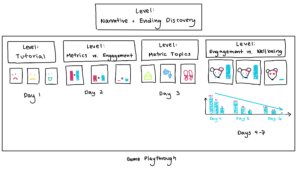
There are two level-systems involved in ReelLife.
The first is based on a Day system. The Day 1 is a tutorial level, teaching the player about the mechanics and overt objective of the game. The reel selection on this day starts with obvious puzzle solutions to maximize engagement (a choice clearly aligned with the character’s interest) that get increasingly difficult over the day. This teaches the player about the character’s interests and that reels aligned with a character’s interests makes their engagement go up more.
Day 2 and 3 are information-gathering levels. On each of these days, new information is unveiled. The players are given metric bars on Day 2 and the corresponding character artifact (what changes upon hitting a metric extrema) icon for those metrics are unveiled on Day 3. On Day 2, the player is given reels that affect the metric bars to teach them that engagement goes up when the metrics bars go up. On Day 3, a player is given one reel per category in every set so that they can select which branch they will play for that character for the remainder of the game.
The remaining levels increase mechanical difficulty, such that certain objectives are more difficult to achieve each day and singular actions are more impactful. The metric and direction of the branch a character is on has a multiplier that increases each day, increasing the difficulty to change branches from a bad ending to a good one and vice versa. If a player is on a Bad Pain branch, for example, reels that increase pain have a multiplier while reels that decrease pain or affect different metrics do not.
Reels also affect engagement differently across days. Reels that less severely amplify the current branch’s emotions drop in their additive quality. Players maximizing engagement must carefully choose their reels to keep increasing their coin count. For a more in depth description of this reel mechanics, read this .md file.
The second system is a per-game level design, where each playthrough is itself a level. There are 12 possible endings in the game. Via the game’s end-screen ending count, the player is incentivised to achieve all of them.
Psychogenic Needs
We began building our game with a fairly assured sense of the dynamics we wanted to create and the mechanics we needed to achieve them. However, certain player needs appeared that we worked to fulfill.
- Achievement (Autonomy): We created specific reels that had immediate effects to give players the feeling of more agency and impact.
- Affiliation (Nurturance): We made the characters more realistic and relatable to give the players a want to care for them, then gave them the ability to positively influence their lives by switching the player’s branch from bad to good.
- Information (Cognizance, Understanding): We increased the amount of information in the game and made more explicit the connection between engagement/metrics and the reels a character sends.
- Sensual (Play): We tried to make the dialogue and narrative funny! And to make the reels feel good to send.
- Materialistic (Acquisition): We added a highest coin count to the ending screen and a count of endings reached to encourage ending and money acquisition, along with gamified engagement and coin increase notifications.
Self Determination Theory
ReelLife uses feelings of autonomy, competence, and relatedness to motivate players intrinsically. The player has the ability to choose the path they want a character to follow through their actions of choosing reels, both on a cumulative higher level and on a granular level. The player develops a feeling of competence by improving their understanding of characters and thus getting better engagement scores OR affecting metrics in the desired way. The player develops a feeling of relatedness to the characters by connecting to their motivations and narratives.
Final Formal Elements
Possible Objectives:
Maximize their coin count by increasing a character’s engagement.
Influence characters positively and save them from a sad ending.
Reach all 12 endings.
Players:
The game is for 1 player, playing against the game.
Procedures:
The core game loop is a single interaction loop (repeated many times across 7 days):
Mental Model: The player has an understanding of their character’s interests and personality.
Decision: The player uses what they know about their character to choose one of three reels best suited for the character.
Action: The player sends the character a reel.
Rules: The reel is identified as within a category that increases engagement/metrics or not.
Feedback: The game increases a character’s engagement based on the rules, which the player can see.
Update: The player understands from the feedback whether or not a character is engaged by that interest.
Resources:
Each character has engagement, which is increased or decreased by the player’s actions and decreased every three reels. Based on engagement, players gain coins (tap). Coins can be used in the shop (converter) to buy different backgrounds and game powerups.
Conflict:
Obstacles: The player starts knowing nothing about a character and must learn how to raise their engagement. The player can not let a character hit zero engagement twice in one day.
Dilemma: The player must decide which objective to complete.
Outcome:
The player loses if they let a character hit zero engagement twice in one day. A character experiences one of many ending scenes.
Future Improvements (if we had more time)
If we had more time to make this game, we would have expanded the game to include more characters that more heavily interacted with each other. We would have created combined endings that are based on multiple characters and the way that the player influenced them, as well as a larger narrative branching tree that allowed for more player agency and more than 6 narrative branches per character. With more time, we would move away from the branch structure and towards a completely adaptable narrative. As well, we would have increased the aspect of environmental storytelling by creating more rooms for each character so the player could understand more of the narrative through architecture alone. We would have made more animations to increase fidelity.
The biggest change we would make is the amount of reels in the game. In future iterations, we would create “content creators” that each have a storyline of reels so that reels never repeat themselves and are more interesting to the user. Content creators would have and build their own individual storylines, adding to the aesthetics of narrative and discovery already present in the game.
Ethics
We made ReelLife to provide a commentary on social media and its effects, as well as to pose several ethical dilemmas to our players and invite them to think about how social media has affected them and the world around them. We used topical themes that many players immersed in social media would be familiar with – conspiracy theories, bodily insecurity, the Manosphere – to help them more easily connect their gameplay experience to their experience in real life. Furthermore, ReelLife demonstrates how the content a person consumes influences their everyday lives. The narrative arcs in ReelLife deal with many topics that the characters may be uncomfortable or have negative prior experiences with, but we felt that they were important to include in order to emphasize the severity of the impacts of social media. While the issues characters experience are somewhat stereotypical (particularly based on gender), we believe this does not further emphasize existing stereotypes but rather brings awareness to the issues people experience because of social media. We abstract many of the details of identity in our game by making the characters both inhuman in appearance and human in experience. Players then do not feel represented or unrepresented by the characters’ attributes. Rather, they relate to those emotions of the characters that are uniquely human.
Accessibility
To make the game friendly towards colorblindness, we tried to pick colors for our metric bars that would be distinguishable for people with different types of colorblindness. Color is also never used as the only mode to convey any information. For the engagement bar, its fixed location and large size are the main identifiable characteristics. For the metric bars, we have icons to supplement what the bars represent.
We also wanted to make sure we added alternative control schemes to the game to support people who have motor impairments. We were able to add keyboard controls for people who have trouble using a trackpad or mouse to control the reels. In the future, we would like to add gamepad support so that players can rebind the keyboard keys to any alternative controller they may need.
Our game relies heavily on visual information. If we had more time, we would have also liked to add narration to the dialogue, and a text-to-speech option to read out the reel captions. To capture the feeling of the characters’ reactions, we could even attach different audio cues for when those are triggered.
Itch.io Content/Accessibility Message
Content warning: This game contains depictions of eating disorders, depression, emotional abuse, death of a loved one, survivor’s guilt, and themes of self-neglect, alongside discussions of body image, bullying, and social media manipulation. This game contains flashing images and patterns that may potentially trigger seizures for people with photosensitive epilepsy. Viewer discretion is advised.
Accessibility: To play with alternate control schemes, press the 1, 2, 3 keys to preview a reel and hold to send it. This game is colorblind-friendly.
Final Game
Keyboard Shortcuts
On main there are the following keyboard inputs:
- “rei”: skips current day
- “stsu”: skips all current and pending dialogue
- “yaypain”: +10 pain
- “naypain”: -10 pain
- “yayescapism”: +10 escapism
- “nayescapism”: -10 escapism
- “yayinsecurity”: +10 insecurity
- “nayinsecurity”: -10 insecurity
- “robertfrost”: forces path choice and logs interaction and most recently viewed category
- “toggleepistats”: shows a debug saying whether stats go up, neutral, or down
- “ending{e/p/i}{good/bad}”
- “fbgm”: get 1000 coins
AI Disclosure
All mechanics, graphics, and code design were conceived by the team. Claude assisted with writing reel descriptions and portions of the code. Original character and graphic designs were created in pixel art using Procreate. Animations were produced through Flora.ai, using Nanobanana and GPT Image 2 for character generation and Seedance 2.0 for animation.