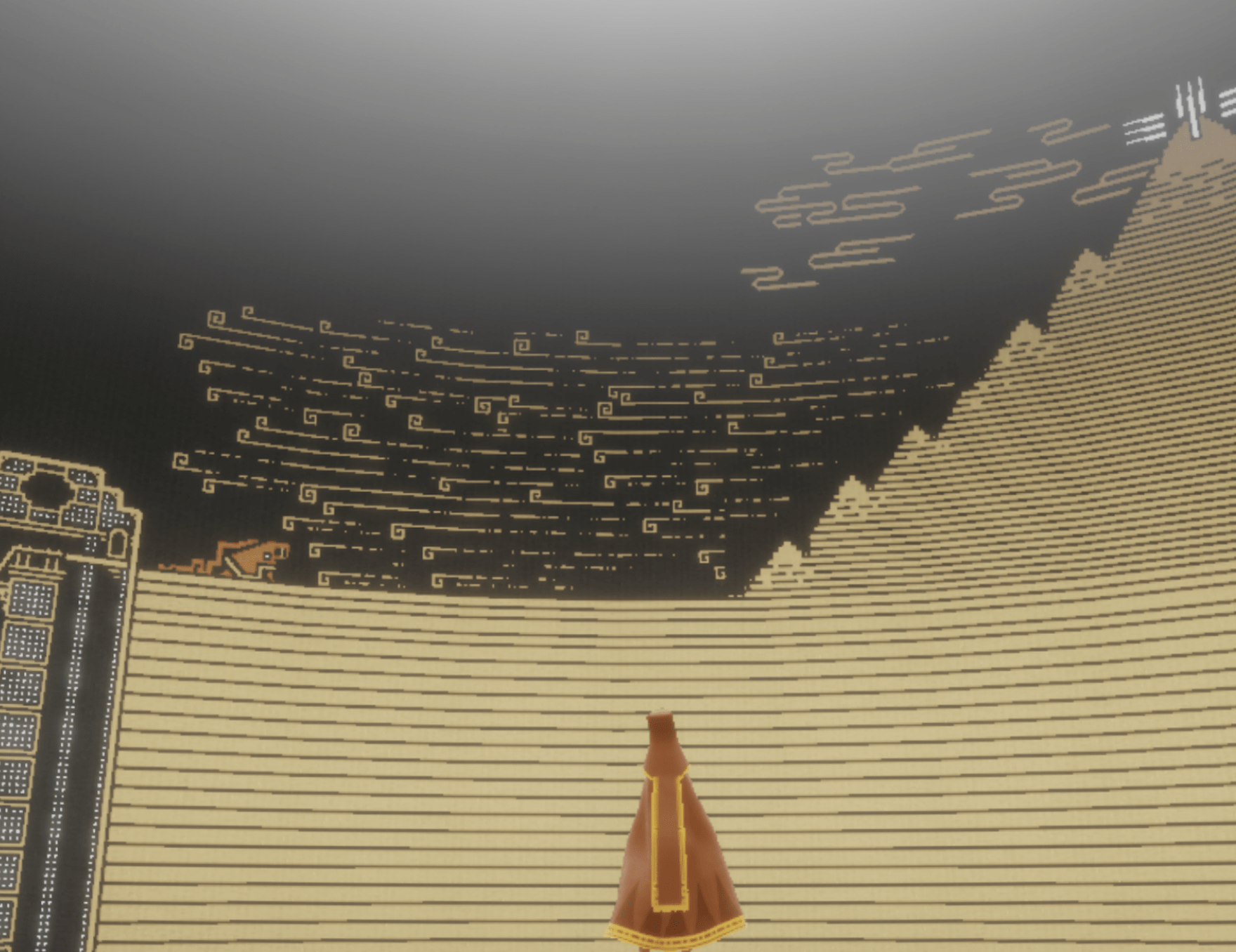
Journey, thatgamecompany’s 2012 masterpiece directed by Jenova Chen (published by Sony), is the strongest rebuttal I’ve played to the “walking simulator” label–a genre defined, as Nicole Clark writes in the Salon article, by “its limitation, rather than its capability.” Available on PS3, PS4, PC, and iOS–where I played the entire game start to finish–it follows an unnamed red-robed traveler traveling eight chapters toward a shining mountain. It targets players seeking a contemplative, artistic experience: maybe newcomers intimidated by traditional games, as well as veterans open to a visual experience. In LeBlanc’s Eight Kinds of Fun, Journey is a rare blend of Sensation, Discovery, and Narrative. In Journey, walking tells the story through the how, the where, and the who–or more formally, through its dynamics, environment, and company: walking dynamics carry the story’s emotional arc, the walked world does the exposition, and who one walks beside creates the story’s relationships.

Walking tells the story first through feel: Core mechanics never change–walking and “singing” to cause the slight glow–but each chapter re-tunes the movement’s dynamic, so gait traces the emotional arc. The opening chapter’s “move” button simply causes the character to walk, a fitting tutorial pace. Later the same input leads to sliding and surfing dunes, creating a play dynamic and a story theme of joyful adventure. While underground, the “move” input becomes a scurry to hide from flying stone serpents, shifting the story’s tone to fear. In the tower chapter, “move” becomes swimming through sunlit air like it’s liquid, shifting the story’s tone back to hopeful. In the snowy chapter, the walking mechanic becomes harder as wind pushes back–a dynamic of struggle and a narrative theme of hardship. And at the summit, the input that once sent the traveler surfing now barely drags a limping figure forward. No cutscene announces that the story has moved from wonder to despair–the gait announces it. Journey takes the most basic mechanic and makes it the emotional storyteller.

Walking also tells the story through the path itself. Because Journey has no map, no waypoints, and no words–it opens on empty dunes with no tutorial–everything the player walks past must do the narrative work. In the tradition of environmental storytelling, guidance is embedded in the environment: light beams mark the next discovery, ribbons of cloth give somewhere to go, creature calls pull the player’s attention, and world boundaries are cliffs and sandfalls. Walking often reveals stone markers shaped like gravestones–both a method progressing the story and nodding to the story’s undertone of grief/reflection. I got lost in the very first dunes and felt quite helpless until the light quietly pointed the way to the beautiful title sequence. Exposition is walked past too: murals in an Egyptian-like style paint the civilization’s history and eventually the player’s own playthrough. Last of all, where the path isn’t guiding, it’s overwhelming: sparkling pink dunes, the glowing sand of the ruined city… the slow walking speed creates unskippable pacing that forces players to spend time feeling small inside the vast nature they’ve built.

Finally, walking with company tells part of the story: Journey builds real relationships out of nothing but walking together, then spends them for emotional effect in the story. Across five chapters, the cloth “kite” creatures interact only through movement: following, carrying, recharging. Through nothing but that, the story builds genuine attachment, and then weaponizes it: In the snow, I found one of my kite friends frozen in the ice, and my honest, immediate reaction, typed into my notes, was “is there anything I can do?” Turns out, there isn’t. I even lingered too long beside the frozen body and was attacked by a patrolling stone monster. Fellowship, built and broken through nothing but walking together.

Journey’s wordless design leads to both flaws and cleverness. In the tower chapter, light-up walls glow brighter than the actual triggers, which led me to do the wrong tasks and remain stuck. In the snow chapter, a locked side-on camera angle made shelter points hard to see, and I failed the same staircase over and over. Clark argues in the article that this kind of “gatekeeping can feel like an impediment to accessing the story,” and that’s how it felt. Small fixes–glow-ier interactables, a view change in the snow–would smooth these kinks. With that said, the same wordless philosophy created the game’s cleverest object: the scarf. Flight energy isn’t an overlaid meter but glowing embroidery on the costume. Fellow walking simulators like Firewatch or Dear Esther make a player walk to a story stored in letters/logs/narration; in Journey the walk is literally the story.
In the end, even if critics are right that all one does in such games is walk, Journey proves walking is enough–enough to make me mourn a kite, grow attached to a nameless red figure, and tear up while walking into a white screen.