Target audience: Players who enjoy social deduction
Game: Dead of Winter
Creator: Plaid Hat Games
Platform: Physical board game
The strongest similarity between Dead of Winter and our game, 404: Alignment Not Found, is that both rely on semi-cooperative mechanics to create player tension. However, while Dead of Winter generates diverse player behaviors through multiple personal objectives, our current design (404: Alignment Not Found) relies on a single incentive, earning Credits, which causes players to adopt similar strategies. This comparison suggests that richer individual incentives are essential for maintaining strategic diversity in semi-cooperative games.
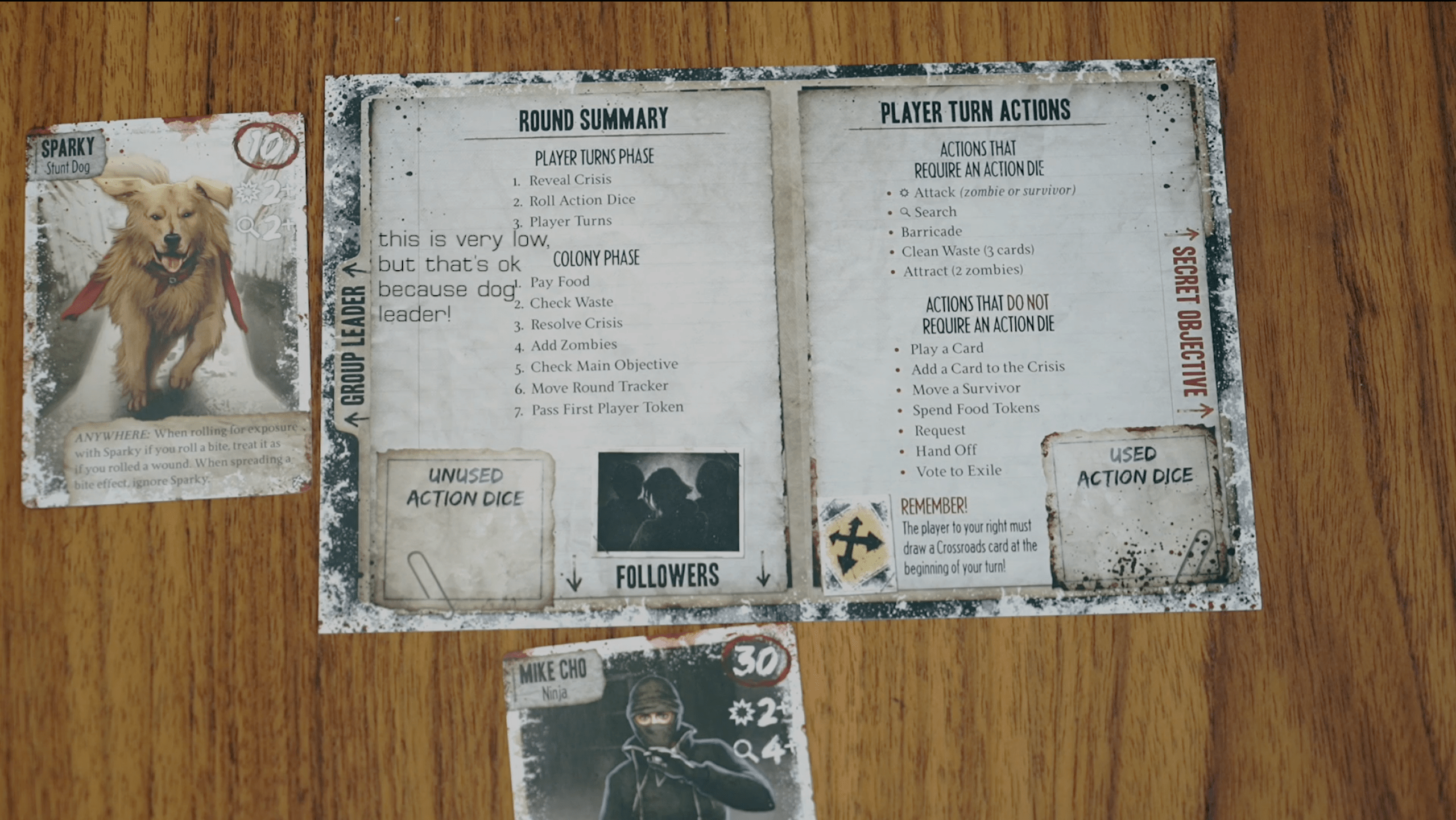
The first source of tension comes from the conflict between opposing factions. In Dead of Winter, the mechanics include colony resources such as food, zombies, and morale, together with attack and exile systems. These mechanics produce the dynamic that survivors must cooperate to keep the colony alive while the Betrayer secretly sabotages the group and avoids detection. As a result, players experience constant suspicion and uncertainty. In 404, the equivalent mechanics are the Doom Track and the voting system. Aligned players reduce Doom by playing SAFE, while Accelerationists increase Doom by playing TRAIN. Because Accelerationists must hide their identities and influence public discussion, the dynamics become deduction and deception, leading to the same aesthetic of trust and tension. In both games, Mechanics including shared resources and voting lead to Dynamics of cooperation and hidden sabotage, and consequently create the Aesthetics of suspicion and confrontation.
The second source of tension is the conflict between personal and public interests, which distinguishes semi-cooperative games from traditional social deduction games. In Dead of Winter, every player receives a Secret Objective, such as collecting medicine or storing food. These mechanics encourage players to occasionally prioritize themselves, making even innocent actions appear suspicious. In 404, the equivalent mechanic is the alternative victory condition that grants any Aligned player with four Credits a win even if Doom reaches ten. This creates the dynamic that Aligned players may repeatedly choose TRAIN to gain Credits despite increasing Doom. Consequently, other players cannot easily distinguish selfish behavior from malicious behavior, producing a trust crisis. Again, the MDA relationship is clear: Mechanics of individual victory conditions causes the Dynamics of self-interested decisions, leading to Aesthetics of challenge and psychological tension.
Although both games successfully create meaningful tension, Dead of Winter offers greater strategic variety. Its multiple Secret Objectives encourage different players to pursue different strategies, making each playthrough less predictable. By contrast, 404 currently provides only one personal objective: earning Credits. During our playtests, many Aligned players independently adopted the same strategy of repeatedly playing TRAIN to secure four Credits. As a result, player behavior converged instead of diversifying, reducing both uncertainty and strategic depth. A possible improvement would be to introduce multiple personal objectives or asymmetric character roles so that players pursue different incentives instead of optimizing the same one.
From an ethical perspective, both games explore the conflict between personal benefit and collective welfare. Interestingly, our playtests showed that players often chose immediate personal rewards over protecting the public good, even when they were on the Aligned team. The game therefore reflects a common social dilemma: people may sacrifice collective interests when individual incentives are more attractive. As designers, we should consider balancing this conflict by increasing the cost of excessive self-interest or making personal victories more difficult to achieve. Doing so would better align individual incentives with collective success while preserving meaningful moral choices.
Overall, both games demonstrate how semi-cooperative mechanics can create engaging social deduction experiences by combining cooperation with competition. However, Dead of Winter achieves richer dynamics because its diverse personal objectives produce a wider range of player behaviors. For 404, expanding the incentive system rather than simply adding more mechanics would likely increase strategic depth, improve playability, and create more meaningful social interactions.