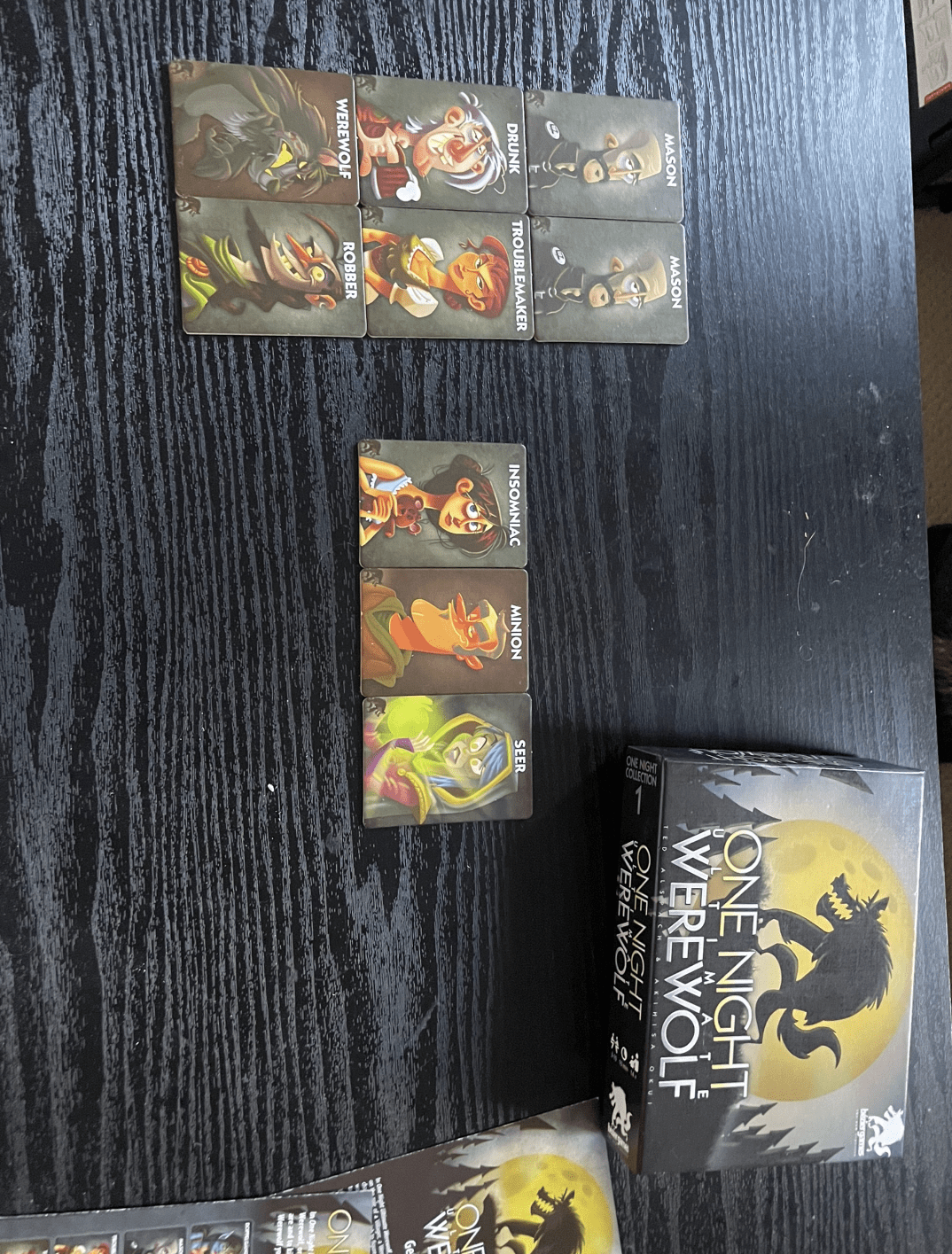
For this critical play, I revisited two games from the Bluffing category: Among Us (developed by Innersloth) and One Night Ultimate Werewolf (designed by Ted Alspach, published by Bezier Games). I drew on a memory from Among Us, played online with friends back when I was still new enough that I didn’t know all its rules yet. I also hosted a recent game of One Night Ultimate Werewolf with six people on campus, using the physical card set. Both revealed something about how I handle deception, from very different angles.
The Among Us memory is the clearer example. I was the Impostor, and at some point I mentioned, out loud, that I had used the vents to get across the map quickly. Vents are something only Impostors can use, and the room knew that instantly. I didn’t say it to sabotage myself; I genuinely thought vent access was available to everyone, since I hadn’t played enough to know otherwise. However, what’s interesting looking back isn’t that I said something false. I hadn’t; using the vents was true. The problem was that the information wasn’t as harmless as I thought, because I still didn’t understand the game’s mechanics well enough to know what that claim would give away. Among Us is structured so that almost everything you say carries information other players can act on: your location, your task progress, who you were near. Some true statements are more dangerous than lies, and I gave one away without realizing it.
One Night Ultimate Werewolf works differently, and my role in it was different too. I explained the rules to the group, showed everyone the card set, and dealt out roles: two Masons, one Drunk, one Troublemaker, one Werewolf, and one Robber to six players, with an Insomniac, a Minion, and a Seer left face-down in the center. In the second round, I swapped the Minion and Insomniac for a second pair of Masons, shifting the balance before anyone picked up a card. That role, running the setup rather than bluffing inside it, says something too. I gravitate toward the facilitator position: explaining structure, making sure everyone understands what they’re working with, adjusting the rules before play starts. That’s a form of control that doesn’t require lying to anyone. Once the round began, though, the game exposed a kind of lying I hadn’t dealt with in Among Us: roles like the Robber and Troublemaker can change what card another player holds without that player knowing. A player can honestly believe they’re a Villager and say so in good faith, while actually holding the Werewolf card: an honest lie, false but not deceptive, since the speaker doesn’t know it’s false. That distinction reframed the ethics question for me. Compared to Among Us, where every lie I told was a deliberate choice I had to track and defend, One Night Ultimate Werewolf makes deception partly structural and involuntary. You can be technically wrong about yourself.
I don’t think lying in a game is wrong, but not because “it’s just a game.” The better reason is closer to what Johan Huizinga called the magic circle: everyone at the table has consented to a frame where deception is the stated function of certain roles (as discussed in the course). Lying to a friend about where you were last night is wrong because it withholds true information they’re entitled to as a matter of trust. Claiming to be a Villager while unknowingly holding the Werewolf card isn’t a violation of that trust, since the game’s premise already told everyone some claims can’t be taken at face value, and in this case, that even the speaker’s own certainty can’t be trusted.Compared to a game like BS (sometimes called Cheat), where you claim to play certain cards face down and anyone can call your bluff, with the loser of the call taking the discard pile, both dynamics here would likely be muted. BS has no falsifiable claim to accidentally reveal and no hidden role that can shift under you; it’s a straightforward bet on whether you’re lying, settled instantly by flipping the cards over. What playing these two games clarified for me isn’t a single stance on the ethics question. It’s that my comfort with deception depends on how the game structures the lie: whether it’s a claim I have to track and defend, or one I might be making without knowing it’s false. I don’t gravitate toward big, sustained lies either way. I gravitate toward whatever keeps the room’s information consistent with what I’ve already said, and let the game’s own uncertainty cover the rest.