A CONCEPT DOCUMENT
FOR A SMALL, MYSTERIOUS GAME
THE WAITING PET
A game about waking up in a house you used to live in.
“There are some doors that only open for you.”
— a note found in the witch’s bedroom, in handwriting that is and isn’t yours

The Settings
You are a dog.
You weren’t always a dog. You don’t know that yet.
This is a small game about waking up hungry on the floor of a bedroom and following the smell of food out into a house that knows you better than you know it. The game is about what a dog can dig up. About what a cat can climb to. About what a fish can swim through.
It is a game about a witch who drank the wrong potion and forgot.
It is also, depending on how you play it, a game about whether she remembers.
Background Story
The first thing you notice is that you are very hungry.
The second thing you notice is the bed.
The bed is made. Tightly. The kind of made that takes time, and care, and at least one person who knew how to fold the corners. The pillows are arranged. The quilt is straight. There is no dent in the mattress. Whoever last slept here did not leave in a hurry, or did not sleep here at all, or made the bed afterward, deliberately, the way a person does when they are putting a thing away.
The room is a bedroom, but a bedroom is the wrong word for a room that no one has slept in. A wardrobe stands closed. A book lies square on the nightstand, its spine perfectly perpendicular to the edge of the wood.
You are a dog. Mid-sized. Brown-coated, Golden Retriever. Your tail moves a little, on its own, when you stretch.
You realized that you might have an owner, but your owner has not fed you in days.
You leave the bedroom looking for food. That is all you mean to do.
✦ ✦ ✦
The house
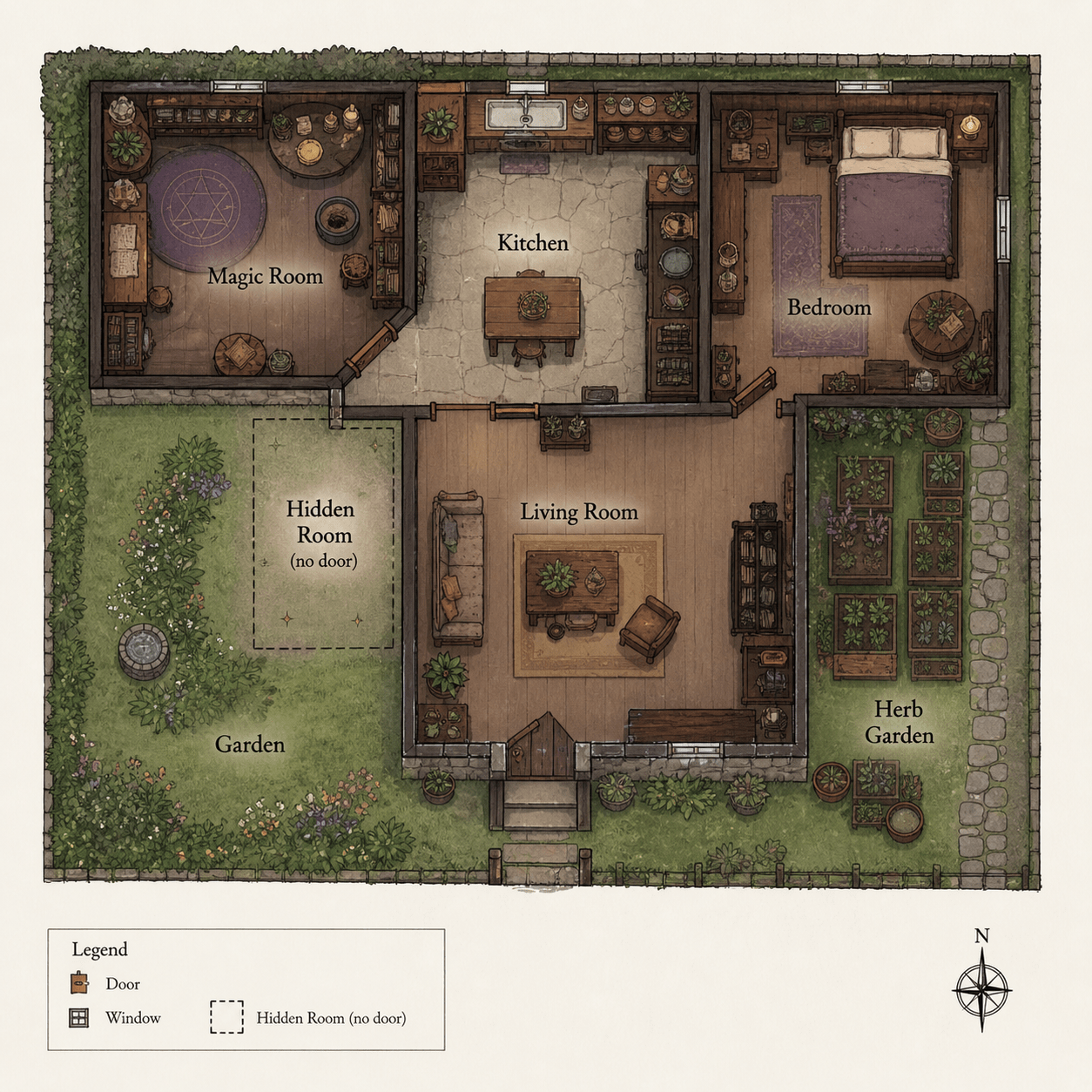
The house has two floors. You will see all of them from the yard, but there’s no floor or door to enter the second floor.
The first floor
A bedroom, a hallway, a living room, a kitchen, a balcony. The fire in the hearth is still burning, though no one has been here to keep it alive.
The kitchen is where the smell is. Something is keeping itself warm in there, somehow, though the stove is cold. The cupboards are closed. The pantry is locked.
The balcony door is closed. You cannot reach the handle. But the balcony rail, when you press your nose to the glass, is gouged with scratches. Long ones. Curved. Made by something with claws much smaller than your own. They look old. Some of them look new. You do not, at first, recognize the pattern in them.
The second floor
There is no door to the second floor.
The staircase does not exist. There is only a wall, smooth and freshly painted, as though someone has covered something over and chosen not to mention it. You walked every wall on the first floor, but couldn’t find the way up.
The only access is the balcony. The balcony rail leads up the side of the house, a route only a cat can do. Sometimes, you can hear something on the second floor when the house is very quiet.
You will get up there eventually. You will not be a dog when you do.
The basement
Below everything. The door at the back of the kitchen opens onto a stairwell that descends into water. Not a flooded basement, it is a black, cold surface that begins three steps down and goes who-knows-how-deep.
The witch never finished the spell that was supposed to keep the river out. It is not certain anymore that the river was the only thing she was keeping out.
The basement is where the answers are. The basement is where the bottles are. You will not be a dog when you go down there either. You will not be a cat. You will be smaller than that, and quieter, and unafraid of the dark.
Three characters
There are three shapes in this game, and you will wear all of them. Each shape is gated by something the shape before it cannot pass.
You begin as a dog. You are hungry for answers, and you begin sniffing around. You become a cat because some answers would otherwise be out of your reach. You become a fish because, by then, you have understood that some answers are kept underwater on purpose.
✦ ✦ ✦
Tone
The opening feeling is hunger for the truth. The first ten minutes of the game are a search for it. Then, curiosity, leading you to places you could not previously explore. Underneath the curiosity is fear of the unknown of the actual truth as you enter the dark, murky water filled basement. The last tone is of mystery as it is dependent on how far you explored.
✦ ✦ ✦
How the story unfolds
There is no narrator. No voice in your ear telling you what is happening. The story comes to you in the way stories actually come to small things, through smell, through scratch-marks, through the things you find under the things you move.
A photograph wedged behind the dresser of a woman. You do not recognize the woman. It is wired. There’s no photo of you.
A book left open on the desk on the second floor, its handwriting smudged in places where something — water, perhaps, or tears, or the careless pad of a paw — has sat on the wet ink. You can almost read it. You will be able to read more of it the further into the house you go, because the further you go, the more of yourself comes back.
A wand, snapped in two, in the bottom drawer of the wardrobe. The break is recent. You do not, at first, remember breaking it.
And the scratches. The scratches, which were old when you were a dog and new when you were a cat, and which match — when you finally look at them long enough — the shape of every other claw mark in this house. As though there has been a cat coming and going through this balcony for years, and the cat has always, in some way, been you.
The deeper you go, the heavier you get. Memory is not weightless. By the time you reach the table at the bottom of the basement, you are no longer sure which of your shapes you would prefer to keep.
✦ ✦ ✦
Gameplay
Our core gameplay centers on exploring a single house from a third-person perspective, where the player directly controls a pet navigating different parts of the environment. The house is divided into distinct spaces based on the pet’s form: the dog explores the first floor, the cat accesses the second floor, and the fish is limited to the basement aquarium.
The player interacts with the environment primarily through puzzles and context-based actions. Certain objects or pathways are only accessible in specific forms, requiring the player to switch between animals to solve problems and unlock new areas. Rather than relying on explicit narration or heavy direction, the game allows players to observe, experiment, and interpret the space through interaction with the pet and its surroundings.
The gameplay focuses on simple but meaningful interactions like reaching a location, activating an object, or changing form. Each area presents unique environmental constraints and opportunities, encouraging the player to move between forms in order to progress. The game creates a reflective mood and encourages player-driven discovery by limiting direct guidance.
✦ ✦ ✦
Challenges
Building the game comes with a steep learning curve, primarily because none of us have worked seriously in Unity before. The game demands three architecturally distinct spaces: the first floor with its warmly lit rooms and navigable objects, the second floor locked behind a balcony climb only a cat can make, and the flooded basement with its black underwater world. Each of these spaces essentially asks for a different kind of game to be built inside the same project.
On top of the technical unfamiliarity, we face the problem of tone. The game carries a feeling that shifts gradually, from hunger, to curiosity, to dread, to mystery, and that arc has to be communicated entirely through the environment. And underneath all of that is perhaps the most delicate problem of all, which is knowing how much to show. The game has to leave enough for the player to follow, a smell that pulls them toward the kitchen, a sound from the floor above, a bottle half visible through the dark water, without ever saying too much. The truth of what happened to the witch is not something that should arrive all at once. It should come the way memory comes, in fragments, in things almost recognized, in the gap between what you find and what you understand. Too little and the player is lost. Too much and there is nothing left to remember. Finding that line, and then building it into objects and light and the placement of a broken wand in a drawer, is something we need to figure out.

THE WAITING PET
Three floors. Three shapes. Multiple endings.
Dig. Climb. Swim.
Appendix