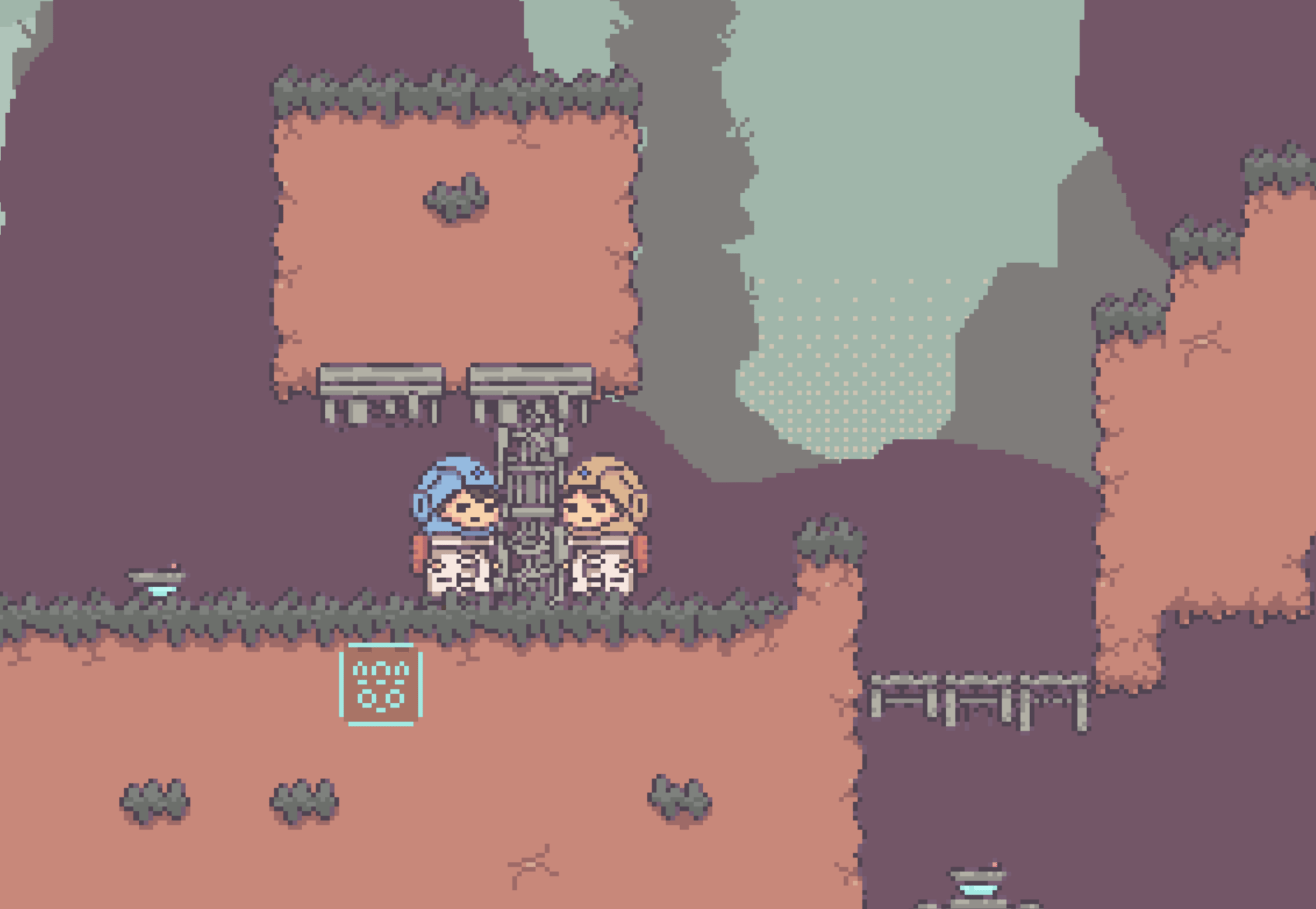
Trust’s often framed as something rooted in our understanding since youth, knowing someone well enough to believe in their intentions. But in Bokura: Planet, I was forced to trust someone whose experience I couldn’t access. At multiple points in the game, my partner and I were exploring entirely different realities where we were unable to verify what the other saw. This experience raised a deeper question: if Thomas Nagel argues that we can never fully understand another’s subjective experience, then what does our sense of trust actually rely on?
In Bokura: Planet, my classmate and I were placed in a co-op setting where our storylines and environments occasionally diverged in ways we couldn’t directly confirm, especially when we were prohibited to communicate at some points. I played with someone I had really only spoken to a few times before, and while the game ultimately brought us closer together, it was difficult at first. We had to figure out how to communicate clearly, how to describe what we were seeing, and how to align our actions toward a shared goal, all without access to each

other’s screens. Very quickly, it became clear that we weren’t just solving puzzles, but that we were learning how to trust each other under a lot of uncertainty.
Nagel argues that “if the subjective character of experience is fully comprehensible only from one point of view, then any shift to greater objectivity… takes us farther away from the real nature of the phenomenon.” In other words, he explains that consciousness can’t be reduced to physical explanations because it’s truly inseparable from a subjective point of view. In Bokura, this idea really becomes tangible. I couldn’t access my partner’s experience in any direct way. Even when we described what we saw, those descriptions were shaped by our own distinct perceptions and language patterns. Like Nagel’s example of the bat, we always had a gap between what I could imagine and what my partner was actually experiencing.
However, the game also revealed something that complicates Nagel’s argument. If we can’t access another person’s subjective experience, then trust can’t depend on fully understanding them. Instead, in Bokura, trust was developed through our limited patterns of behavior. I began to rely more on how consistently their actions aligned with mine than what my partner said their world was like. When they described a button, I pressed the corresponding object I saw. When they hesitated, I adjusted. Over time, our coordination became less about understanding and more about our own responsiveness.
This is where The Evolution of Trust becomes especially relevant. Nicky Case explains that trust evolves through repeated interactions, the possibility of mutual benefit like a non-zero sum game, and low miscommunication. Bokura creates all three conditions: we repeatedly interacted through puzzle solving mechanics from hovering drones to inputting codes, we shared the goal of progressing through the game, and we adapted our communication styles to reduce confusion. But the game introduces a crazy plot twist, these interactions happen without shared perception and sometimes with us having different missions. Even when we achieved “win-win” outcomes, we were doing so from entirely different realities.

This tension between subjectivity and trust becomes even more important later in the game. When my partner’s mind became inhabited by another person’s memories and I was killed by an alien parasite with intentions to use my partner as a host as well, our realities diverged even further and we couldn’t even tell each other. In that moment, trust sort of became unstable. Not because we stopped trying, but because the signals we relied on became harder to interpret. I knew my partner had a different storyline, but I didn’t have access to it. I couldn’t rely on understanding them, so I had to rely only on what I could observe, like their actions, their timing, their responses. In certain situations, after this change in storylines, specific moments like having a gun from Rika became nerve wracking as I didn’t know if perhaps my partner had a mission to kill me with that gun.

This experience suggests that trust doesn’t actually require shared understanding. In fact, as Nagel argues, such an understanding may be fundamentally out of reach. Instead, trust works through something more simple and sensitive, our willingness to act on incomplete, objective signals from others, even when we can’t verify their reality. These signals like patterns of behavior, consistency, responsiveness are easy to overlook when thinking about deeply personal and subjective experiences like trust and Nagel’s arguments. However, in Bokura, they become essential. The game doesn’t resolve the gap between subjective experiences, but makes it impossible to ignore. And yet, it still allows trust to emerge, not from knowing what it’s like to be the other person, but from choosing to move forward together anyway.